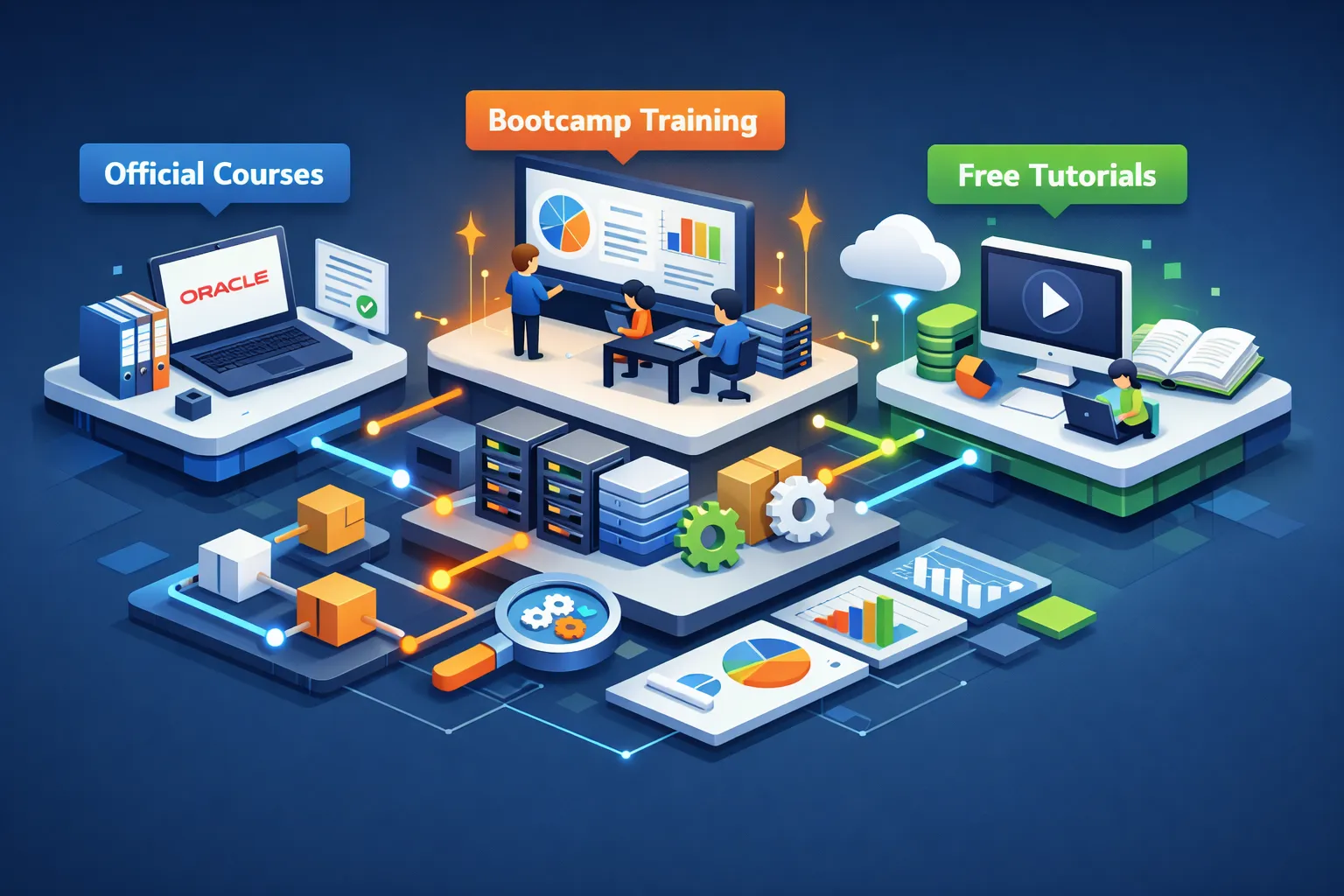
Quick verdict: If you need vendor-certified knowledge and resume credibility, start with Oracle University; if you need job-ready implementation skills and placement help, choose a hands-on bootcamp (CloudShine’s practical model is a strong fit — CloudShine). If you’re budget‑conscious or just testing the fit, use curated free resources first. This article explains what each path teaches, realistic cost/time expectations, and gives a practical 90‑day plan to reach interview readiness.
Official Oracle University paths: what they teach and who should pick them
Oracle’s role-based learning paths cover Procurement (source-to-pay), Inventory, Order Management, Supply Chain Planning, Product Lifecycle Management, Logistics, and Costing, plus foundational setup via Functional Setup Manager and basic integration/reporting. The official content is written by product teams and emphasizes configuration options, best practices, and exam objectives aligned to implementation roles.
Delivery formats include interactive video modules, digital learning paths, instructor-led options, and proctored certification exams. Employers who list “Oracle University training/certification” as a requirement usually mean these official credentials.
The trade-off is clear: you get vendor accuracy and credential credibility, but many official paths provide limited sustained hands-on instance access and pricing is often not published publicly. Before you buy, confirm practical lab access; exam voucher policy; how long the content is available to you; and whether implementation scenarios are included. If your employer will reimburse or the job market values certificates, combine Oracle University for credentialing with separate lab time to build real system experience.
Bootcamps & paid third-party programs: choose this if you want implementation skills
Bootcamps compress the practical work you’d normally learn on the job into weeks. The value comes from instructor-led practice, real-instance configuration, and end-to-end scenarios (procure-to-pay, order-to-cash) that produce interviewable artifacts: completed configurations, screenshots, and documented case studies.
A quality bootcamp must provide live Oracle Cloud instance access, step-by-step configuration exercises, end-to-end business scenarios, trainers with real-world implementation experience (15+ years is a strong signal), and placement support including resume and mock-interview prep.
- Vetting checklist — ask any bootcamp: Do you provide sustained cloud instance access for each student? Can I see sample projects or student output? What are the trainers’ implementation credentials and years of experience? What are your placement rates and alumni contacts? Do you offer a money‑back or repeat‑class policy?
CloudShine’s model follows these standards: a 100% practical curriculum, live Fusion instances for hands-on labs, scenario-based projects you can present in interviews, and dedicated placement coaching (resume, mock interviews). We structure delivery around a 60:24 rule — about 60 instructor hours balanced with 24+ lab hours — so students finish with demonstrable system experience rather than only theory.
If you’re evaluating consultancies or third-party training partners, our guide on what to consider when hiring an Oracle consultant firm lists practical questions and red flags to use during vendor selection.
Red flags: vague lab claims, no instance access, missing alumni outcomes, or ultra-short schedules promising mastery. If your goal is a job within 2–4 months, shortlist 2–3 bootcamps that pass the vetting checklist and ask for a sample lab or an alumni reference before you pay.
Free and low‑cost options: how to use them effectively (and when they’re not enough)
Free resources include Oracle product documentation, select free modules on Oracle University, vendor videos, and community tutorials and YouTube playlists. These are excellent to confirm interest and learn conceptual flows such as item setup, purchase order lifecycle, and basic inventory transactions.
Turn free learning into something employers respect by mapping a module progression (for example: Procurement → Item master → Supplier setup → Purchase order lifecycle), replicating demos on a trial or low-cost sandbox, and keeping a lab diary with screenshots and short notes. Publish one or two mini case studies on GitHub or LinkedIn that show a business problem and the configuration steps you used to solve it.
For supplier-focused topics, the supplier lifecycle has subtopics worth documenting separately — for example, supplier qualification management and the supplier portal both have role and process nuances that hiring managers look for in interviews.
Limits are obvious: free routes rarely include official instance access, exam vouchers, or interview-ready projects. Use free material to map the exact modules you need, then budget for a single paid lab session or one bootcamp module to obtain live-instance proof of work when you’re ready to move from learning to hiring.
Pragmatic comparison: syllabus, cost, duration — how to pick
Choose by scoring syllabus completeness, lab hours & instance access, trainer experience, placement support, price, and time-to-interview. Weigh each criterion by your goal: certification vs. hireability.
| Option | Typical Price | Typical Duration | Hands‑on Access |
|---|---|---|---|
| Oracle University (official) | Varies by path; vendor quote required | Self‑paced to multi‑week | Limited interactive demos; confirm lab availability |
| Third‑party bootcamps | ~$220–$800 (₹18,500+) | 25–60+ hours (bootcamp) | Live instance access (if provider commits) |
| Free resources | $0 | Variable | Mostly none |
Cost vs. ROI: estimate your expected salary uplift from Fusion Cloud skills (many markets show a 20–40% delta) and calculate payback months. If employers reimburse certification, Oracle University can make sense; if you need projects to interview, a bootcamp with guaranteed lab access usually gives faster hiring ROI. When stuck, prefer the option that explicitly documents lab access and shows trainer implementation experience.
For a concise orientation to the product landscape while you score syllabi, see our article An Intro to SCM Modules in Oracle Cloud Applications — it helps map which role-specific modules you should prioritize for your target job.
Certification steps and a practical 90‑day plan (enroll → interview)
Certification simplified: pick the module certificates that match your target role (Procurement, Inventory, Order Management, or Supply Chain Planning), complete the role-based learning or bootcamp work, run timed mock tests, buy a proctored exam voucher, and pass the exam. Verify current exam codes and objectives on Oracle University before scheduling.
- Days 0–7: Choose target module(s). Enroll in the official digital path or a bootcamp; map the syllabus and secure lab access (trial or paid).
- Weeks 2–4: Learn fundamentals and Functional Setup Manager basics — enterprise structures, items, suppliers, and basic transactions. Log labs with screenshots and short notes.
- Weeks 5–8: Build core end‑to‑end flows — procure‑to‑pay and order‑to-cash. Complete two small implementation scenarios you can present in interviews.
- Weeks 9–12: Tackle advanced topics (integrations, OTBI/analytics, costing). Take mock exams, schedule your certification, and run 2–3 timed mock interviews with a placement coach or peer.
For finance-adjacent roles and accounts-payable specifics, review role details to highlight process improvements in your case studies — see our Oracle Fusion Finance important roles write-up for examples you can adapt into interview bullets.
Interview readiness is simple: have 2–3 documented case studies, live-instance screenshots or access to demo a change, clear bullets that translate your tasks into business outcomes (cost reduction, time saved), and a polished resume highlighting those outcomes. Book your first paid milestone — a lab session or exam voucher — within 14 days of starting to create a measurable commitment.
FAQs
Q: How long to prepare for an Oracle Fusion SCM certification?
A: Focused preparation typically takes 6–12 weeks (30–80 hours) depending on your background and whether you use a bootcamp or self-study.
Q: Do Oracle University courses include hands‑on labs?
A: Some digital paths include interactive demos, but many learners pair Oracle University with external lab time or a bootcamp to secure full instance access.
Q: How much does an Oracle SCM exam cost?
A: Proctored exams generally range from $175–$300, though exact prices vary by location — check Oracle University for current fees. You can also compare official training and certification options on Oracle’s SCM training page.
Q: Can I get a job using only free resources?
A: Possible if you already have ERP experience, but most fresh entrants need documented practical projects or bootcamp experience to pass recruiter filters.
Q: I need hands‑on help and placement — what should I do next?
A: Score your options on the rubric above, book a paid lab session within 14 days, and follow the 90‑day plan. If you want guided hands‑on labs plus placement coaching, request a trial lab and placement details from CloudShine’s Oracle Fusion SCM training. Also consider reviewing published certification learning paths before you buy an exam voucher — a helpful summary is available at Oracle certification learning paths.
Summary: Pick Oracle University when you need a vendor credential; pick a hands-on bootcamp when you need interviewable projects and placement support; use free resources to validate interest and map required modules. Take one small paid action in the next two weeks — a lab session or exam voucher — and follow the 90‑day calendar above to be interview-ready.
Leave a Reply