CloudshinePro

Category: B01 PPM 1 on 1 Training

  • Oracle Fusion Technical Training: 2026 Roadmap & Picks

    Oracle Fusion Technical Training: 2026 Roadmap & Picks

    Direct answer: If you need a job-ready, hands-on route choose a vendor bootcamp that provides live Fusion tenants and placement support; if you need vendor authority and formal certification opt for Oracle University; self‑paced courses are best when you need specific skills on a tight budget. This oracle fusion technical training guide cuts through options and shows which path works for Pivoters, Aspirants and Enterprises.

    Quick credibility: at CloudShine we’ve trained 500+ consultants, provide live Fusion instances for labs, and run a placement cell—I’ll use that vendor‑bootcamp model as the practical example throughout this guide.

    Pick your path: official vs bootcamp vs self‑paced

    Direct takeaway: Match the training path to your career stage, timeline and ROI needs—there’s no single “best” route.

    Who each path fits: Pivoters (experienced EBS or ERP professionals switching to Fusion), Aspirants (recent grads or career starters), Enterprise buyers (teams needing consistent upskilling), and Specialists (integration or developer-focused engineers). Your persona determines whether you prioritize certification, hands‑on labs, or flexibility. If you want a deeper look at consultant responsibilities, see The Role of an Oracle Fusion Consultant in Successful ERP Implementation, CloudShine.

    What each path delivers: Oracle University grants official certification authority and the most direct route to badges employers recognize. Vendor bootcamps focus on speed and practice—live tenants, scenario projects and placement prep. Self‑paced courses offer low cost and modular learning for targeted technical skills.

    • Decision checklist — before you choose, ask: How many hours/week can I commit? What’s my budget? Do recruiters require certification? Do I need live tenant experience? How quickly must I be job-ready?

    Example: a mid‑career EBS consultant who needs to land Fusion consulting gigs fast will generally do better in an intensive bootcamp with live instances and placement coaching than by only buying an Oracle University course and sitting exams.

    Actionable takeaway: Decide in three steps—identify your persona, list two non‑negotiable skills (e.g., OIC + OTBI), then choose the provider type that guarantees those outcomes.

    Compare costs, timelines and delivery formats

    Direct takeaway: Expect exam fees to be fixed (about $245) while course delivery ranges from low‑cost self‑study to high‑value, placement‑oriented bootcamps that often exceed $1,200.

    Price ranges: Oracle University exams typically cost ~$245. Self‑paced video courses run $50–$500. Short instructor‑led modules often fall in the $400–$1,200 range; intensive placement bootcamps with live tenants and mock interviews are usually >$1,200.

    Timelines: Self‑study can take weeks to months; short instructor‑led classes are days to weeks; immersive bootcamps with placement run 4–12 weeks. Exams are generally ~90 minutes with ~50–58 questions.

    ROI example: an Implementation Specialist salary band may increase by $10–30k after moving from legacy EBS to Fusion consulting. If a bootcamp costs $2k, a conservative $15k uplift pays back in under two months on first promotion or new role.

    What to verify before you pay: confirm live tenant access hours, total lab hours, trainer experience (years and project background), placement support scope, and refund/guarantee terms. For an authoritative breakdown on certification pricing and what to expect, review what it costs to get Oracle certified.

    • Vendor checklist: live tenant availability; minimum lab hours; trainer CVs and real project experience; placement cell services and success metrics; clear refund/guarantee language.

    Actionable takeaway: Use the 5‑point checklist above to compare providers side‑by‑side before committing funds.

    Core technical skills and which courses teach them

    Direct takeaway: Master these core skills—OIC for integrations; OTBI and BI Publisher for reporting; FBDI for data loads; REST/SOAP APIs and ADF/customization—and you’ll be interview‑ready.

    OIC (Oracle Integration Cloud): look for OIC modules or integration tracks in vendor bootcamps and Oracle’s integration courses. Practicals should include adapters, mapping, orchestration and error handling.

    OTBI & BI Publisher: choose courses with hands‑on report labs. Ideal sessions let you build dashboards and author BI Publisher templates from live data.

    FBDI/Data migration: prioritized in migration modules. Good training provides FBDI templates, CSV staging practice and end‑to‑end import runs into a tenant.

    Integrations/APIs & customizations: developer tracks covering REST/SOAP, ADF/JDeveloper, Redwood UI and, for advanced work, Oracle AI Agent Studio. Training should combine dev tools with Fusion configuration context. For security-focused guidance relevant to customization and integration work, read Optimizing Oracle Fusion Security: Best Practices for Consultants.

    Sample lab projects to build your portfolio: build an OIC invoice sync to a backend accounting system; create an OTBI executive dashboard for AR aging; deploy a BI Publisher invoice template; perform an FBDI employee data migration with reconciliation notes.

    Proving skills in interviews: show a tenant walkthrough, export report PDFs, include command‑by‑command migration logs and a short video demo. Employers value repeatable evidence over memorized answers.

    Actionable takeaway: Choose two core skills and one capstone project to complete within 90 days and list them prominently on your resume. If your focus includes supply chain modules, our training path Master Oracle Fusion SCM Training Quickly: Your Path to Success outlines SCM-specific labs and projects.

    Certification roadmap employers respect

    Direct takeaway: Start with Process Essentials, then target a module Implementation Professional (ERP/SCM/HCM) and add Integration/Developer certs for technical differentiation.

    Suggested sequence: foundation (Process Essentials) in 0–1 month; module Implementation Professional prep in 2–4 months; integration/developer certs after 6 months once you’ve had labs and a capstone project.

    Practical exam notes: plan for ~90 minutes per exam, ~$245 each, and keep delta exams in mind for yearly updates. Preparation must include hands‑on practice, not only reading materials.

    Which certs employers value: Implementation Professional tracks for consultants; Integration/Developer certs (OIC, AI Agent Studio) for technical hires. These map to titles like Implementation Consultant, Integration Specialist and can materially shift compensation expectations. For details on specific Implementation Professional tracks, review the Oracle Fusion Implementation Professional track.

    Study strategy: combine Oracle MyLearn theory, vendor bootcamp labs, and practice exams. Maintain a practice tenant where you repeat tasks you’ll be asked about in interviews.

    Actionable takeaway: Use a 6‑month plan—month 1 foundations, months 2–4 module prep with labs, month 5 exam attempts, month 6 start an integration cert—book exams at least two weeks ahead to fix a deadline. For official certification paths and exam scheduling, see Oracle certification paths.

    A 30/90‑day learning plan: weekly milestones and portfolio deliverables

    Direct takeaway: Use the first 30 days to gain practical competency and the 90‑day plan to produce demonstrable work for interviews.

    30‑day sprint (weeks 1–4): Week 1—complete Process Essentials and set up your practice tenant; Week 2—learn OIC basics and implement a simple integration; Week 3—build an OTBI mini-report and a BI Publisher template; Week 4—perform an FBDI sample load and prepare your capstone demo.

    90‑day summary: Month 1 foundations and reporting; Month 2 integrations and data migration depth; Month 3 module configuration, mock interviews and scheduling certification attempts.

    Time guidance: weekdays 1–2 hours or weekend blocks of 4–8 hours; aim for a 60:24 training:lab ratio—60 hours of guided instruction balanced with 24+ lab hours where possible.

    • Deliverables checklist for hiring: capstone project summary (one‑page); demo video/screenshots with steps; an integration design document (2–3 pages); OTBI dashboard PDF or shared report link.

    Interview readiness: complete three mock interviews, do one technical walkthrough with a mentor, and update LinkedIn and your resume with explicit project bullets and artifact links.

    Actionable takeaway: Block time in your calendar for the first 30 days now, and commit to the deliverables checklist as your interview portfolio.

    Where to enroll: provider shortlist, selection checklist, next steps

    Direct takeaway: Oracle University for official certification, self‑paced platforms for low‑cost topic learning, and a practical vendor like CloudShine when you need live instances, mentorship and placement support.

    Provider comparisons: Oracle University provides the official curriculum and exam paths; Udemy and other self‑paced platforms fit targeted skill gaps at low cost; CloudShine emphasizes 100% practical labs, live Fusion tenants, 60:24 lab rule, trainers with 15+ years’ experience and a placement cell that runs mock interviews and resume coaching—ideal for Pivoters and Aspirants who need job readiness. For a short primer on choosing a training program before you enroll, read Oracle Fusion Training: Things to Know Before You Learn, CloudShine.

    Three-step next actions: choose the path that matches your persona; verify the vendor using the 5‑point checklist above; enroll and schedule your first 30‑day sprint and exam window.

    FAQs

    Q: How long before I can apply to Fusion technical roles?
    A: With focused, hands‑on training you can be interview‑ready in 30–90 days depending on prior experience; intensive bootcamps compress hands‑on exposure and placement prep.

    Q: How much does a Fusion certification cost?
    A: Expect ~$245 per standard Oracle exam; training costs range from $50–$500 for self‑study to $400–$1,200 for short courses and higher for full placement bootcamps. For an official source on training and certification pricing, see Oracle’s certification information and the Oracle University cost overview linked above.

    Q: Which cert should a developer aim for?
    A: Start with Process Essentials, then move to Integration/Developer credentials (OIC, AI Agent Studio) after completing practical integration projects.

    Q: Do bootcamps guarantee jobs?
    A: Some offer placement assistance or guarantees—read terms carefully. What matters most is proven hands‑on experience, mock interviews and employer introductions.

    Q: Does CloudShine provide live Fusion instances and placement support?
    A: Yes—CloudShine’s model centers on live Oracle Fusion instances, project labs, mentor guidance and a placement cell that provides mock interviews and resume help. Confirm current batch details before enrolling.

    Final takeaway: Choose the path that matches your timeline—if you need to show skills quickly, pick a practical bootcamp with live tenants and a placement cell; if you want official badges, layer Oracle University certs on top of hands‑on labs. Block the first 30 days on your calendar today and build a one‑page capstone that proves you can do the work recruiters care about.
  • Oracle Cloud Integration Training: OIC Pro Roadmap

    Oracle Cloud Integration Training: OIC Pro Roadmap

    If you want a clear exam roadmap use Oracle University / MyLearn; if you want job‑readiness, live instance practice and interview help pick a hands‑on bootcamp — CloudShine is one provider that gives live OIC labs, mentor feedback and placement support. This guide on oracle cloud integration training compares official vs third‑party routes, gives 4‑ and 8‑week study plans, points to lab sandboxes, and shares exam tactics so you can pick and execute the right path.

    Quick verdict: which OIC training should you pick

    Pick by goal. If your sole objective is the certification badge and you need official alignment, follow Oracle University / MyLearn and their guided path. If you need interview‑ready skills, live instance time and placement help, choose a practical bootcamp that provides real integrations, mentor reviews and mock interviews.

    • Budget: official paths can be free or low‑cost; third‑party varies—compare total cost with included lab time.
    • Timeline: short window (4–6 weeks) → Oracle + focused labs; 2–3 months → bootcamp with capstone and placement prep.
    • Hands‑on need: require live OIC instance & resume project → only some bootcamps (e.g., CloudShine) provide this reliably.

    Example: If you have 4–6 weeks and want a certified resume line, follow Oracle MyLearn and a test simulator; if you want a job in 2–3 months, choose a mentor‑led bootcamp with live instances and placement support.

    Official Oracle vs third‑party courses — realistic tradeoffs

    Oracle University / MyLearn wins on currency and exam alignment. Their “Become an Application Integration Professional” path maps to the exam objectives and often includes official labs and updates. Third‑party providers win on depth, mentorship and placement support — they can focus on durable, interviewable skills and repeatable project templates.

    Practical comparison points you should check on any course page: whether the syllabus maps to the Application Integration Professional topics; whether the provider gives hands‑on OIC instance time or guided Luna Labs; whether mock exams and timed practice are included; trainer experience and real project exposure; and whether placement or mock‑interview services are offered. Also confirm refund/retake policies before you pay. If your role touches security, review Optimizing Oracle Fusion Security: Best Practices for Consultants for recommended controls and operational checks.

    Neutral vendor notes: Oracle University / MyLearn — official guided paths and specializations; Udemy — low cost, variable depth and little live instance access; Apps2Fusion & Rainbow — specialist OIC offerings with targeted modules; CloudShine — 100% practical labs, direct OIC instance access, mentors with 15+ years and a placement cell for resume and mock interviews. CloudShine also runs other practical courses such as Master Oracle Fusion SCM Training Quickly: Your Path to Success.

    Week‑by‑week hands‑on study plans you can follow

    How to choose between the 4‑ and 8‑week plans: if you’re an experienced integrator or infrastructure pro, the 4‑week fast track fits; if you’re new to OIC or to cloud integration concepts, follow the 8‑week beginner path. Time commitments: for working professionals on a compressed plan expect roughly 10–15 hours/week; full‑time learners doing an intensive 8‑week path should plan 20–30 hours/week.

    4‑week fast track (experienced integrators)

    Week 1 — Provisioning & first integration

    Create an OCI trial account (use the 30‑day $300 credit when needed), provision an Integration instance, learn the console, and build a REST→REST integration. Deliverable: one working integration and screenshots. I recommend building REST→ERP first because it touches mapping, auth and connector configuration in one go. For step‑by‑step instructions on creating a short OIC trial instance you can follow Oracle’s community guide to create a free OIC trial instance.

    Week 2 — Adapters & mappings

    Focus on connections and adapters: REST, SOAP, File, and an ERP Cloud connector if available. Build two adapter examples and practice XSLT/mapper logic and simple JavaScript lookups. Deliverable: adapter config notes and mapping screenshots.

    Week 3 — Orchestration & error handling

    Implement orchestrated integrations with scopes, fault handlers and retry logic. Simulate failures and validate error hospital entries. Deliverable: one orchestrated flow and a short demo of faults handled and recovered.

    Week 4 — Monitoring, packaging & mocks

    Practice monitoring dashboards, export/import packages (.iar), and run three timed practice tests. Deliverable: practice scores, an exported package and notes on found weaknesses to fix.

    8‑week beginner path (stepwise, capstone build)

    Weeks 1–2: foundations, OCI sign‑up, console navigation, basic REST/SOAP integrations and activation. Weeks 3–4: deep dive adapters, transformations and JavaScript lookups. Weeks 5–6: orchestrations, scheduled integrations, file processing and a primer on B2B. Week 7: testing, monitoring, packaging and environment migration basics. Week 8: capstone project (example: a Hire‑to‑Pay onboarding flow), record walkthroughs and do interview practice. Deliverable: Git repo or exported .iar with two 2‑minute screencasts.

    Done criteria: build six adapters, complete three orchestration flows, average 80%+ on three mocks, and be able to explain three integrations in a clear 2–3 minute interview walkthrough.

    Exam blueprint and practical checklist for 1Z0‑1042‑25

    Exam facts: 1Z0‑1042‑25, approximately 50 questions, 90 minutes, passing score around 68% (verify the current value on Oracle’s certification page before booking). Oracle recommends about a year of hands‑on experience or completion of the MyLearn path before attempting the Professional exam. For a deeper roadmap and study resources see our Oracle Integration Cloud Service Certification: Your Ultimate Guide.

    Topic priorities to master: Connections & adapters (REST, SOAP, ERP, File) — highest priority; Orchestration and scheduled integrations — high; Mappings, transforms and JavaScript lookups — medium; File processing, B2B and packaging/deployment — medium; Testing, monitoring and troubleshooting (Error hospital, dashboards) — medium. Focus study time proportionally: heavy on adapters and orchestration, then on end‑to‑end testing and troubleshooting.

    Exam prep tactics: build before you read — construct integrations, then read docs to fill gaps; create flashcards for adapter properties and common status codes; do timed mocks (50 questions/90 minutes) and aim to average 80% before scheduling. Exam‑day checklist: choose a morning slot, bring government ID, flag questions to revisit, budget ~1.7 minutes per question, and review flagged items if time remains.

    Labs, sandboxes, and capstone projects — where to practice

    Start points: sign into Oracle MyLearn for guided labs, use the OCI Free Trial (see Oracle Free Tier) to provision a paid integration instance while credits last, and run Luna Labs for browser‑based guided exercises without heavy setup. The Oracle Integration Simulator is useful for quick demos and mapping practice.

    Practice exercises mapped to topics: build a REST→ERP adapter and verify payloads; create a file ingestion pipeline with schedule and archive logic; simulate an orchestrated approval flow with fault handling; create a B2B document exchange sample and a packaging/export exercise. For each exercise capture expected outputs, test steps and screenshots.

    Capstone ideas: an end‑to‑end Hire‑to‑Pay onboarding flow, an invoice ingestion and validation pipeline, or a scheduled payroll export to ERP. Capture an export package (.iar), screenshots and a 2‑minute screencast to show during interviews. Pro tip: keep a “lab evidence” folder with exports, screenshots and a short README for every project.

    From certification to a job: resume bullets, interview prep and how CloudShine helps

    Resume bullets should be outcome focused and mention the adapters and business impact. Example lines you can paste:

    • Implemented REST→ERP integration using Oracle Integration Cloud; designed mappings and authentication, reducing manual data entry by 90%.
    • Built scheduled file ingestion and reconciliation flows with fault‑handling and retry logic; improved data availability SLAs from 24h to 2h.
    • Packaged and migrated integrations across dev/test/prod using .iar exports and configuration plans; cut deployment errors by 80%.

    Interview prep: practice six technical walkthroughs (provisioning, connection setup, REST/SOAP integrations, mappings, orchestrations, monitoring). Structure answers as: setup → challenge → steps you took → verification and outcome. Be ready for one behavioral story framed around a failed integration and how you recovered it.

    How CloudShine fits: CloudShine emphasizes 100% practical labs with real OIC instance time, mentor feedback from consultants with 15+ years’ experience, recorded walkthroughs and a placement cell that offers resume reviews and mock interviews. CloudShine runs flexible batches for working professionals and global delivery to match your timezone. For guidance on career progression see The Path to Becoming an Oracle Fusion Consultant: Skills and Challenges.

    Actionable next steps:

    • Export two integrations and record a 2‑minute walkthrough for each.
    • Do three timed mocks and hit an 80% average before scheduling the real exam.
    • Apply to 20 targeted roles while using your lab evidence and mock interview feedback.

    Conclusion

    The fastest route to pass the Application Integration Professional exam is practice first, then mocks. The fastest route to be job‑ready is projects plus recorded evidence and mock interviews. If you need structured, mentor‑led labs and placement support, contact CloudShine to discuss an OIC bootcamp or a tailored placement plan. Also consider reading How to Choose the Right Oracle Implementation Partner: Key Considerations, CloudShine when evaluating providers.

    FAQs

    How long does it take to prepare for the OIC certification? For experienced integrators: 4–6 weeks of focused practice; for beginners: 8–12+ weeks depending on hours/week.

    Is the OCI Free Tier enough to practice OIC? OCI Always Free does not include OIC, but the OCI 30‑day Free Trial with credits can be used to provision an Integration instance; Luna Labs offers browser‑based guided OIC labs without provisioning. For alternative third‑party training options see K21 Academy’s Application Integration course.

    What is the exam code and passing score? The Professional exam is 1Z0‑1042‑25 (about 50 questions, 90 minutes); passing score is around 68% — verify the current details on Oracle’s certification page before booking.

    Which training is best: Oracle or a bootcamp? It depends: Oracle University/MyLearn is best for exam alignment; a quality bootcamp (CloudShine) is best if you need live instances, mentor feedback and placement assistance.

    Links for quick reference: Oracle MyLearn — learn.oracle.com; OCI Free Tier — oracle.com/cloud/free; Luna Labs — luna.oracle.com. For another course perspective you can review Apps2Fusion’s Oracle Integration Cloud Service course.

  • Oracle OIC Training: Best Paths, Labs & Cert Guide

    Oracle OIC Training: Best Paths, Labs & Cert Guide

    For job‑readiness in 2026, pair Oracle’s official Application Integration Professional learning path with focused hands‑on labs; if you need the fastest hire route, join a short bootcamp that gives live instance access plus placement support. CloudShine’s 100%‑practical approach—live Oracle instances, expert mentors and a placement cell—is an example of that bootcamp model.

    This guide helps you choose the right Oracle Integration training, follow a study roadmap for the Gen‑3 cert, and find the exact labs and projects that make you job‑ready. If you want speed, jump to the 12‑week plan; if you need course comparisons, read the course trade‑offs section next.

    Quick decision: which OIC training fits your goal?

    Choose a path by answering three questions: are you on a budget, do you need placement help, and how much hands‑on time can you commit? Your answers map to one of three realistic tracks: self‑study, instructor‑led with labs, or bootcamp with placement.

    • Aspirant (recent grad): Start with Oracle’s free learning paths and the OCI Free Tier. Add a 6–12 week practical bootcamp to build a portfolio and land interviews.
    • Pivoter (experienced IT/ERP pro): Follow the OCI Application Integration Professional path, then plug gaps with targeted bootcamp modules that provide live instances and interview prep.
    • Enterprise (corporate upskill): Use Oracle University for baseline training and run custom corporate lab sessions or partner with a provider that offers a Recruit‑Train‑Deliver model—CloudShine follows this pattern for corporate cohorts.

    Action: answer the three questions and pick one track. If you need placement, prioritize providers that advertise live instance access, mock interviews and resume help.

    Official vs third‑party courses — trade‑offs and a quick scorecard

    Official Oracle content aligns tightly with the exam blueprint; third‑party providers add mentorship, real projects and placement help. Use official courses for canonical theory and hands‑on labs; use third‑party bootcamps to get instance time, troubleshooting practice and hiring support.

    What to verify before you pay: syllabus coverage, real lab access (not just demos), instructor experience, placement support, and total price. Choose the official learning path for exam alignment and a cohort provider for the practical experience and career services you actually need to get hired.

    CloudShine snapshot: CloudShine emphasizes 100% practical labs, live Oracle instances, trainers with 15+ years’ industry experience, and a placement cell offering mock interviews and resume support. Use these elements as a checklist when evaluating paid cohorts.

    Certification roadmap (Gen‑3): exam facts and must‑know skills

    Exam fact Snapshot
    Target certification OCI Application Integration Professional (Gen‑3)
    Typical code 1Z0‑1042‑25 (confirm on Oracle University)
    Format ~50 multiple‑choice questions, 90 minutes
    Passing score ~68% (verify current Oracle page)

    Focus study time on high‑weight modules first. Orchestrations and data mappers carry the largest exam weight; connections and adapters follow. Monitoring, scheduled integrations and troubleshooting round out the rest.

    Topic Recommended practice hours
    Orchestration (flows, lookups, custom functions) 30–40 hrs
    Connections & adapters (REST/SOAP/DB/File/ERP) 20–30 hrs
    Mapping & lookups 15–20 hrs
    Scheduling & monitoring 10–15 hrs

    Must‑know practical skills: build orchestrated integrations, configure REST/SOAP and DB adapters, create mappings and lookups, implement scheduled/incremental batches, and use the monitoring dashboard to debug failures. Practice each skill with one small project and one failure scenario so you can explain fixes in interviews.

    Where to get hands‑on practice: sandboxes, labs and portfolio projects

    Hands‑on beats lecture—reserve 60–80% of your study time for labs. Start with Oracle LiveLabs and the Oracle Cloud Free Tier for instant sandboxes, then replicate labs on your own tenancy to learn provisioning and troubleshooting.

    Key resources: Oracle LiveLabs (run ready-made OIC Gen‑3 workshops), Oracle Cloud Free Tier (Autonomous DB + compute), Oracle Learn hands‑on labs, and curated GitHub repos with example integration definitions. Use LiveLabs to get a sandbox in minutes, then move work into your Free Tier tenancy to own the artifacts.

    Three portfolio projects you should complete and showcase:

    • FTP/File → Autonomous DB scheduled integration: parse files, map fields, schedule incremental runs.
    • REST API orchestration that calls a SOAP backend then writes to DB: demonstrates adapters, mapping, error handling and orchestration logic.
    • ERP/HCM connector demo: push/pull sample employee or order data with retries and alerting—this mirrors enterprise patterns recruiters expect.

    Present each project with a one‑page summary, flow screenshots, an exported integration file link (or GitHub repo), and a 2‑3 minute demo video. Keep a lab log: two columns (what you built, what failed/what you learned) for quick interview anecdotes.

    Practical study plan (12–24 weeks) with milestones and mock exams

    Pick the track that matches your experience: a condensed 12‑week plan for mid‑level professionals, or a 24‑week plan for beginners. Start mocks early enough to identify blind spots and expand practice time on weak topics.

    Accelerated (12 weeks, 12–16 hrs/wk) Focus
    Weeks 1–2 Core OIC concepts + LiveLabs basics
    Weeks 3–6 Adapters, mapping, 2 small projects
    Weeks 7–9 Orchestrations, automations, 1 complex project
    Weeks 10–11 Revision, targeted labs, timed mocks
    Week 12 Final mock, exam booking
    Beginner (24 weeks, 8–12 hrs/wk) Focus
    Weeks 1–4 Fundamentals, console navigation, first integration
    Weeks 5–10 Adapters, mappers, small projects
    Weeks 11–16 Orchestration patterns, error handling
    Weeks 17–22 Portfolio projects and documentation
    Weeks 23–24 Revision and timed practice tests

    Start timed mock exams by week 6 (accelerated) or week 14 (beginner). Target consistent 68%+ on timed mocks before you register for the real exam.

    Cost, time‑to‑job‑ready, next steps and FAQs

    Expect 12–24 weeks to be job‑ready with 8–16 hrs/week. Cost ranges widely: Oracle’s learning paths and LiveLabs can be near free; exam fees typically fall in the low hundreds (check Oracle University for the current price). Bootcamps range from a few hundred to several thousand dollars depending on included lab access and placement services.

    Time‑to‑hire: with a cert plus three portfolio projects and active job search, 3–6 months is a realistic window for entry roles; experienced integrators convert faster.

    Next steps — do these in the next 48 hours:

    • Create an Oracle account and run a LiveLabs OIC Gen‑3 workshop.
    • Choose a training track: self‑study, mentor‑led, or bootcamp with placement.
    • Start the three portfolio projects and log each lab result.
    • Schedule timed mock exams at your midpoint and track scores.
    • If you need hiring help, request the syllabus and lab access from providers (ask CloudShine about live instance access and interview prep).

    FAQs

    Is OIC certification worth it? Yes—OIC certification validates platform knowledge for integration roles and helps recruiters shortlist candidates, especially when backed by hands‑on projects.

    How long to prepare? Plan 12–24 weeks depending on background and weekly hours; mid‑level professionals can often follow the 12‑week track.

    Where to get free sandboxes? Oracle LiveLabs and the Oracle Cloud Free Tier are the primary free options for OIC Gen‑3 labs.

    Do I need to be a developer? No. Many integrations are configuration‑driven, but familiarity with JSON/XML and basic scripting speeds troubleshooting.

    What’s the exam format and passing score? The Gen‑3 Application Integration Professional exam is roughly 50 questions in 90 minutes with a passing score around 68%—verify the current details on Oracle University.

    Summary

    Pair Oracle’s official learning path with concentrated lab time and portfolio projects. If you need faster hiring outcomes, choose a bootcamp that provides live instances and placement support; CloudShine’s 100% practical model is an example of that approach. Run a LiveLabs sandbox within 48 hours and start building the three projects—those artifacts matter more than slides in interviews.

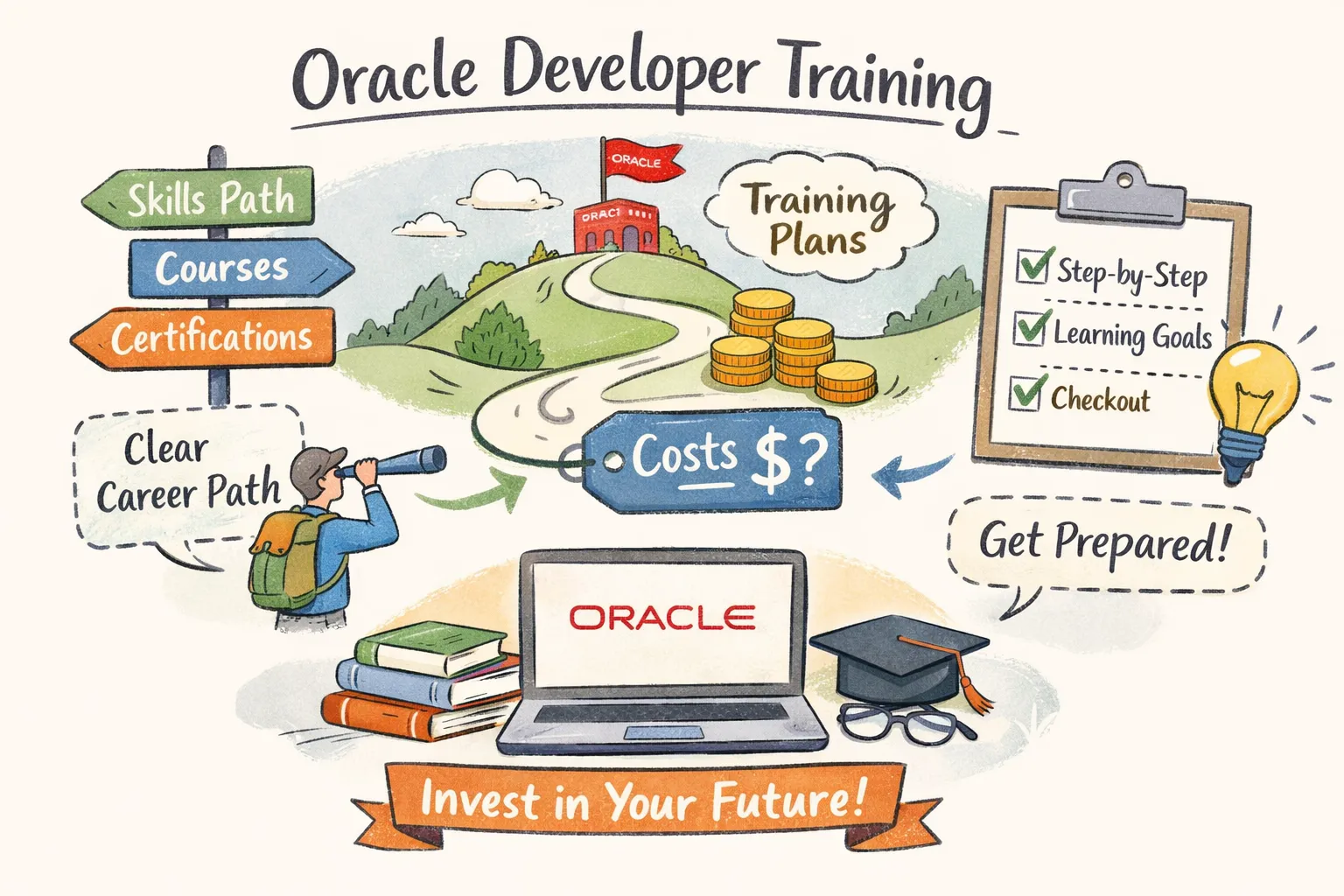
  • Oracle Developer Training: Clear Paths, Costs & Plan

    Oracle Developer Training: Clear Paths, Costs & Plan

    If you want to become an Oracle developer, follow a hands‑on sequence: SQL → PL/SQL → APEX → OCI, pair that learning with one role‑aligned certification (APEX or OCI), and commit to a 3–6 month, milestone‑driven plan. At CloudShine we teach the same sequence with live cloud instances, mentor feedback and placement support so you get both the credential and the project experience employers want.

    Which training path fits you?

    Pick a path based on timeline, budget, credential value and whether you need placement help. The core trade-offs are simple: official Oracle courses give recognition and direct alignment with exams; Coursera offers structured lessons at lower monthly cost; self‑study is cheapest but slowest; instructor‑led bootcamps (CloudShine style) speed hiring with live projects and interview prep.

    Match by persona:

    • Pivoter (experienced IT/ERP): Choose Oracle University or an intensive CloudShine bootcamp plus certification prep—you need recognized credentials and live instance work to translate ERP knowledge to cloud apps. (See our Master Oracle Fusion SCM Training Quickly: Your Path to Success.)
    • Aspirant (recent grad): Use Coursera or Oracle Academy for core skills, then a short capstone (APEX app) and CloudShine’s placement support to build a hireable portfolio.
    • Skilled dev upskilling: If you already know SQL/Java, target 1Z0‑771 (APEX) or 1Z0‑1084‑26 (OCI) with focused hands‑on labs and one capstone project.

    Recommendation in one line: if hiring is the goal, choose a bootcamp with live instances and placement support; if time and money are constrained, combine Oracle Academy + OCI Free Tier + focused self‑study and one exam.

    Certification map — which Oracle exams to take and in what order

    Certifications validate different employer needs: database fundamentals, low‑code app development (APEX), or cloud‑native dev skills (OCI). Pick one primary cert and a supporting DB cert.

    Key exams and where they fit:

    1Z0‑771 — Oracle APEX Cloud Developer Professional. Covers APEX app design, SQL Workshop, REST, security and PWA concepts. Ideal for web/app developer roles. Exam: ~90 minutes, ~50 questions (verify current format on Oracle: Oracle Certification).

    1Z0‑1084‑26 — OCI Certified Developer Professional. Cloud‑native app dev on OCI: functions, containers, APIs, and integration patterns. (See our Oracle Integration Cloud Service Certification: Your Ultimate Guide.) Target this if you expect to build microservices and serverless apps.

    1Z0‑1114‑26 — Redwood Application Developer Associate. Useful where UI/UX and Oracle’s Redwood Design System matter.

    Database SQL / PL/SQL associate & professional. Start here if you lack SQL and procedural DB skills; these are the foundations employers expect.

    Order to follow: Database SQL associate → PL/SQL basics → APEX (1Z0‑771) for app developers OR OCI Developer (1Z0‑1084‑26) for cloud roles → advanced add‑ons (Redwood, AI integrations, analytics).

    Best courses and bootcamps: where to learn and what to buy

    There are three practical learning tiers: official, structured online, and bootcamps. Each has a place depending on your goal.

    Official Oracle options. Oracle Academy / Learn offers free modules for SQL, PL/SQL and APEX foundations. For instructor‑led and self‑paced official material see Oracle Training. Oracle’s APEX Developer Professional is ~22 hours of guided labs—use this when you’re ready to follow the exact exam objectives (see APEX training here).

    Coursera and third‑party. Coursera specializations (Oracle SQL and PL/SQL tracks) are solid for step‑by‑step learning and include graded exercises; audit free, pay for certificates. Udemy can fill gaps cheaply but vet recency and reviews.

    Bootcamps — when you need hiring help. CloudShine’s bootcamp is built for conversion to employment: 100% practical labs, live Oracle instances, mentors with 15+ years’ experience, the 60:24 practical rule (instructor hours balanced with lab time), resume polishing and mock interviews. Choose a bootcamp if you want live projects, a portfolio and direct placement assistance. Read about typical career transitions in The Path to Becoming an Oracle Fusion Consultant: Skills and Challenges.

    How to pick a course: match the syllabus to the target exam objectives, confirm lab access, and prefer options that include a capstone project you can publish to GitHub or APEX Gallery.

    A practical 3–6 month study plan (weekly schedule, milestones, deliverables)

    Assumption: beginner→certified with 15–20 hours/week = ~4–5 months. Push to 25+ hours/week to compress to ~3 months.

    Phase plan and deliverables:

    Weeks 1–4 — Foundations (SQL & schema design). Focus: SELECT, JOINs, aggregates, indexing basics and normalization. Deliverable: 10 query exercises and a one‑page schema design doc for a sample app.

    Weeks 5–10 — Core development (PL/SQL & APEX basics). Focus: stored procedures, packages, exception handling, and build a CRUD APEX app. Deliverable: A basic APEX expense manager (CRUD, validations).

    Weeks 11–14 — Advanced & Cloud. Focus: RESTful services, OCI basics (Functions, Object Storage), security patterns. Deliverable: APEX app with an external REST integration or an OCI Function + DB microservice. For migration and implementation guidance see our Oracle Cloud Implementation Best Practices: Tips for A Successful Migration, CloudShine.

    Weeks 15–18 — Exam prep & portfolio. Take full timed mocks, fix weak areas, publish project repos and a deployment README, and prepare interview demos.

    Sample weekly schedule (15 hrs/week): Mon/Wed/Fri — 2 hrs video + 1.5 hrs lab; Tue/Thu — 2 hrs coding exercises; Weekend — 4 hrs review + one practice test every other week. Milestone checklist: SQL proficiency test passed; PL/SQL mini‑project; APEX app deployed; two mocks ≥80%.

    Costs, labs and free resources — concrete numbers and money‑saving hacks

    Budget items you will pay for: exam attempts, lab access and optionally a paid course or bootcamp. Verify current prices on Oracle’s site before purchase.

    Typical costs (ballpark):

    • Exam attempt: commonly around $245 USD per exam.
    • OCI self‑paced lab access: 1‑month ≈ $29; 12‑month ≈ $299 (Oracle self‑paced labs).
    • OCI Free Tier: $300 trial credit (30 days) + always‑free services for hands‑on work.
    • Coursera: subscription model (~$39–$79/month depending on promos).

    Budget scenarios: low‑cost self‑study $0–$400; mid‑range (Coursera + one exam + short lab) $200–$800; bootcamp with placement $800–$4,000+. Use these hacks to save:

    – Audit Coursera courses for free and pay only for the months you need. 
- Use Oracle Academy and APEX free labs as your primary practice environment. 
- Buy a one‑month lab subscription only for intensive final exam prep. 
- Watch for Oracle “Race to Certification” promotions that include free exam attempts.

    Pass the exam and get hired — portfolio, interview prep, and how CloudShine helps

    Passing an exam is necessary but not sufficient for hiring. Employers look for live projects, measurable impact and the ability to demo solutions under pressure.

    Exam tactics: practice on live instances under timed conditions, prefer debugging labs over passive reading, and take the exam only after two full‑length mock tests with 80%+ scores. For 1Z0‑771 expect a 90‑minute test; confirm on Oracle’s site.

    Portfolio & interview checklist: build three short projects with README and demo links — (1) APEX expense manager with REST API; (2) PL/SQL batch loader with error handling and audit logs; (3) OCI Function + DB microservice. Resume bullets should quantify work (data volumes, latency improvements, integration points). Be ready to whiteboard schema design, optimize SQL, explain REST & OAuth flows, and demo your APEX app in 5 minutes. Consider adding analytics as an advanced add‑on (for example, see our piece on Oracle Analytics Cloud In Finance Applications), which can boost interviews for data‑heavy roles.

    How CloudShine converts training to interviews: we provide live Oracle instances for realistic labs, mentors with 15+ years of experience, a 60:24 practice balance, resume and LinkedIn optimization, mock technical and HR interviews, and placement introductions. Request a free bootcamp snapshot or demo instance to map your background to a 3–6 month plan and see sample capstone projects.

    FAQs

    How long does Oracle developer training take to become job‑ready?

    Typically 3–6 months depending on prior experience; 15–20 hrs/week is realistic for beginners, 25+ hrs/week accelerates to ~3 months.

    Which certification should I start with as a new developer?

    Start with a Database SQL associate or APEX Cloud Developer Professional (1Z0‑771) if you plan to build web apps. Choose OCI Developer (1Z0‑1084‑26) for cloud‑native roles.

    How much do Oracle exams and lab access cost?

    Exam attempts are commonly around $245; Oracle self‑paced labs are typically $29 for 1 month or $299 for 12 months. Always confirm current pricing on Oracle MyLearn.

    Can I prepare for Oracle certification with Coursera or Udemy only?

    Yes for fundamentals and structured lessons, but add official hands‑on labs (OCI/Oracle Academy) and practice tests for exam readiness. Use a bootcamp if you need placement support.

    Actionable next step:

    Pick your target exam today, open an OCI Free Tier account, and schedule the first four weeks: SQL drills + a small schema design deliverable. If you want a guided, placement‑focused route, request a CloudShine demo or bootcamp snapshot to see how your background maps to a 3–6 month conversion plan.

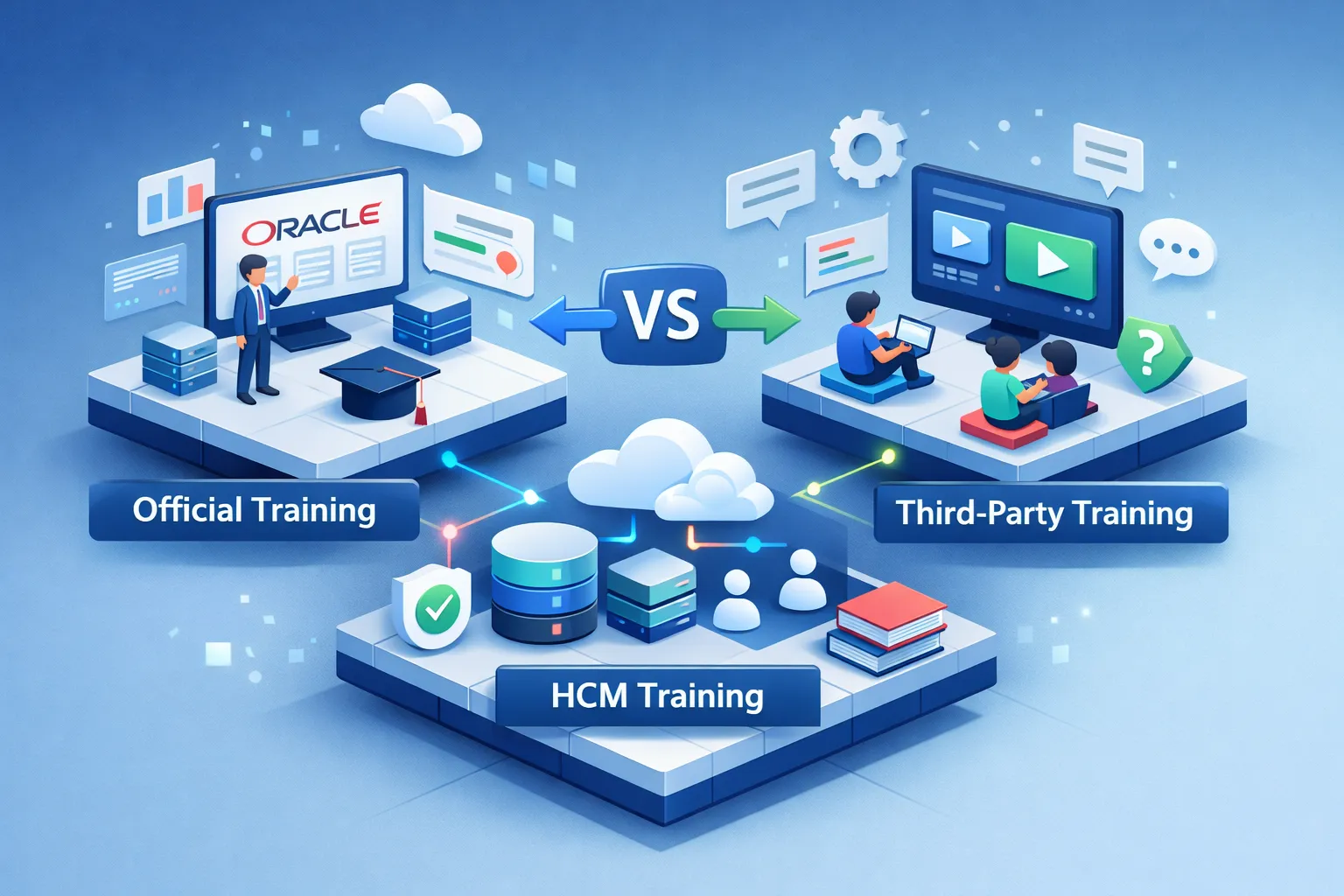
  • Oracle HCM Online Training: Official vs Third‑Party

    Oracle HCM Online Training: Official vs Third‑Party

    If your primary goal is official certification and exhaustive module depth, go with Oracle University; if you need a faster, lower‑cost route to hands‑on skills, a reputable third‑party course will do; and if you want live‑instance practice plus placement support, CloudShine is the practical middle ground. This guide compares curriculum, certification mapping, lab access, costs, delivery formats and who each option fits best so you can enroll with confidence in your Oracle Fusion Cloud HCM course choice.

    Quick snapshot: Oracle University vs Third‑Party vs CloudShine

    Oracle University — Best for certification-aligned, end-to-end learning. Curriculum: full HCM suite (Global HR, Workforce Management, Payroll, Talent, Absence/Time). Labs: role-based Oracle-hosted environments are available in official paths. Certification path: direct alignment to Oracle implementation professional exams. Typical duration & cost tier: longer paths and subscription pricing; higher cost but includes official exam mapping and curated learning plans.

    Third‑party providers — Best for budget and speed. Curriculum: concentrated on Core HR, Payroll and Talent to match hiring demand. Labs: varied — some include sandboxes, many rely on guided demos. Certification path: useful for interview prep but not always aligned to Oracle exam blueprints. Typical duration & cost tier: 25–45 hours is common; prices range from low-cost self-paced packages to premium instructor-led options.

    CloudShine — Best for job-readiness and placement focus. Curriculum: practical Core HR, Payroll, Talent plus integrations, reporting and scenario-based projects. Labs: live Oracle instances, extended mentor support and a dedicated placement cell. Certification path: prepares you for both job tasks and Oracle certification if you want it. Typical duration & cost tier: structured 60:24 model (60 hours instructor-led + 24 lab hours), tiered pricing with placement assistance and mock interviews.

    Practical takeaway: Want a cert-first career as an implementer? Oracle University. Need faster employability on a budget? Choose a focused third‑party provider. Need both live-instance practice and placement support? CloudShine is the pragmatic middle path.

    Curriculum reality check — what modules hiring managers actually expect

    Recruiters hiring for Fusion HCM roles routinely look for Core HR, Payroll, Recruiting/Onboarding, Talent Management (performance/comp), Absence, Time & Labor, Security/roles, Integrations (A2A and file-based), and OTBI/BI reporting. If your course skips several of these, you’ll be less competitive for implementation roles. For further context, see our article on Benefits of Oracle Fusion Human Capital Management, CloudShine.

    Oracle University covers the full suite and specialized workforce management topics; it’s the only route that consistently includes Absence, Time & Labor, and deep payroll localization. Third‑party courses typically focus on Core HR, Payroll and Talent because these areas produce hires faster. CloudShine emphasizes hands‑on Core HR, Payroll, Talent, plus integrations and end‑to-end project scenarios you can put on a resume.

    What you must be able to do (job‑readiness checklist)

    • Configure a hire‑to‑retire process: create positions, hire employees, manage transfers and terminations.
    • Define payroll elements, run a payroll cycle and post payroll adjustments.
    • Create an absence plan and process an absence/time scenario end‑to‑end.
    • Set security roles and test role‑based access to HR screens and data.
    • Build a basic OTBI report that extracts employee and payroll data.
    • Run a simple data load (HCM Data Loader or spreadsheet import) and validate transactions.

    For reporting practice that bridges HCM reporting concepts with real analytics workflows, see our piece on Oracle Analytics Cloud In Finance Applications | Oracle Analytics Cloud, CloudShine.

    Actionable tip: before you enroll, map the provider’s syllabus against this checklist. If more than two items are missing, expect to supplement training with labs or projects.

    Hands‑on labs and sandbox access — how much is enough, and how to verify it

    Practical confidence comes from repetition. Target at least 24 structured lab hours for basic job readiness and 40+ hours for implementer-level confidence. Labs teach debugging, data integrity checks, and how configuration choices propagate through pay and reporting — things slides can’t convey.

    In practice, a 24‑hour plan focuses on core cycles and troubleshooting; a 40‑hour plan adds integrations, payroll corner cases and a mini end‑to‑end implementation project. For concrete, lab-focused training examples see providers that publish hands-on lab content such as Apps2Fusion’s Oracle HCM lab training.

    Sample lab schedule in prose: a 24‑hour plan dedicates 8 hours to Core HR (employee lifecycle + data loads), 8 hours to Payroll (elements, run, adjustments) and 8 hours to Talent/OTBI and role testing. A 40‑hour plan expands each area and includes a two‑day integration workshop (HCM → Payroll or ATS) plus a portfolio-ready project.

    Provider verification checklist — questions to ask before you pay

    • Is the sandbox Oracle‑hosted and a real Fusion instance or just a simulated UI?
    • How long will each student keep access after the course ends?
    • Are student accounts full‑admin or role‑limited for safe practice?
    • Are lab tasks documented and graded so I can track progress?
    • Can I export screenshots, config notes or a project artifact for my portfolio?
    • What is the support SLA for lab help (response time, mentor access)?

    CloudShine note: our 60:24 model pairs 60 instructor‑led hours with 24 dedicated lab hours, live instance access and extended mentor support — designed for learners who need both practice and placement assistance.

    Price, delivery formats and guarantees — what you’ll actually pay for

    Delivery formats: self‑paced is cheapest but offers little mentor feedback; instructor‑led gives real-time Q&A and is best for learning complex flows; bootcamps are fast and intense; blended formats are the most practical for working professionals. Choose delivery mode to match your schedule and learning style, not just price.

    Pricing reality: Oracle University uses subscription/exam bundles and typically costs more upfront but maps directly to certification. Third‑party vendors are priced for affordability and speed — expect a wide range depending on hours and lab access. CloudShine provides tiered pricing with placement assistance, mock interviews and resume help; check eligibility and terms for placement guarantees.

    Before you buy, read the fine print: clear refund windows, explicit placement guarantee terms (eligibility, timelines, exclusions), and lab‑extension policies matter more than glossy marketing. Judge ROI by how quickly a course can get you interview‑ready for the specific job listings you’re targeting and whether the provider helps you create a verifiable project artifact.

    How to choose — a practical checklist by career stage

    Answer three questions: Do you need a vendor‑recognized certification? Are you switching careers and need placement support? Are you hiring or upskilling a team? Your answers map to the recommended route.

    Recommended match by persona: Aspirants (fresh grads) — choose a focused third‑party course with labs or CloudShine if you want placement support. Pivoters (EBS/legacy ERP pros) — CloudShine or Oracle University depending on whether you need certified proof or job‑ready projects. Implementers/consultants — Oracle University for deep module coverage, supplemented with extra lab time from a third‑party or CloudShine for real projects. Corporates — look for a “Recruit‑Train‑Deliver” model and custom batch timing that aligns to your go‑live. For corporate buyers, our guide on How to Choose Oracle Cloud Training Institute for Corporate Training, CloudShine covers what to negotiate and pilot options.

    Red flags: no lab access; trainers with no real-world implementation experience; vague placement guarantees; a syllabus that omits payroll or core HR tasks. When buying at scale, negotiate: ask for corporate pricing, a pilot batch, custom labs that match your configuration, and a short evaluation window for trainee performance.

    Enrollment roadmap, a sample 6‑week prep plan and FAQs

    Enrollment roadmap in short: pick your primary goal (cert, job, fast upskill), vet providers with the verification checklist above, request a demo lab, compare actual lab access and guarantees, then enroll and follow a structured study + lab schedule.

    Sample 6‑week plan (milestones)

    • Weeks 1–2: Core HR and data model — hire‑to‑retire flows and HCM Data Loader exercises.
    • Week 3: Payroll basics — define elements, run a test payroll, reconcile results.
    • Week 4: Talent & Recruiting + build a simple OTBI report that supports a business question.
    • Week 5: Integration and security labs — basic file integration and role testing.
    • Week 6: Mock interviews, create a 3‑page project artifact with screenshots and business context, and polish your resume.

    FAQs

    Do I need prior experience to take a Fusion HCM course?

    No formal prior Fusion experience is required for entry‑level courses, but familiarity with HR concepts, basic Excel and understanding of business processes will speed learning. For implementer tracks, prior ERP or HRIS exposure is helpful.

    Which route is fastest to a job in HCM?

    A focused third‑party course or a placement‑focused program like CloudShine with live instance practice and interview coaching is typically the fastest path to an entry role.

    Are Oracle University certifications necessary to get hired?

    Certs help, especially for consultancy and implementer roles, but employers increasingly value verifiable hands‑on projects and live‑instance experience. If you can do both — cert + portfolio — you’ll stand out.

    How many lab hours make me job‑ready?

    Target 24 structured lab hours for basic job readiness; 40+ hours to feel confident as an implementer. Quality of labs (real instance + mentor feedback) matters more than raw hours.

    What should I ask about placement guarantees?

    Ask for eligibility criteria, timeline for placements, refund or repeat training clauses if placements don’t materialize, and any caps on interview introductions. Vague language is a red flag.

    For cross-functional examples showing how HR workstreams interact with finance processes, you may find our walkthrough of an Order to Cash Drop Shipment Flow | CloudShine useful as a template for documenting end-to-end artefacts.

    If you are comparing Oracle to other HCM systems before choosing a training path, our Workday HCM Tutorial, CloudShine provides a concise primer to help map skills across systems.

    Final action: pick based on your goal — certification, rapid hire, or employer‑ready implementation skills. If you want the balanced option (official-level rigor plus real instances and a placement cell), request a demo from CloudShine’s Oracle Fusion HCM course and compare it against an Oracle University demo and a reputable third‑party provider such as MindMajix Oracle Fusion HCM training to see which lab access and guarantees match your needs.

  • Oracle Fusion Financials Training: 7 Best Paths 2026

    Oracle Fusion Financials Training: 7 Best Paths 2026

    If you’re shopping for oracle fusion financials training the short answer is: for a certification badge fast, use Oracle University’s MyLearn + target exams; for hire-ready implementation skills, choose an instructor-led, project-based course with live Fusion tenants and placement support. For career-changers the fastest route to hire is an intensive, sandbox-driven bootcamp—CloudShine’s 100% practical model is one example that combines live instances, recorded project demos and placement coaching.

    Quick answer: Which training path gets you job-ready?

    If your priority is a resumeable implementation skillset plus placement help, pick an instructor‑led, hands‑on program that provides live Fusion instances, project deliverables and mock interviews. If you already have deep finance or ERP experience and only need the Oracle badge, Oracle University’s Learning Subscription and targeted exams are the shorter route.

    Decision rule: Oracle University for certification; a CloudShine‑style bootcamp for implementation + hire support. If you’re undecided, book a demo lab within 7 days and confirm the vendor provides an actual Fusion tenant (not slides).

    7 Best paths for 2026 (pick one based on outcome)

    • Oracle University Learning Subscription — official exam alignment and digital labs; fastest for badge-first candidates.
    • Oracle University instructor‑led exams package — exam-focused classroom training for candidates targeting a specific certification quickly.
    • CloudShine 100% Practical Bootcamp — live Fusion tenants, 60:24 instructor/lab balance, placement cell; designed for fast hiring.
    • Third‑party intensive bootcamps (Triotech, Mindmajix Oracle Fusion Financials training, GoLogica Oracle Fusion Financials course equivalents) — project work and flexible schedules for working professionals.
    • Self‑paced video + Oracle MyLearn labs — low cost, best for experienced practitioners who only need brushing up (examples: GangBoard Oracle Fusion Financials training).
    • Corporate upskilling / Recruit‑Train‑Deliver programs — for enterprises needing coordinated team readiness.
    • Project apprenticeship / internship + community labs — gain implementation hours by working on small client projects or simulated migrations.

    Official Oracle vs third‑party — what each path delivers

    Oracle University (official)

    What you get: role-based learning paths, official exam blueprints, MyLearn labs and product docs. Pros: authoritative materials and direct mapping to Oracle exam objectives. Cons: higher price, less personalized mentorship, and limited placement support.

    Third‑party providers (CloudShine, Triotech, Mindmajix, GoLogica)

    What to look for: authentic live‑tenant access, project deliverables, trainer implementation experience (15+ years ideal), and an active placement cell. For guidance on vendor selection see our notes on what to consider when hiring an Oracle consultant firm. Pros: practical labs, portfolio-ready projects, mock interviews and flexible schedules. Cons: variable quality—vet trainers and confirm tenant authenticity before you pay.

    Compact checklist to choose fast: lab access (real tenant vs simulated); trainer pedigree (implementation years); placement support (mock interviews + employer connections); certification alignment (does the syllabus map to Oracle exam objectives?).

    Certification map: exams, codes, prerequisites and realistic costs

    Typical progression: Foundation → General Ledger → Payables/Receivables → Accounting Hub/Revenue Management. Codes are updated annually—always verify on Oracle’s exam pages.

    Module Example Exam Code (illustrative) Typical Prep Time
    General Ledger 1Z0‑1054‑26 (or current variant) — see the official 1Z0-1054-26 exam page 3–8 weeks
    Payables 1Z0‑1055‑25/26 3–6 weeks
    Receivables 1Z0‑1056‑26 — see the official 1Z0-1056-26 exam page 3–6 weeks
    Accounting Hub 1Z0‑1060‑26 4–8 weeks

    Costs: Oracle exam fees vary by region—expect roughly $200–$400 per exam; Oracle Learning Subscriptions bundle labs and prep for an annual fee. Training providers range from low‑cost self‑paced ($50–$500) to premium bootcamps ($1,000–$3,000+). Plan 3–8 weeks prep per exam depending on prior experience. For real exam experiences and study notes see a community write-up of real exam experience notes for 1Z0-1056-26.

    Where to get real hands‑on practice — labs, sandboxes and projects

    Start with Oracle MyLearn and Oracle’s product docs for guided labs and step‑by‑step configuration. The Oracle docs site also covers administrative tasks like activating your Oracle Fusion Intelligence subscription and cloud admin topics such as accessing instance settings.

    Complement that with vendor demos and official tutorial videos (for example an Oracle Fusion Financials demo video and a Fusion GL configuration walkthrough) and community scripts on GitHub for sample data loads.

    For true implementation practice you need access to a Fusion tenant. Confirm your vendor offers a live instance and how many lab hours are included. At CloudShine we follow a 60:24 model—60 instructor hours plus 24+ hours of dedicated lab time on live Fusion instances so students complete real configurations. If you want alternative vendor courses to compare, review offerings such as Apps2Fusion Oracle Fusion Financials Cloud v1.1 course or course roundups like OracleERPGuide’s Oracle Fusion Financials training.

    Six short labs you should complete and record as portfolio pieces: configure a Chart of Accounts and run a trial balance; process AP from invoice through payment run; complete AR billing, receipts and cash application for a monthly cycle; perform a bank reconciliation and day‑to‑day cash management; create a fixed asset, run depreciation and record a disposal; execute a month‑end close including reclassifications and reconciliations. For each lab record a 5‑7 minute screencast and a one‑page “What I configured and why” summary. For examples of common pitfalls, review Common Errors in Oracle Fusion Cost Accounting.

    A practical learning plan: 3 sample timelines

    Choose a timeline by budget and baseline experience.

    Beginner (part‑time): 9–12 months

    Months 1–2: finance fundamentals + Fusion basics. Months 3–6: core modules (GL, AP, AR, FA). Months 7–9: project labs, mock implementations, resume and interview prep.

    Intermediate (finance/ERP background): 4–6 months

    8–12 weeks module training + 4–8 weeks intensive labs + 2–4 weeks certification push and interviews.

    Experienced (EBS/ERP pro): 1–3 months

    Targeted module skilling, delta exam prep and recorded project demos for hiring conversations.

    12‑week bootcamp (working pro schedule): Weeks 1–2 foundation + GL; Weeks 3–6 AP/AR/Cash; Weeks 7–9 Assets + reporting; Weeks 10–11 project labs + mock interviews; Week 12 certification prep and applications. For additional commercial courses and comparison, see other vendor trainings such as CloudShine Oracle Fusion Finance training or marketplace options like GangBoard.

    Pick the right course: 12‑point checklist, price ranges and CloudShine next steps

    • Do you provide a live Oracle Fusion tenant?
    • How many instructor-led hours and how many lab hours per student?
    • Trainer experience: years and implementation background?
    • Are materials mapped to Oracle exam objectives?
    • Placement support: resume, mock interviews, employer introductions?
    • Batch schedule flexibility and recordings access?
    • Student-to-trainer ratio in labs?
    • Real project deliverables and templates included?
    • Refunds or trial/demo classes?
    • Salary placement assistance and employer connections?
    • Cost, payment plans and EMI?
    • Post‑training mentoring window and instance access?

    Ballpark prices: self‑paced video courses $50–$500; instructor‑led short courses $400–$1,200; intensive bootcamps with live tenants + placement support $1,000–$3,000+. Verify lab hours and placement commitments before you enroll.

    Why consider CloudShine: we emphasize implementation mastery—not just slides. Our model includes live Oracle Fusion instances, a 60:24 instructor-to-lab balance, trainers with 15+ years’ implementation experience, and a dedicated placement cell that runs mock interviews and resume coaching. We’ve trained 500+ consultants and partner with 50+ organizations across the USA, India and UAE. If you want to read about the typical skills employers expect for remote Fusion functional roles, review this summary of key skills and qualifications for Work-From-Home Oracle Fusion Financial Functional Consultant.

    Next steps: shortlist two vendors, book a demo lab, confirm tenant access and ask the 12 checklist questions. Enroll within 14 days to maintain momentum.

    FAQs

    How long to become a Fusion Financials functional consultant? Realistic ranges: 1–3 months for experienced ERP pros, 4–6 months for finance/ERP backgrounds, and 9–12 months for beginners on a part‑time schedule.

    Do I need a finance/accounting background? Strongly recommended. Understanding GL, AP and AR processes shortens the learning curve significantly, but motivated non‑finance learners can progress with practical labs and mentorship. For role clarity and task expectations see Oracle Fusion Finance Important Roles.

    Are Oracle certifications necessary to get hired? They help signal competence, but employers prioritize hands‑on implementation experience and portfolio projects over certificates alone.

    Can third‑party courses qualify me to sit Oracle exams? Yes—anyone can register for Oracle exams. Choose courses that explicitly map to Oracle exam objectives for best results. For certification pathway reading, this Oracle Fusion Financials certification guide is a useful primer.

    Summary and action

    If you need a badge fast, pick Oracle University; if you need to be hire‑ready, choose a project‑based bootcamp with live tenants and placement support. Shortlist two providers, book demo labs within a week, and start the 12‑week practical plan if you want measurable outcomes in under three months.

    Ready to test a live tenant? Book a 15‑minute training needs call or request a free demo lab with CloudShine to confirm lab access and trainer pedigree before you sign up. For supplier and procurement-related configuration topics you may also find our notes on the Oracle Fusion Supplier Portal and Oracle Fusion Supplier Qualification Management helpful when mapping end-to-end procure-to-pay processes.

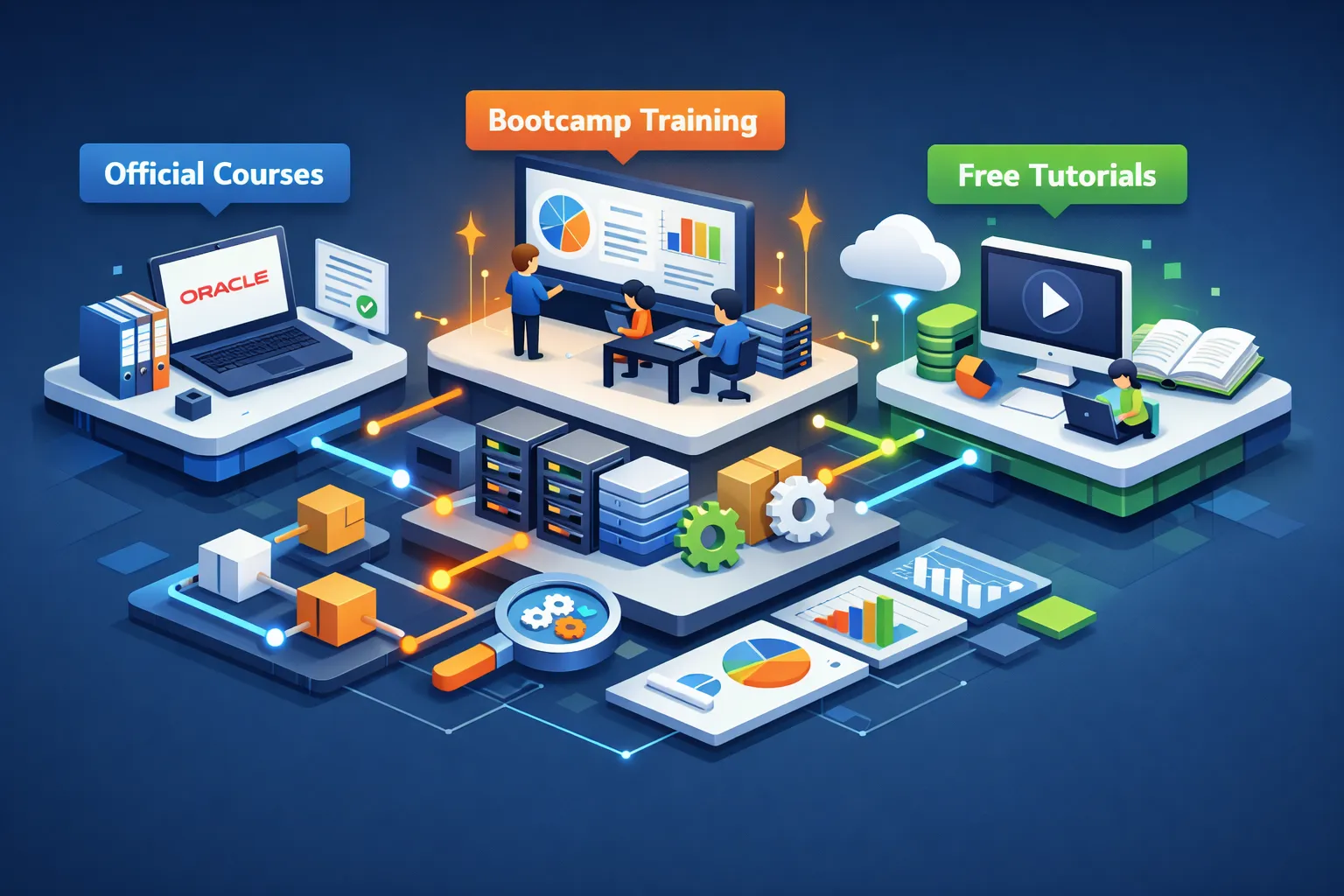
  • Oracle Fusion SCM Training: Official, Bootcamps, Free

    Oracle Fusion SCM Training: Official, Bootcamps, Free

    Quick verdict: If you need vendor-certified knowledge and resume credibility, start with Oracle University; if you need job-ready implementation skills and placement help, choose a hands-on bootcamp (CloudShine’s practical model is a strong fit — CloudShine). If you’re budget‑conscious or just testing the fit, use curated free resources first. This article explains what each path teaches, realistic cost/time expectations, and gives a practical 90‑day plan to reach interview readiness.

    Official Oracle University paths: what they teach and who should pick them

    Oracle’s role-based learning paths cover Procurement (source-to-pay), Inventory, Order Management, Supply Chain Planning, Product Lifecycle Management, Logistics, and Costing, plus foundational setup via Functional Setup Manager and basic integration/reporting. The official content is written by product teams and emphasizes configuration options, best practices, and exam objectives aligned to implementation roles.

    Delivery formats include interactive video modules, digital learning paths, instructor-led options, and proctored certification exams. Employers who list “Oracle University training/certification” as a requirement usually mean these official credentials.

    The trade-off is clear: you get vendor accuracy and credential credibility, but many official paths provide limited sustained hands-on instance access and pricing is often not published publicly. Before you buy, confirm practical lab access; exam voucher policy; how long the content is available to you; and whether implementation scenarios are included. If your employer will reimburse or the job market values certificates, combine Oracle University for credentialing with separate lab time to build real system experience.

    Bootcamps & paid third-party programs: choose this if you want implementation skills

    Bootcamps compress the practical work you’d normally learn on the job into weeks. The value comes from instructor-led practice, real-instance configuration, and end-to-end scenarios (procure-to-pay, order-to-cash) that produce interviewable artifacts: completed configurations, screenshots, and documented case studies.

    A quality bootcamp must provide live Oracle Cloud instance access, step-by-step configuration exercises, end-to-end business scenarios, trainers with real-world implementation experience (15+ years is a strong signal), and placement support including resume and mock-interview prep.

    • Vetting checklist — ask any bootcamp: Do you provide sustained cloud instance access for each student? Can I see sample projects or student output? What are the trainers’ implementation credentials and years of experience? What are your placement rates and alumni contacts? Do you offer a money‑back or repeat‑class policy?

    CloudShine’s model follows these standards: a 100% practical curriculum, live Fusion instances for hands-on labs, scenario-based projects you can present in interviews, and dedicated placement coaching (resume, mock interviews). We structure delivery around a 60:24 rule — about 60 instructor hours balanced with 24+ lab hours — so students finish with demonstrable system experience rather than only theory.

    If you’re evaluating consultancies or third-party training partners, our guide on what to consider when hiring an Oracle consultant firm lists practical questions and red flags to use during vendor selection.

    Red flags: vague lab claims, no instance access, missing alumni outcomes, or ultra-short schedules promising mastery. If your goal is a job within 2–4 months, shortlist 2–3 bootcamps that pass the vetting checklist and ask for a sample lab or an alumni reference before you pay.

    Free and low‑cost options: how to use them effectively (and when they’re not enough)

    Free resources include Oracle product documentation, select free modules on Oracle University, vendor videos, and community tutorials and YouTube playlists. These are excellent to confirm interest and learn conceptual flows such as item setup, purchase order lifecycle, and basic inventory transactions.

    Turn free learning into something employers respect by mapping a module progression (for example: Procurement → Item master → Supplier setup → Purchase order lifecycle), replicating demos on a trial or low-cost sandbox, and keeping a lab diary with screenshots and short notes. Publish one or two mini case studies on GitHub or LinkedIn that show a business problem and the configuration steps you used to solve it.

    For supplier-focused topics, the supplier lifecycle has subtopics worth documenting separately — for example, supplier qualification management and the supplier portal both have role and process nuances that hiring managers look for in interviews.

    Limits are obvious: free routes rarely include official instance access, exam vouchers, or interview-ready projects. Use free material to map the exact modules you need, then budget for a single paid lab session or one bootcamp module to obtain live-instance proof of work when you’re ready to move from learning to hiring.

    Pragmatic comparison: syllabus, cost, duration — how to pick

    Choose by scoring syllabus completeness, lab hours & instance access, trainer experience, placement support, price, and time-to-interview. Weigh each criterion by your goal: certification vs. hireability.

    Option Typical Price Typical Duration Hands‑on Access
    Oracle University (official) Varies by path; vendor quote required Self‑paced to multi‑week Limited interactive demos; confirm lab availability
    Third‑party bootcamps ~$220–$800 (₹18,500+) 25–60+ hours (bootcamp) Live instance access (if provider commits)
    Free resources $0 Variable Mostly none

    Cost vs. ROI: estimate your expected salary uplift from Fusion Cloud skills (many markets show a 20–40% delta) and calculate payback months. If employers reimburse certification, Oracle University can make sense; if you need projects to interview, a bootcamp with guaranteed lab access usually gives faster hiring ROI. When stuck, prefer the option that explicitly documents lab access and shows trainer implementation experience.

    For a concise orientation to the product landscape while you score syllabi, see our article An Intro to SCM Modules in Oracle Cloud Applications — it helps map which role-specific modules you should prioritize for your target job.

    Certification steps and a practical 90‑day plan (enroll → interview)

    Certification simplified: pick the module certificates that match your target role (Procurement, Inventory, Order Management, or Supply Chain Planning), complete the role-based learning or bootcamp work, run timed mock tests, buy a proctored exam voucher, and pass the exam. Verify current exam codes and objectives on Oracle University before scheduling.

    1. Days 0–7: Choose target module(s). Enroll in the official digital path or a bootcamp; map the syllabus and secure lab access (trial or paid).
    2. Weeks 2–4: Learn fundamentals and Functional Setup Manager basics — enterprise structures, items, suppliers, and basic transactions. Log labs with screenshots and short notes.
    3. Weeks 5–8: Build core end‑to‑end flows — procure‑to‑pay and order‑to-cash. Complete two small implementation scenarios you can present in interviews.
    4. Weeks 9–12: Tackle advanced topics (integrations, OTBI/analytics, costing). Take mock exams, schedule your certification, and run 2–3 timed mock interviews with a placement coach or peer.

    For finance-adjacent roles and accounts-payable specifics, review role details to highlight process improvements in your case studies — see our Oracle Fusion Finance important roles write-up for examples you can adapt into interview bullets.

    Interview readiness is simple: have 2–3 documented case studies, live-instance screenshots or access to demo a change, clear bullets that translate your tasks into business outcomes (cost reduction, time saved), and a polished resume highlighting those outcomes. Book your first paid milestone — a lab session or exam voucher — within 14 days of starting to create a measurable commitment.

    FAQs

    Q: How long to prepare for an Oracle Fusion SCM certification?
    A: Focused preparation typically takes 6–12 weeks (30–80 hours) depending on your background and whether you use a bootcamp or self-study.

    Q: Do Oracle University courses include hands‑on labs?
    A: Some digital paths include interactive demos, but many learners pair Oracle University with external lab time or a bootcamp to secure full instance access.

    Q: How much does an Oracle SCM exam cost?
    A: Proctored exams generally range from $175–$300, though exact prices vary by location — check Oracle University for current fees. You can also compare official training and certification options on Oracle’s SCM training page.

    Q: Can I get a job using only free resources?
    A: Possible if you already have ERP experience, but most fresh entrants need documented practical projects or bootcamp experience to pass recruiter filters.

    Q: I need hands‑on help and placement — what should I do next?
    A: Score your options on the rubric above, book a paid lab session within 14 days, and follow the 90‑day plan. If you want guided hands‑on labs plus placement coaching, request a trial lab and placement details from CloudShine’s Oracle Fusion SCM training. Also consider reviewing published certification learning paths before you buy an exam voucher — a helpful summary is available at Oracle certification learning paths.

    Summary: Pick Oracle University when you need a vendor credential; pick a hands-on bootcamp when you need interviewable projects and placement support; use free resources to validate interest and map required modules. Take one small paid action in the next two weeks — a lab session or exam voucher — and follow the 90‑day calendar above to be interview-ready.

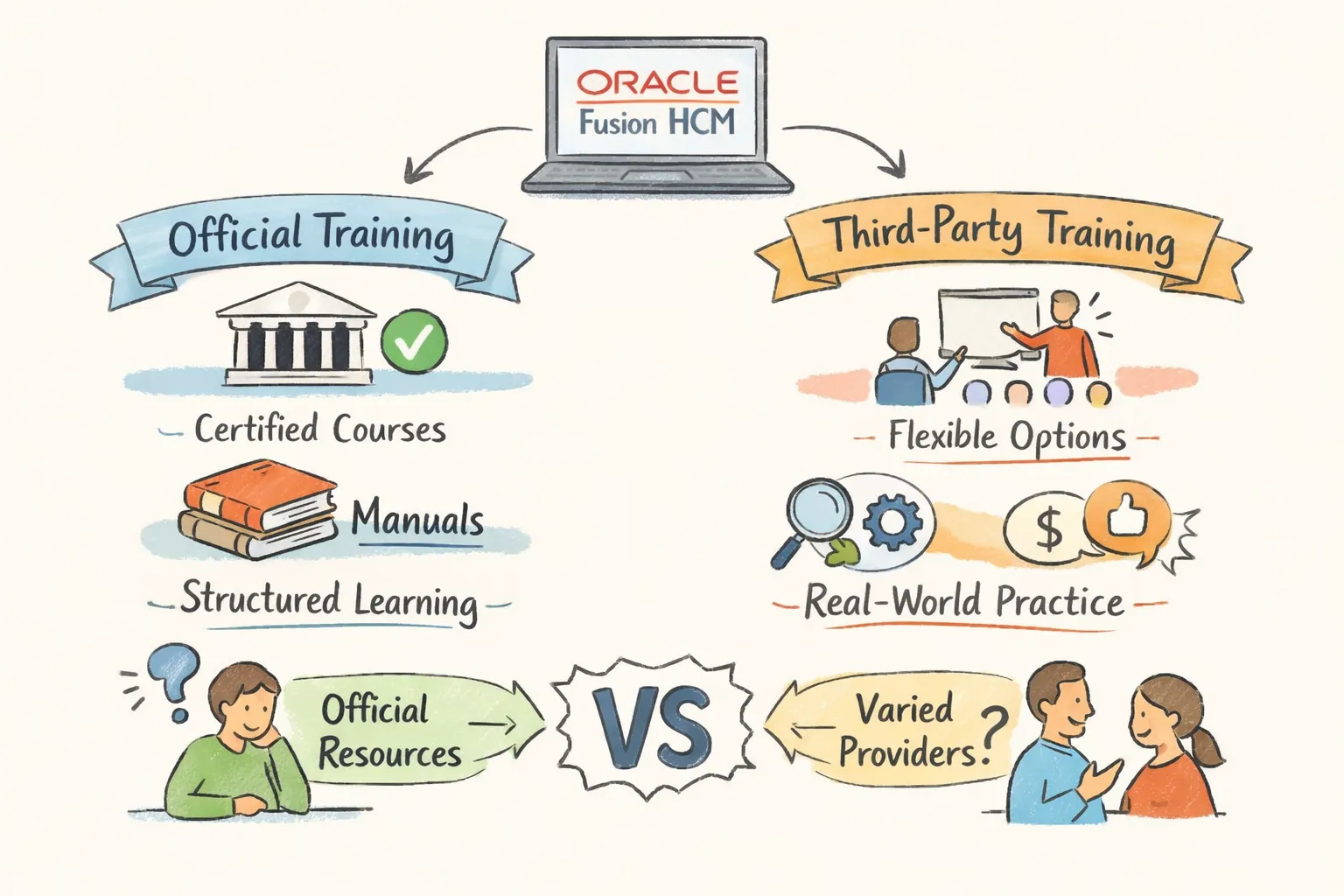
  • Oracle Fusion HCM Training: Official vs Third‑Party Guide

    Oracle Fusion HCM Training: Official vs Third‑Party Guide

    If you need vendor credibility and formal certification, start with Oracle University; if you need fast, hands‑on experience to get hired quickly, pick a high‑quality third‑party bootcamp — the safest route is a blend of both. At CloudShine we use a mixed approach (official prep + intensive lab days) to make learners interview‑ready faster.

    Read on to get a straight comparison, realistic cost/time estimates, certification steps, and a 6‑step learning plan you can execute this quarter.

    What Oracle University actually provides (who should pick it)

    Oracle University organizes learning around role‑based paths: Global HR, Payroll, Talent, Workforce Management and associated implementation/admin tracks. Content comes as digital, self‑paced modules, instructor‑led virtual classes, and occasional classroom offerings. The official ladder includes foundational Process Essentials up to Implementation Specialist certifications and delta releases tied to product versions.

    Official credentials deliver vendor-backed credibility, a controlled exam environment, and access to MyLearn resources. Exams test configuration knowledge, process flows and basic troubleshooting; prerequisites commonly expect some hands‑on experience (Oracle recommends roughly six months of practical exposure for advanced tracks).

    Pros: recognized by enterprise buyers, clear syllabus aligned to product releases, and formal exam attempts (often bundled in subscription plans). Cons: higher cost and calendar lead‑time, limited open lab time in many offerings, and training that can be heavier on theory than real‑world config.

    Actionable takeaway: prioritize Oracle University if you’re targeting enterprise consulting roles, vendor‑validated resumes, or clients that require certified consultants on projects.

    What third‑party courses and bootcamps actually deliver

    The market splits into self‑paced marketplaces, instructor‑led bootcamps, and corporate upskilling vendors. Typical third‑party deliverables are extended lab hours, project‑based assignments, placement support, and mock interviews. Providers range from Coursera micro‑courses to specialist bootcamps and niche Oracle trainers.

    Key difference: access to a real Oracle instance versus simulated sandboxes. Real instances let you perform end‑to‑end payroll runs, data loads and role testing exactly like a client POD; simulated sandboxes limit actions and can leave blind spots in interviews. Trainer experience matters — an instructor with implementation history (10–15+ years) closes gaps manuals won’t. For technical details on sandbox behavior and limitations, see Oracle’s guidance on working with sandboxes (Working With Sandboxes).

    Watch for red flags: no live lab access, vague placement claims, cookie‑cutter syllabi reused across cohorts, and unclear refund/retake policies.

    Five vendor questions to ask before you pay:

    • Do you provide direct access to a live Oracle Fusion instance (POD) or only simulated sandboxes, and how long is access retained?
    • How many guaranteed lab hours are included and can I re‑use them after class?
    • What are the trainers’ implementation years and recent project references?
    • What measurable placement outcomes do you publish (placement % in 90 days) and are there guarantees?
    • Is Oracle exam prep included (mock tests, objectives mapping) and how many timed mocks are provided?

    How employers view Oracle certs vs course certificates

    In hiring, Oracle certifications carry clear vendor recognition and often accelerate short‑listing for implementation and consulting roles. Third‑party certificates demonstrate hands‑on exposure but usually require corroborating evidence — projects, sandbox screenshots, or recorded demos.

    On your resume, lead with any Oracle credential, then one line summarizing real‑instance projects: for example, “Oracle Global HR: configured enterprise structure and executed payroll run in Oracle Fusion sandbox (screenshots/demo available).” For smaller firms, demonstrable project work can outweigh formal certs; for large consultancies, vendor certs are a baseline.

    Actionable takeaway: aim to pair an Oracle certificate with one or two complete, end‑to‑end projects performed on a live instance before applying broadly. Consider cross‑functional projects to show breadth, such as supplier qualification or supplier portal configuration — see Oracle Fusion Supplier Qualification Management Important Roles and Oracle Fusion Supplier Portal Important Roles for example project ideas.

    Practical side‑by‑side: credibility, labs, time‑to‑job and who wins

    Criteria Oracle University Third‑Party Bootcamp
    Credibility High (vendor‑backed) Medium (depends on brand & trainer)
    Hands‑on labs Limited lab windows; paid lab subs available ($29/mo or $299/yr) Typically more hours and project work; may include managed PODs
    Time‑to‑job Longer (cert cadence + exam scheduling) Faster with intensive placement tracks
    Placement support Minimal Often included (variable quality)
    Best for Enterprise roles and consultants Career switchers, fast hires

    Persona recommendations in practice: The Pivoter (EBS/ERP consultant) — do an intensive third‑party lab track and then sit the Oracle Implementation Specialist exam; blended 3–6 months. The Aspirant (fresh grad) — enroll in a bootcamp with placement support plus Oracle Foundation/Process Essentials prep; expect 4–6 months, ~300–450 hours. The Enterprise buyer — use Oracle University for standardization and a third‑party partner for rapid team upskilling (25–30 day options).

    Cost/time estimation method: add course fees + exam fees (or subscription) + paid lab access + opportunity cost (weekly hours × salary). Verify current Oracle lab rates (OCI free trial: $300/30 days; lab subs $29/mo or $299/yr) and provider prices before committing.

    Scoring rule: if enterprise credibility matters, weight Oracle certs heavier; for immediate employability, weight lab access and placement support higher.

    A repeatable 6‑step job‑ready learning & certification plan

    Foundations (40–60 hrs)

    Learn HCM concepts, UI navigation and Modern Best Practices. Deliverable: a one‑page cheat‑sheet and a simple configuration task (create a business unit and employee record).

    Core functional training (100–150 hrs)

    Cover Core HR, Absence, Payroll, Talent and Compensation. Deliverable: configured enterprise structure and a payroll run on a sandbox with documented results.

    Role specialization (60–120 hrs)

    Choose Implementation, Administration or Integration. Deliverable: a role‑specific mini project — for implementers, an OTBI report or security role matrix; for integrators, a basic file‑based integration (you can also show cross‑module knowledge by referencing an order‑to‑cash cycle project such as Oracle Fusion Sales Order to Shipment Cycle).

    Hands‑on projects (40–80 hrs)

    Execute end‑to‑end scenarios (hire‑to‑retire, full payroll cycle). Deliverable: a project report with screenshots, error log analysis and a recorded demo.

    Exam prep & mock tests (30–60 hrs)

    Map topics to Oracle exam objectives, take timed mocks and review weak areas. Deliverable: three timed mocks with target scores (aim ≥75% on final mock).

    Interview readiness & placement (ongoing)

    Polish resume, system demo, and soft skills. Deliverable: one live mock interview and a ready‑to‑send resume packet with a one‑page project summary.

    Accelerated track: CloudShine compresses practical work using a 60:24 model (60 hours instruction + 24 hours lab) and offers a focused 25–30 day corporate upskill option for working teams.

    Weekly schedule template: working professionals — 8–10 hours/week for 20–24 weeks; intensive bootcamp — 6–8 hours/day for 4–6 weeks.

    Decision checklist, vendor vetting, CloudShine option and FAQs

    Seven quick decision checks before you enroll:

    • Live Oracle instance access (POD) vs simulated sandbox.
    • Guaranteed lab hours and retention policy.
    • Trainer experience and implementation references.
    • Placement outcomes, timelines and any guarantees.
    • Exam prep materials and mock test availability.
    • Batch schedule flexibility and refund/retake policy.
    • Student reviews and sample project deliverables.

    Vendor vetting script — six quick questions to ask sales:

    • What exact instance type will I get and how long will snapshots be available?
    • Can I reuse lab hours after class ends and are they scheduled or on‑demand?
    • Which trainers will teach my batch and what projects did they implement recently?
    • What percentage of graduates are placed within 90 days and can you share references?
    • Are mock exams mapped to current Oracle exam objectives and how many attempts are included?
    • What is your refund policy if I can’t complete the program or fail the mock criteria?

    For guidance on purchasing and approval workflows during implementations, review best practices in approval hierarchy setup — Understanding Fusion Purchasing Approvals Hierachy. For a broader checklist on selecting a consultancy partner, see What To Consider When Hiring An Oracle Consultant Firm.

    How CloudShine helps (one proven option): CloudShine offers 100% practical labs with access to live Oracle instances, trainers with 15+ years of implementation experience, the 60:24 teaching model, and a placement cell covering resume building and mock interviews. CloudShine runs global cohorts across the USA, India and UAE and provides pay‑in‑installments and placement‑guarantee tiers for qualifying students.

    Three next steps you can do now: request Oracle University’s current HCM course list and pricing; ask a prospective vendor for a 24‑hour trial sandbox; book a 15‑minute CloudShine consultation to map a blended plan.

    FAQs

    Which certification should I start with for Oracle Fusion HCM?
    Start with the Fusion Cloud Applications HCM Process Essentials or a Foundations associate path, then move to an Implementation Specialist aligned to your chosen module (Global HR, Payroll, etc.). For a broader view of available Oracle credentials, see the consolidated list of Oracle certifications.

    Do third‑party courses count if I don’t have an Oracle cert?
    Yes — but pair coursework with tangible deliverables (project report, screenshots, recorded demo). Employers trust demonstrated work; certificates alone rarely close interviews.

    How long does it take to become job‑ready?
    Typical ranges: 4–6 months with part‑time study (~300–450 hours) or an intensive 4–6 week bootcamp if you can commit full time. Prior ERP experience shortens the timeline.

    Is real Oracle instance access necessary?
    Practically speaking, yes — real instance work prepares you for configuration quirks, payroll runs and integration tests that simulated sandboxes often hide.

    Final takeaway: combine official certification for credibility with focused third‑party practical training for speed‑to‑hire; use the checklist above when choosing a vendor and build one complete project on a live instance before you apply.

  • Workday HR Training: Choose Official, Free, or Third‑Party

    Workday HR Training: Choose Official, Free, or Third‑Party

    If you’re choosing workday hr training, pick the path that matches your outcome: official training for employer/partner recognition, third‑party bootcamps for fast, job‑ready skill development with tenant practice, or free/open courses for everyday user skills. At CloudShine we run a placement‑focused Workday HCM bootcamp that follows this exact rubric — live labs, project portfolio, and interview support for career pivoters.

    How to decide: a simple rubric for picking the right path

    Match the learning pathway to the role you want. Simple rules cut wasted time and money.

    • Outcome: Business user, admin, or consultant? Your end role determines the depth required.
    • Access: Do you need tenant access and real configuration labs or only guided demos?
    • Time & Budget: Short audit (free) → ₹700 Udemy; hands‑on bootcamp or partner training → ₹20,000–$2,500+ depending on live instance and placement support.

    Role guidance in one line each: an HR generalist can start with free Workday Basics and an employer sandbox; an admin aspirant needs targeted third‑party or official admin tracks with labs; a career pivoter or aspiring consultant should choose a partner‑backed or premium bootcamp that includes live projects and placement help.

    Actionable takeaway: eliminate 1–2 options immediately. If you need admin rights or consulting roles, cross out purely video courses; if you only need basic day‑to‑day use, cross out paid bootcamps.

    Official Workday programs: what they cover, who qualifies, and typical costs

    Workday’s official learning ranges from Workday Basics and Workday in Action (open, on‑demand business user content) to Workday Pro certifications (HCM Core, Benefits, Compensation, Recruiting, Payroll, Learning, Platform Admin). Basics are accessible to everyone; Pro certifications are commonly available to Workday employees, customers, or partner staff.

    Eligibility & access: Expect official Pro tracks to require employer or partner sponsorship for tenant access and exam enrollment. Some partners can enroll individuals via learning credits, so partner‑mediated routes exist.

    Exam format (example): Pro Core exams are frequently described as ~50 questions, ~100 minutes, with an ~80% pass threshold and certificate validity often cited around two years. Confirm live details on Workday’s learning portal before booking.

    Pricing reality check: Workday’s public pages rarely list full prices; industry reporting and provider data place exam fees around $800 per attempt and course bundles or partner packages starting in the low thousands. Corporate sponsorship is often the cleanest path to avoid these costs.

    Pros: official badge, direct materials, employer recognition. Cons: limited direct access for independents, enterprise pricing, and certification availability often restricted to sponsored learners.

    Actionable takeaway: if your employer will sponsor you, take the official route. If not, use partner‑mediated enrollment or a third‑party provider that provides tenant access and project work.

    Third‑party courses that actually get you job‑ready — what to look for and a provider shortlist

    Not all third‑party training is equal. Prioritize providers that give configuration access, project experience, and career support. Compare providers such as Online IT Guru for live+LMS formats and demonstrable placement outcomes.

    • Tenant or simulated instance access for real configuration practice.
    • Several hands‑on projects that you can include in a portfolio.
    • Trainer industry experience and active mentor support.
    • Placement help: resume review, mock interviews, and hiring introductions.
    • Transparent pricing and replay or lifetime access to materials.
    Provider Format Hands‑On Placement Price (approx.)
    Online IT Guru Live + LMS 2 projects Yes ₹18,040
    Multisoft Virtual Academy Instructor‑led Yes Limited ₹30,000
    ERP Cloud Training Live Projects Yes $2,499+
    Udemy Self‑paced No No ₹700
    CloudFoundation / ZaranTech Self‑paced + labs Some labs Varies Free → $599

    Where CloudShine fits: our Workday HCM offering follows a 100% practical curriculum with live cloud instance access where available, mentors with 15+ years of implementation experience, and a dedicated placement cell that covers resume building and mock interviews. If your projects touch procurement or supply chain, see our intro to SCM modules in cloud applications to understand common integration points. We position the program for career pivoters and aspirants who need a short, practical route to employability and real project artifacts.

    Tradeoffs and price guidance: low‑cost options are fine for familiarization; justify higher spend when the course includes verified tenant access and placement outcomes. Ask for a lab demo and recent placement stats before you pay.

    Free and open‑enrollment routes: what they teach and when they’re enough

    Useful free resources exist and are a smart first step. Workday Basics (Learn with Workday) is roughly a ten‑hour on‑demand series open to everyone and covers navigation, basic business processes, and fundamental reporting. Coursera offers a Workday HCM business user course free to audit. CloudFoundation and several YouTube walkthroughs provide additional no‑cost orientation.

    What they do well: teach navigation, day‑to‑day HR tasks, and reporting awareness — ideal for HR users or to test interest. What they don’t do: provide admin privileges, partner‑level tenant access, or directly qualify you for Pro certification.

    Two‑week audit plan (practical): Week 1 — complete Workday Basics and one Coursera module; practice navigation and take notes on data model terms. Week 2 — follow a CloudFoundation walkthrough to create one sample report and evaluate whether you need live tenant practice. Use these results to decide on bootcamp investment.

    Actionable takeaway: start free to validate fit; only pay for bootcamps when you need tenant practice and placement outcomes.

    A practical learning path to Workday HCM certification — week‑by‑week plans and exam checklist

    Sequence the learning: HCM Core first (shared vocabulary and data model), then Recruiting, then Payroll, followed by Compensation/Benefits/Talent as needed. Core is the foundation for configuration and integrations.

    Estimated study hours: HCM Core 40–80 hours (including labs); Recruiting 20–40 hours; Payroll 40–60 hours depending on payroll rules. Expect a realistic path to basic certification in 2–3 months full‑time or 3–6 months part‑time.

    Sample fast track (8 weeks): weeks 1–3 HCM Core with daily labs; weeks 4–5 Recruiting and mock scenarios; weeks 6–7 Payroll basics and one portfolio project; week 8 mock exams and interview preparation. Steady track (12 weeks): evenings/weekends covering the same modules with extended lab practice and staged portfolio reviews.

    Exam day checklist: stable internet, proctoring software installed, government ID, quiet room. Study checklist: hands‑on practice, business process scenarios, sample report writing. Passing strategy: aim for 80%+ in practice quizzes, time management on the real test, and re‑run key configuration exercises until you can reproduce them confidently.

    Portfolio items hiring managers want: a hire‑to‑retire business process configuration, one custom report, a security role exercise such as an Inventory Management View Only Role Creation, and a sample data load/migration worksheet.

    Actionable takeaway: pick one real business problem (for example, hire‑to‑retire) and rebuild it in your lab — that’s the single most effective hiring display.

    Enrollment logistics, access workarounds, and FAQs

    Enrollment checklist — Official: confirm employer/partner sponsorship, request Workday Learn access, then schedule core courses. Partner route: identify an authorized partner who can purchase tenant seats and enroll individuals. Third‑party: verify tenant and project claims, request a sample lab, and check placement statistics. Coursera/free: enroll and save screenshots of completion for your portfolio.

    Common access workarounds: employer training budgets, partner‑bought seats, or high‑quality simulators and recorded tenant walkthroughs when live tenant access is unavailable.

    Sample email to request employer sponsorship:
    Subject: Request: Workday HCM Training Sponsorship
    Hi [Manager], I’d like to request sponsorship for Workday HCM training (core + recruiting). This will reduce support tickets and speed up process configuration for our team. Course includes live labs and a placement/project deliverable I can use to immediately support [project]. Cost estimate: [amount]. Happy to discuss ROI and timing.
    

    How to verify a provider: ask for a recorded lab demo, trainer CVs, LinkedIn outcomes for recent graduates, and verifiable testimonials. Ask specifically for role configuration examples (for instance, self‑service procurement roles or inventory management roles) so you can validate real configuration experience. For payment, look for EMI options, student discounts, or employer reimbursement.

    Can I get Workday Pro certification if I’m not a partner or customer?

    Short answer: sometimes. Workday Basics is open to everyone; many Pro certifications require partner/customer status, but partner‑mediated enrollment or paid third‑party routes can create access. For practical steps and industry tips on getting certified independently, see resources like how to get Workday HCM certification.

    How long does a Workday HCM certification stay valid?

    Community reporting commonly cites a two‑year validity for individual certifications; verify the current policy on Workday’s learning portal.

    Will employers accept third‑party training?

    Yes — if it includes demonstrable hands‑on projects, a portfolio, and mentor validation. Third‑party credentials plus real artifacts often beat theoretical certificates alone.

    How long until I can land a Workday HR job?

    With focused labs, a portfolio, and placement support, motivated learners can land roles in roughly 2–4 months; without hands‑on practice it typically takes longer.

    Is a free course enough to become an admin?

    No. Free courses are excellent for users; admins and consultants need tenant practice, configuration work, and exposure to business processes that free materials rarely provide.

    • Audit Workday Basics today and save completion badges.
    • Shortlist two providers and request a recorded lab demo before paying.
    • If you want placement support, book a 30‑minute career call to review portfolio and role fit with a CloudShine mentor.

    Summary: Choose the learning path that matches the role you want — basics for users, partner/official for employer‑recognized certification, and third‑party bootcamps for fast, job‑ready transition with tenant practice. If you need a placement‑focused route with live labs and interview coaching, CloudShine’s practical bootcamp is built exactly for that outcome; book a short career call to evaluate fit. If you’re exploring career pivot frameworks outside tech, you may also find a step‑by‑step guide for becoming a fitness trainer useful: Szeretnél fitness edző lenni? Lépésről lépésre 2026-ban.