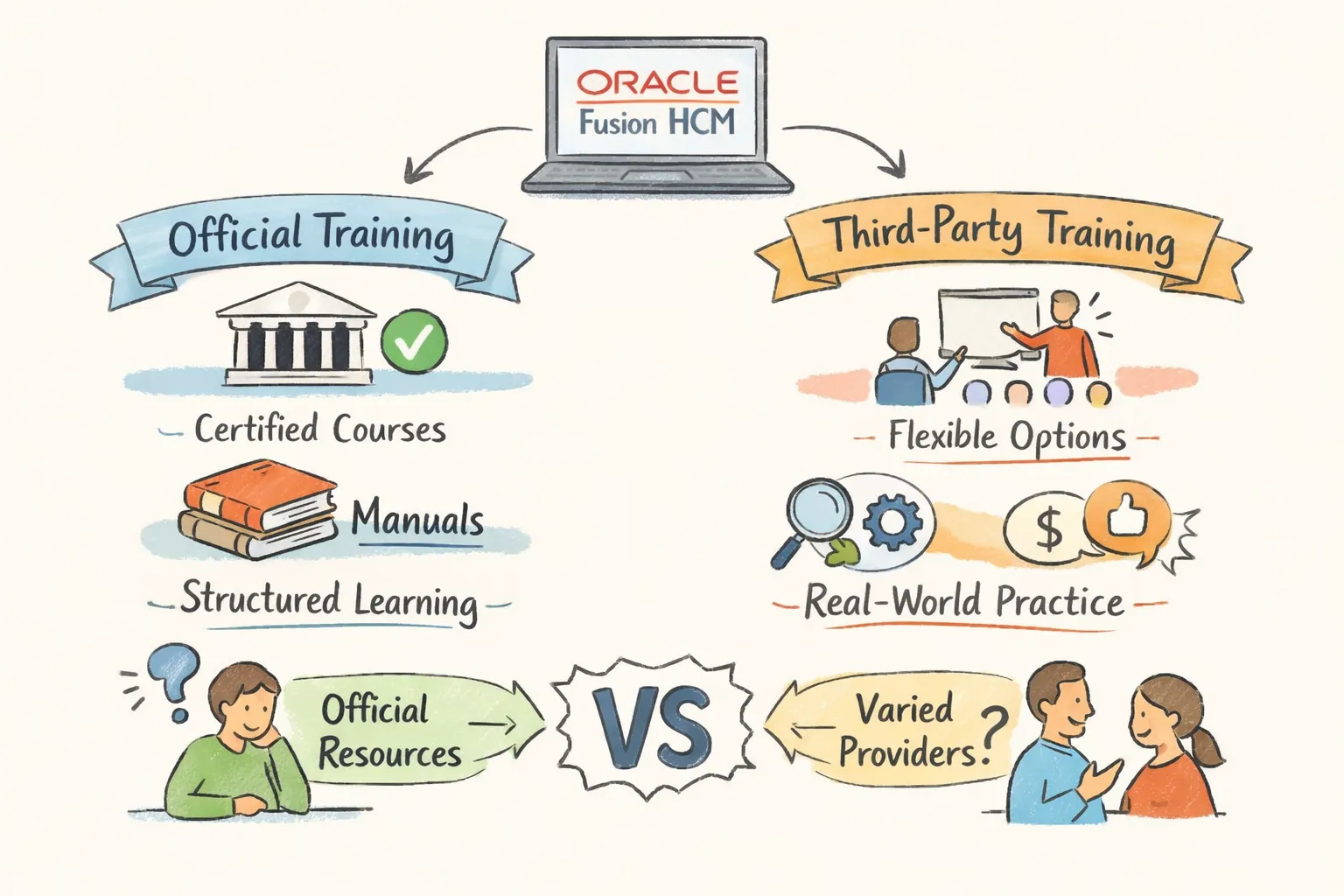
If you need vendor credibility and formal certification, start with Oracle University; if you need fast, hands‑on experience to get hired quickly, pick a high‑quality third‑party bootcamp — the safest route is a blend of both. At CloudShine we use a mixed approach (official prep + intensive lab days) to make learners interview‑ready faster.
Read on to get a straight comparison, realistic cost/time estimates, certification steps, and a 6‑step learning plan you can execute this quarter.
What Oracle University actually provides (who should pick it)
Oracle University organizes learning around role‑based paths: Global HR, Payroll, Talent, Workforce Management and associated implementation/admin tracks. Content comes as digital, self‑paced modules, instructor‑led virtual classes, and occasional classroom offerings. The official ladder includes foundational Process Essentials up to Implementation Specialist certifications and delta releases tied to product versions.
Official credentials deliver vendor-backed credibility, a controlled exam environment, and access to MyLearn resources. Exams test configuration knowledge, process flows and basic troubleshooting; prerequisites commonly expect some hands‑on experience (Oracle recommends roughly six months of practical exposure for advanced tracks).
Pros: recognized by enterprise buyers, clear syllabus aligned to product releases, and formal exam attempts (often bundled in subscription plans). Cons: higher cost and calendar lead‑time, limited open lab time in many offerings, and training that can be heavier on theory than real‑world config.
Actionable takeaway: prioritize Oracle University if you’re targeting enterprise consulting roles, vendor‑validated resumes, or clients that require certified consultants on projects.
What third‑party courses and bootcamps actually deliver
The market splits into self‑paced marketplaces, instructor‑led bootcamps, and corporate upskilling vendors. Typical third‑party deliverables are extended lab hours, project‑based assignments, placement support, and mock interviews. Providers range from Coursera micro‑courses to specialist bootcamps and niche Oracle trainers.
Key difference: access to a real Oracle instance versus simulated sandboxes. Real instances let you perform end‑to‑end payroll runs, data loads and role testing exactly like a client POD; simulated sandboxes limit actions and can leave blind spots in interviews. Trainer experience matters — an instructor with implementation history (10–15+ years) closes gaps manuals won’t. For technical details on sandbox behavior and limitations, see Oracle’s guidance on working with sandboxes (Working With Sandboxes).
Watch for red flags: no live lab access, vague placement claims, cookie‑cutter syllabi reused across cohorts, and unclear refund/retake policies.
Five vendor questions to ask before you pay:
- Do you provide direct access to a live Oracle Fusion instance (POD) or only simulated sandboxes, and how long is access retained?
- How many guaranteed lab hours are included and can I re‑use them after class?
- What are the trainers’ implementation years and recent project references?
- What measurable placement outcomes do you publish (placement % in 90 days) and are there guarantees?
- Is Oracle exam prep included (mock tests, objectives mapping) and how many timed mocks are provided?
How employers view Oracle certs vs course certificates
In hiring, Oracle certifications carry clear vendor recognition and often accelerate short‑listing for implementation and consulting roles. Third‑party certificates demonstrate hands‑on exposure but usually require corroborating evidence — projects, sandbox screenshots, or recorded demos.
On your resume, lead with any Oracle credential, then one line summarizing real‑instance projects: for example, “Oracle Global HR: configured enterprise structure and executed payroll run in Oracle Fusion sandbox (screenshots/demo available).” For smaller firms, demonstrable project work can outweigh formal certs; for large consultancies, vendor certs are a baseline.
Actionable takeaway: aim to pair an Oracle certificate with one or two complete, end‑to‑end projects performed on a live instance before applying broadly. Consider cross‑functional projects to show breadth, such as supplier qualification or supplier portal configuration — see Oracle Fusion Supplier Qualification Management Important Roles and Oracle Fusion Supplier Portal Important Roles for example project ideas.
Practical side‑by‑side: credibility, labs, time‑to‑job and who wins
| Criteria | Oracle University | Third‑Party Bootcamp |
|---|---|---|
| Credibility | High (vendor‑backed) | Medium (depends on brand & trainer) |
| Hands‑on labs | Limited lab windows; paid lab subs available ($29/mo or $299/yr) | Typically more hours and project work; may include managed PODs |
| Time‑to‑job | Longer (cert cadence + exam scheduling) | Faster with intensive placement tracks |
| Placement support | Minimal | Often included (variable quality) |
| Best for | Enterprise roles and consultants | Career switchers, fast hires |
Persona recommendations in practice: The Pivoter (EBS/ERP consultant) — do an intensive third‑party lab track and then sit the Oracle Implementation Specialist exam; blended 3–6 months. The Aspirant (fresh grad) — enroll in a bootcamp with placement support plus Oracle Foundation/Process Essentials prep; expect 4–6 months, ~300–450 hours. The Enterprise buyer — use Oracle University for standardization and a third‑party partner for rapid team upskilling (25–30 day options).
Cost/time estimation method: add course fees + exam fees (or subscription) + paid lab access + opportunity cost (weekly hours × salary). Verify current Oracle lab rates (OCI free trial: $300/30 days; lab subs $29/mo or $299/yr) and provider prices before committing.
Scoring rule: if enterprise credibility matters, weight Oracle certs heavier; for immediate employability, weight lab access and placement support higher.
A repeatable 6‑step job‑ready learning & certification plan
Foundations (40–60 hrs)
Learn HCM concepts, UI navigation and Modern Best Practices. Deliverable: a one‑page cheat‑sheet and a simple configuration task (create a business unit and employee record).
Core functional training (100–150 hrs)
Cover Core HR, Absence, Payroll, Talent and Compensation. Deliverable: configured enterprise structure and a payroll run on a sandbox with documented results.
Role specialization (60–120 hrs)
Choose Implementation, Administration or Integration. Deliverable: a role‑specific mini project — for implementers, an OTBI report or security role matrix; for integrators, a basic file‑based integration (you can also show cross‑module knowledge by referencing an order‑to‑cash cycle project such as Oracle Fusion Sales Order to Shipment Cycle).
Hands‑on projects (40–80 hrs)
Execute end‑to‑end scenarios (hire‑to‑retire, full payroll cycle). Deliverable: a project report with screenshots, error log analysis and a recorded demo.
Exam prep & mock tests (30–60 hrs)
Map topics to Oracle exam objectives, take timed mocks and review weak areas. Deliverable: three timed mocks with target scores (aim ≥75% on final mock).
Interview readiness & placement (ongoing)
Polish resume, system demo, and soft skills. Deliverable: one live mock interview and a ready‑to‑send resume packet with a one‑page project summary.
Accelerated track: CloudShine compresses practical work using a 60:24 model (60 hours instruction + 24 hours lab) and offers a focused 25–30 day corporate upskill option for working teams.
Weekly schedule template: working professionals — 8–10 hours/week for 20–24 weeks; intensive bootcamp — 6–8 hours/day for 4–6 weeks.
Decision checklist, vendor vetting, CloudShine option and FAQs
Seven quick decision checks before you enroll:
- Live Oracle instance access (POD) vs simulated sandbox.
- Guaranteed lab hours and retention policy.
- Trainer experience and implementation references.
- Placement outcomes, timelines and any guarantees.
- Exam prep materials and mock test availability.
- Batch schedule flexibility and refund/retake policy.
- Student reviews and sample project deliverables.
Vendor vetting script — six quick questions to ask sales:
- What exact instance type will I get and how long will snapshots be available?
- Can I reuse lab hours after class ends and are they scheduled or on‑demand?
- Which trainers will teach my batch and what projects did they implement recently?
- What percentage of graduates are placed within 90 days and can you share references?
- Are mock exams mapped to current Oracle exam objectives and how many attempts are included?
- What is your refund policy if I can’t complete the program or fail the mock criteria?
For guidance on purchasing and approval workflows during implementations, review best practices in approval hierarchy setup — Understanding Fusion Purchasing Approvals Hierachy. For a broader checklist on selecting a consultancy partner, see What To Consider When Hiring An Oracle Consultant Firm.
How CloudShine helps (one proven option): CloudShine offers 100% practical labs with access to live Oracle instances, trainers with 15+ years of implementation experience, the 60:24 teaching model, and a placement cell covering resume building and mock interviews. CloudShine runs global cohorts across the USA, India and UAE and provides pay‑in‑installments and placement‑guarantee tiers for qualifying students.
Three next steps you can do now: request Oracle University’s current HCM course list and pricing; ask a prospective vendor for a 24‑hour trial sandbox; book a 15‑minute CloudShine consultation to map a blended plan.
FAQs
Which certification should I start with for Oracle Fusion HCM?
Start with the Fusion Cloud Applications HCM Process Essentials or a Foundations associate path, then move to an Implementation Specialist aligned to your chosen module (Global HR, Payroll, etc.). For a broader view of available Oracle credentials, see the consolidated list of Oracle certifications.
Do third‑party courses count if I don’t have an Oracle cert?
Yes — but pair coursework with tangible deliverables (project report, screenshots, recorded demo). Employers trust demonstrated work; certificates alone rarely close interviews.
How long does it take to become job‑ready?
Typical ranges: 4–6 months with part‑time study (~300–450 hours) or an intensive 4–6 week bootcamp if you can commit full time. Prior ERP experience shortens the timeline.
Is real Oracle instance access necessary?
Practically speaking, yes — real instance work prepares you for configuration quirks, payroll runs and integration tests that simulated sandboxes often hide.
Final takeaway: combine official certification for credibility with focused third‑party practical training for speed‑to‑hire; use the checklist above when choosing a vendor and build one complete project on a live instance before you apply.
Leave a Reply