CloudshinePro

Category: Articles

  • Oracle HCM Certification: Clear Path, Cost & 8‑Week Plan

    Oracle HCM Certification: Clear Path, Cost & 8‑Week Plan

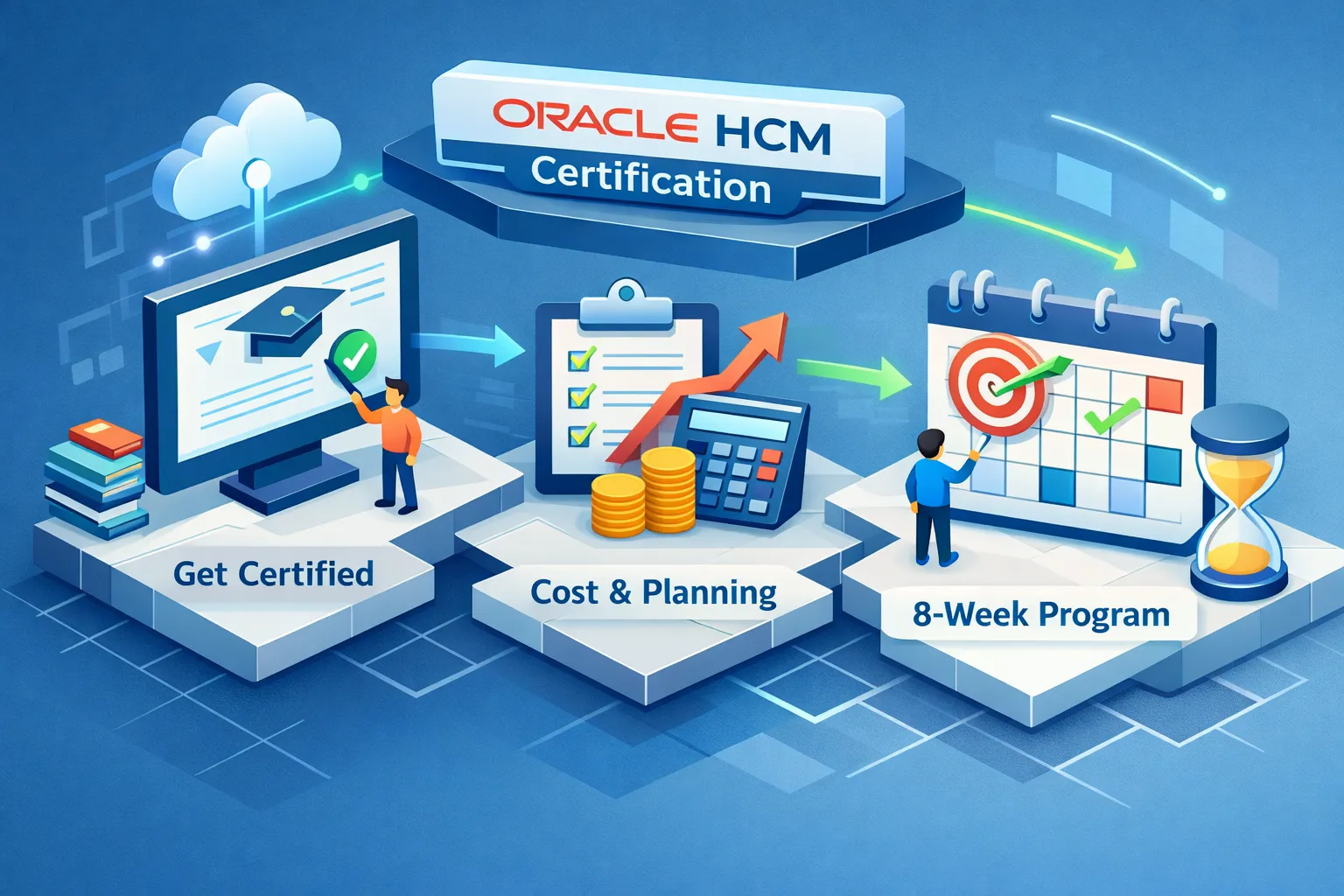
    If you need a fast, reliable route to certification, start with the Global HR (Core HR) implementation path, plan for 6–8 weeks at about 10–12 hours per week, and budget roughly $200–$300 per exam (many sit near $245). Use Oracle University blueprints plus hands‑on labs; at CloudShine we train candidates on live Fusion instances and run a tested 8‑week plan that follows the schedule below.

    This guide is for career pivoters, recent aspirants and enterprise teams. Read on to pick the right exam, register correctly, follow a practical week‑by‑week study plan and choose the training route that actually gets you job‑ready.

    Which Oracle Fusion Cloud HCM certification path fits your goals

    Oracle’s HCM credentials are modular: Global HR (Core HR) is the standard entry point, while Payroll, Compensation, Benefits, Recruiting and Talent are specialist tracks. Pick a path that maps to the role you want to perform day‑to‑day.

    Decide by three factors: job role (implementer vs admin vs specialist), your current experience, and employer needs/support. Examples you’ll see on Oracle University include Global Human Resources Cloud Implementation Professional (example code: 1Z0‑1046‑24) and Compensation or Payroll implementation exams (codes vary). Always verify exact codes and prerequisites on Oracle University before booking.

    Simple decision rule:

    • No prior HCM experience → start with Global HR (Core HR).
    • HR practitioner focused on payroll/compensation → select the corresponding specialist module.
    • Employer sponsoring you → pick the role your employer needs for current projects.

    Quick task: open Oracle University’s certification catalog now and copy the exact exam code and blueprint link for your chosen path. Save that screenshot — it will direct everything that follows.

    Exam format, fees and registration — facts you must know

    Format varies by module and over time. Many HCM exams remain multiple‑choice (MCQ), while recent implementation professional exams combine MCQs with hands‑on, performance‑based tasks in a lab environment. Check the blueprint for format, topic weights and recommended materials.

    Typical expectations: question counts commonly sit between ~60–110 items for MCQ‑heavy exams; some performance sections are timed tasks. Pricing usually falls in the $200–$300 band (many Oracle Cloud HCM exams are ~$245 USD), though region/currency differences apply.

    How to register (short):

    • Open the exam page on Oracle University and read the blueprint and prerequisites.
    • Create or log into your Pearson VUE/Oracle testing account.
    • Choose remote proctored or test‑centre delivery, pay, and schedule the slot.
    • Save confirmation email and the exam code screenshot.

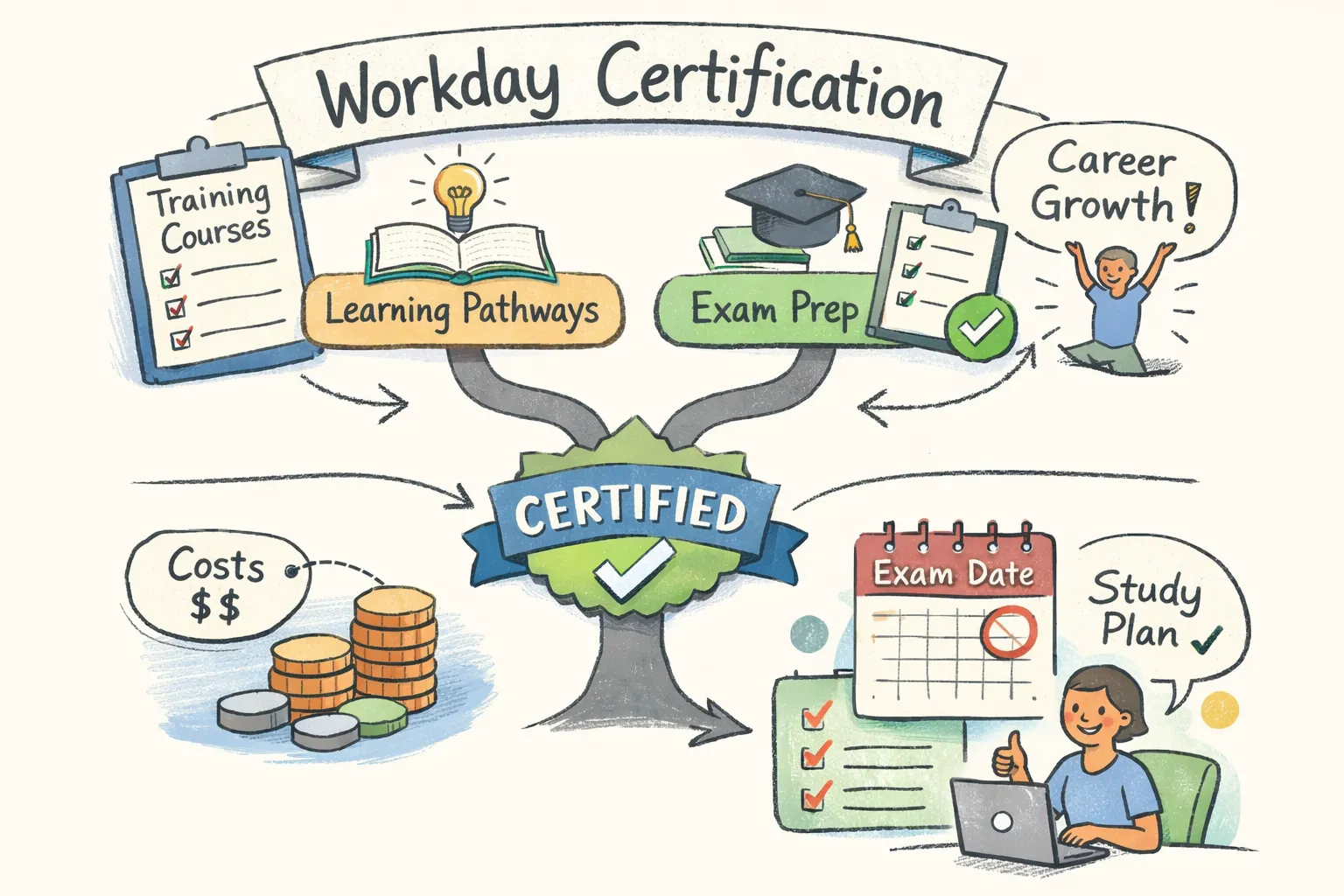
    Money‑saving tips: an annual Oracle Cloud Learning Subscription often includes three exam attempts and broad course access; self‑paced labs can be rented (examples: $29/month or $299/year through OU in some offers). Ask your employer for reimbursement—many corporate upskilling budgets cover these subscriptions.

    Short checklist to capture now: Oracle exam page URL, exam code screenshot, acceptable photo ID, a credit card for payment, and a test day plan (remote or centre).
    The 8‑week study plan you can follow

    Plan for 10–12 hours/week (60–100 total). If you can block more time, compress to 6 weeks; if you work full time, spread across 8 weeks. The goal: concept → hands‑on → mock under time pressure.

    Weeks 1–2: Foundation (10–12 hrs/week)

    Read the blueprint start‑to‑finish. Complete Oracle University “Getting Started” and HCM Process Essentials. Build a one‑page cheat sheet listing core entities (Legal Entity, Business Unit, Person Record). Milestone: hit ~70% on module quizzes.

    Weeks 3–4: Core modules and lab practice (12–15 hrs/week)

    Deep dive Core HR, People Management, Security and Data Structures. In a live instance, configure a sample legal entity, create person records and assign roles. Milestone: complete three real tasks on a live Fusion instance (hire, transfer, terminate sequence).

    Weeks 5–6: Specialist areas & integrations (12–15 hrs/week)

    Study Talent, Absence/Time, Benefits and basic Payroll integration points. Run scenario labs that cross modules (hire → payroll eligibility → benefits enrollment). Take timed module practice tests and focus remediation on weak topics. Milestone: 85%+ on module practice tests.

    Weeks 7–8: Mock exams & polish (10 hrs/week)

    Run two full timed mocks (one MCQ, one hands‑on where applicable). Re‑run weak labs and review the latest release notes for any quarterly changes. Milestone: consistent 90%+ on two full mocks; schedule the exam.

    Resources each week: Oracle University lessons & lab subscriptions, curated Udemy practice sets (use only high‑rated ones), and CloudShine lab exercises + mock interviews if you need placement support. If you already have strong HCM experience, compress Weeks 1–4 into three weeks and use the remaining weeks for exam polish.

    Best training routes — and why CloudShine matters

    Options in plain terms: Oracle University (canonical content, paid labs), self‑study + paid practice tests (cheapest but variable quality), and instructor‑led bootcamps/mentorship programs (faster, costlier). The differentiators are live‑instance access, mentor quality and post‑training placement help.

    Route Speed Hands‑on access Placement help
    Oracle University Moderate Paid labs Limited
    Self‑study + Udemy Slow–Moderate Depends (often none) None
    CloudShine instructor‑led Fast Live Fusion instances (continuous) Resume & mock interviews; placement cell

    CloudShine facts: we provide live Oracle Fusion instances, follow a 60:24 instructor‑to‑lab hour model, and our mentors have 15+ years of implementation experience. We also operate a placement cell offering resume building and mock interviews. If you lack instance access or interview coaching, choose an instructor‑led program with live labs — that investment shortens time to job‑readiness.

    Exam tactics, hands‑on tips and the exam‑day checklist

    Study the blueprint, practice labs, and learn to trace end‑to‑end processes (hire → payroll eligibility → benefits). Focus on scenarios: what business outcome changes when you modify X configuration?

    During the exam, quick scan all questions first, answer the easy MCQs, then methodically complete hands‑on tasks while saving time for review.

    Common pitfalls: ignoring quarterly release notes, using outdated sandbox versions, and rote memorization without understanding business impact.

    • Exam‑day technical checklist: stable internet, updated browser, government ID, test software installed and verified, quiet room, snacks, and a mock‑exam timer synced to the test duration.

    Last‑minute one‑page review: key tables/entities, navigation shortcuts, common configuration screens and six practice actions (create legal entity; hire person; configure job; assign role; run payroll eligibility; build OTBI report). Mini exercise: perform a timed configuration (30–45 minutes) a week before the exam and record the steps—you’ll be faster and less error‑prone on test day.

    After you pass: getting hired, next steps and FAQs

    Immediately add your certification badge to LinkedIn and include 3–4 bullets showing hands‑on tasks you completed (for example: configured legal entities, completed hire‑to‑retire flows, built an OTBI report). If you trained with CloudShine, engage the placement cell for mock interviews and system demo practice.

    Career roadmap: specialize in Payroll, Compensation or Integrations; add OTBI/Reporting, basic Cloud Integration skills or functional testing to stand out. Maintain skills by subscribing to Oracle release notes and re‑running two key labs each quarter.

    FAQs

    How much does an HCM Cloud exam usually cost? Most HCM Cloud exams are in the ~$200–$300 range (commonly ~$245 USD); check Oracle University guidance on certification costs or Pearson VUE for exact regional pricing.

    Which exam should I take first if I’m new to HCM? Start with Global HR / Core HR—it covers the foundational entities and processes that other modules build on.

    Can I pass without hands‑on access? You might pass theory questions, but hands‑on tasks and interview readiness require live lab practice—strongly recommended.

    When should I book the exam and what’s the retake policy? Book once you consistently score 90%+ on full mocks. Retake policies vary; Oracle generally allows retakes but check the specific exam page for rules and waiting periods.

    Does CloudShine provide lab access and placement assistance? Yes—CloudShine offers continuous live Fusion instances, mentor hours, and a placement cell with resume help and mock interviews; confirm batch schedules and pricing with admissions.

    Final 3‑step checklist: verify the current exam blueprint on Oracle University, build your 8‑week calendar with blocked lab slots, and only book your exam after hitting the mock exam milestones outlined above.

    Direct next step: check the Oracle University exam page for the exact code and blueprint for your chosen path, then either enroll in a CloudShine live‑lab batch or schedule your lab subscription and start Week 1 tasks. Have questions or want a sample week‑by‑week calendar? Comment below or visit the CloudShine training page to see upcoming batches and lab options.

    Short checklist to capture now: Oracle exam page URL, exam code screenshot, acceptable photo ID, a credit card for payment, and a test day plan (remote or centre).
  • Workday Training Certification: Paths, Costs & Exam Plan

    Workday Training Certification: Paths, Costs & Exam Plan

    If you’re an HR, finance, or integrations professional, a Workday training certification can accelerate hiring and salary momentum — but official Workday courses are often restricted and expensive. This guide maps the common certification tracks, gives realistic costs and timelines, and lays out a practical 4–8 week exam plan, including how CloudShine’s hands‑on bootcamps help unaffiliated learners get job‑ready.

    What you’ll get: a quick decision map, training tradeoffs (official vs third‑party), three sample budgets, a concrete study timeline, registration steps, and interview‑ready next actions.

    Quick verdict: Is a Workday certification the right next step for you?

    Short answer: Yes if you need employer recognition or deep product skills; choose third‑party bootcamps if you’re unaffiliated and need hands‑on practice quickly. Official badges matter to employers; practical tenant experience gets you interviews.

    Pivoter (experienced IT/ERP or finance pros)

    If you’re moving from legacy ERP to cloud ERP, certification plus real tenant hours shortens the hiring curve. You should target a functional cert aligned to your background (Financials for finance, Integrations for middleware engineers).

    Aspirant (recent grads or career starters)

    If you need job‑ready artifacts and interview practice, prioritize hands‑on bootcamps and a portfolio project over chasing official partner-only badges you can’t access.

    Enterprise (internal upskilling)

    If your employer will sponsor training and exams, the official Workday Academy route is often the fastest path to internal roles and promoted pay bands.

    Quick checklist to decide now:

    • Employer‑sponsored? Go official.
    • Need tenant/Lab access and placement help? Choose a reputable bootcamp (CloudShine included).
    • Only need basic end‑user skills? Start with self‑paced content.

    Actionable takeaway: If your company will pay, ask HR/Training to enroll you. If not, skip waiting — read section 3 to evaluate bootcamps that include live instance practice and placement help.

    Which Workday certification fits your role?

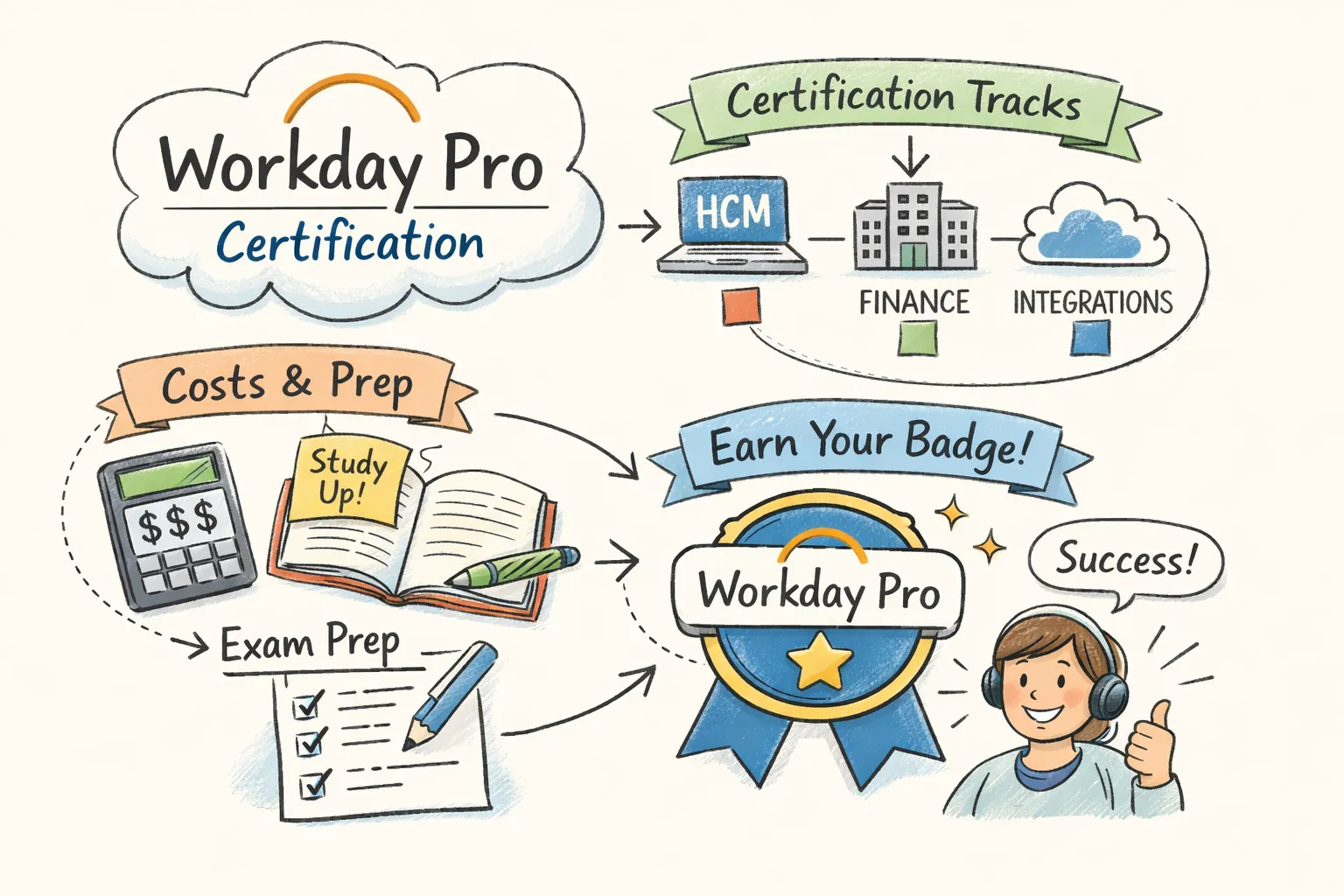
    Direct answer: Pick the certification by the job you want, not by what sounds trendy — HCM for HR, Financials for finance, Integrations for technical roles, Platform Admin for system admins, and Workday Pro for broad operational mastery.

    Workday Pro: Broad operational mastery aimed at customers and service teams; good for administrators who manage security, tenant updates and business processes.

    HCM (Core/Payroll/Recruiting): Covers hire‑to‑retire configuration, payroll, recruiting workflows — ideal for HR practitioners and implementers.

    Financials: Focuses on GL, AR/AP, reporting and period close — choose this if you’re a finance or accounting professional moving into ERP roles.

    Integrations: Workday Studio, connectors and APIs for middleware and technical consultants who build system-to-system flows.

    Platform Admin: Tenant management, configuration testing and release control — aimed at system administrators keeping the instance healthy.

    Prism/Adaptive: Treat analytics and planning (Prism, Adaptive Planning) as complementary skills; they increase hireability but often aren’t the primary cert employers ask for.

    Time & exam expectations (ballpark): HCM / Financials — 4–8 weeks of study with course/lab time; Integrations — 6–10 weeks; Platform Admin — 2–6 weeks depending on prior platform exposure. Exams are typically proctored and require hands‑on familiarity more than pure theory.

    Actionable takeaway: Choose one primary cert and one complementary skill (for example HCM + Integrations). Write a 3‑month goal with weekly milestones: training, 20–40 tenant hours, two mock exams, portfolio artifacts.

    For a quick overview of popular certification tracks, see this list of top Workday certification courses.

    Training routes: Official Workday Academy vs self‑study vs bootcamps — and where CloudShine helps

    Direct answer: Official Workday training is authoritative but often restricted and costly; self‑study is economical for end users; third‑party bootcamps give unaffiliated learners practical tenant access and interview readiness.

    The official Workday Academy provides the definitive curriculum and is required for some partner roles. It’s recognized by employers but access is usually limited to Workday employees, partners or paying customers and units are expensive (see next section). For enrollment details, refer to the Workday enrollment job aid.

    Self‑paced options (Workday Learning, Coursera integrations) are low cost and useful to learn concepts. They rarely include a live tenant or mentor guidance, so they’re fine for end users but insufficient for consultant‑level interviews.

    Third‑party bootcamps combine live labs, scenario projects and mentor coaching. They’re unofficial but highly practical: students finish with configuration hours, problem logs and interview artifacts employers value.

    At CloudShine we replicate implementation realities: live cloud instance access, scenario‑based projects that mirror hire‑to‑retire and procure‑to‑pay cycles (see related posts on Oracle Fusion Self Service Procurement Important Roles | CloudShine and Oracle Fusion Inventory Management Important Roles | CloudShine), expert mentors with 15+ years of experience, and a placement cell that provides resume reviews and mock interviews. Our 100% practical model (60 instructor hours + 24+ lab hours) is designed to bridge the “no‑employer” gap.

    If your employer pays, go official. If you need hands‑on practice and hiring support, pick a bootcamp with live tenant access. If your goal is basic user knowledge, start self‑paced content and add labs later.

    Actionable takeaway: Decide your delivery method this week and book your first slot — an official course, a CloudShine bootcamp intake, or a start date for self‑study.

    Costs, time and budgeting — realistic numbers you can rely on

    Direct answer: Expect an $800 exam fee plus official training units at roughly $800 per unit; total investment usually falls between $1,500 and $3,500 depending on route and experience.

    Official route: Workday commonly charges about $800 per exam attempt. Instructor‑led courses are often priced by training units at ~$800/unit; typical courses run 1–5 units, so a multi‑day course can be $800–$3,200 on top of the exam fee.

    Third‑party bootcamps: Prices vary widely, from roughly $300 on the low end up to $2,000 for full bootcamps that include labs and placement support. Expect to pay more for guaranteed placement or extended mentorship.

    Extras to factor: retake fees (another $800), paid practice exams, travel for proctored tests (if required), and the opportunity cost of study hours.

    Sample budgets:

    Employer‑sponsored: Employer pays training units and exam; your out‑of‑pocket is typically zero—just schedule time (2–8 weeks).

    Independent bootcamp: Bootcamp $700–$1,500 + exam $800 = $1,500–$2,300 outlay; plan for 6–8 weeks of part‑time study.

    Career pivoter (official + prep): Official course(s) $1,600–$3,200 + exam(s) $800 + mock/interview prep $200–$500 → $2,600–$3,500 total and 8–12 weeks to build a hireable portfolio.

    Actionable takeaway: Pick the sample scenario closest to you and write one line: “Total $ / Weeks to commit / Who pays.” Add an $800 buffer for a possible retake.

    Exam format, passing score, retake policy and a practical 4–8 week study plan

    Direct answer: Most Workday exams are proctored, closed‑book, roughly 50 questions in 120 minutes with a passing threshold commonly around 80%; the effective study mix is course content + tenant practice + timed mocks.

    Exam structure: Expect multiple‑choice and multi‑select scenario questions. Results are typically pass/fail; confirm exact rules for your target exam. Retake rules and wait periods can vary — a short waiting window (several days) is common.

    Study components to prioritize: official course materials, 20–40 hours in a live tenant practicing configuration and business processes, two to three timed mock exams, and focused flashcards for multi‑select logic.

    Practical plan templates:

    • 4‑week fast track (experienced): 6–10 hours/week. Week 1: review fundamentals + 8 tenant hours. Weeks 2–3: deep config labs. Week 4: two timed mocks and weak‑spot remediation.
    • 6‑week standard (novice): 8–12 hours/week. Weeks 1–2 fundamentals and concepts; Weeks 3–4 practical builds and test cases; Week 5 one full mock + fixes; Week 6 final revision + exam.
    • 8+ week deep dive (career pivot): 6–8 hours/week spread over structured projects, integration scripts, reporting exercises and a portfolio deliverable for interviews.

    Exam‑day checklist:

    • Stable internet, quiet room and government ID ready.
    • Device with required browser and proctor software installed; run a 10–15 minute pre‑check.
    • Have notes/flashcards reviewed and two timed mocks completed in the 48 hours before the exam.

    Actionable takeaway: Choose your timeline (4/6/8 weeks), book the exam slot at the end of your calendar, and schedule two mock exams into your plan.

    How to register, take the exam, recertify and convert the cert into a job (plus FAQs)

    Direct answer: Official exams generally require employer or partner enrollment through Workday channels; unaffiliated candidates should use third‑party programs (CloudShine and similar bootcamps) to gain tenant hours and placement support.

    Registration & logistics: If you work for a Workday customer or partner, request enrollment via your learning admin or Workday Education contact. Independent learners should evaluate bootcamps that bundle live tenant access and mock interviews, or contact authorized partners for occasional public seats (see this practical guide on how to get Workday certification for more on pathways).

    Recertification and currency: Workday updates frequently; plan on periodic recertification or continuing education (Workday moved to more structured recert cycles recently — verify the latest schedule for your target cert). For recent changes and what they mean for learners, review this overview of Workday certification and training changes. Keep a log of tenant hours and training activities to demonstrate currency to employers.

    Turning certification into interviews: Put measurable artifacts on your resume — cert name, tenant hours, and concise project bullets (e.g., “Configured hire‑to‑retire business process in a 5,000‑employee mock tenant”). Build three mini‑stories for interviews: a design tradeoff (e.g., approvals and business process design — see Understanding Fusion Purchasing Approvals Hierachy | CloudShine), a bug triage, and an integration troubleshooting case. Export anonymized screenshots, process maps and test scripts as portfolio appendices (example process flows: Oracle Fusion Sales Order to Shipment Cycle | CloudShine).

    CloudShine placement support: Our bootcamps pair live instance practice with resume workshops and mock interviews. We help candidates convert lab work into interview‑ready portfolio items and offer tiered placement‑guarantee tracks for qualified learners.

    FAQs

    Q: Can I get Workday certified without a partner or customer employer?
    A: Official badges are generally restricted; use reputable third‑party bootcamps with live labs to gain practical experience and interview readiness.

    Q: How much does certification cost?
    A: Expect roughly $800 per exam attempt plus training costs. Official instructor‑led courses are often ~$800 per training unit; total outlay typically ranges $1.5k–$3.5k depending on route.

    Q: What’s the exam format and passing score?
    A: Most Workday exams are proctored, ~50 questions in 120 minutes, with a pass threshold commonly near 80%; confirm specifics for your chosen track.

    Q: How long should I study?
    A: Experienced users can prepare in 4 weeks; novices should plan 6–8 weeks with focused tenant practice and mock exams.

    Q: Will certification get me a job?
    A: Certification helps, but hiring decisions hinge on demonstrable tenant hours, project artifacts, and interview performance. Certifications plus a portfolio and mock‑interview practice are the fastest path to offers.


    Summary: If an employer covers it, take the official path; if you’re independent, pick a practical bootcamp with live tenant access and placement support. Commit to one primary cert + one complementary skill (for example SCM — see An Intro to SCM Modules In Oracle Cloud Applications | CloudShine), budget for training + an $800 exam buffer, and follow a 4–8 week, lab‑first study plan.

    Ready to get hands‑on? If you’re unaffiliated and want live tenant practice plus resume and interview coaching, CloudShine’s Workday bootcamps are built to convert lab hours into hireable experience—apply for the next intake or request an orientation call to map your 8‑week plan.

  • Workday Pro Certification: Tracks, Costs, Prep & Badges

    Workday Pro Certification: Tracks, Costs, Prep & Badges

    workday pro certification is a practical, employer-focused credential that proves hands-on product skills in reporting, platform administration, integrations and analytics. If you work with Workday or plan to support implementations, choose the track that mirrors the tasks you perform every day.

    If you want live-instance practice and placement support, CloudShine runs targeted Workday bootcamps featuring real tenants, mentor feedback, mock interviews and an active placement cell. This article shows how to pick a track, the exact registration steps, realistic cost and time estimates, a 6–8 week study plan, and how to claim and share your Credly badge.

    Quick verdict and a fast way to pick your track

    Short answer: Workday Pro is best for practitioners who configure, maintain, or report from Workday—not for casual users. Start with the track that maps to your day‑to‑day work and broaden later.

    Decision shortcut: HR analysts → HCM Reporting; Finance pros → Financials Reporting; Integrations engineers → Integrations; System administrators → Platform Administrator; BI/data teams → Prism Analytics or Adaptive Planning.

    Fast filter: if you’re a Workday employee, partner or a customer admin, most tracks are available through your Learning Center. If you’re external, Platform Administrator has public options (and third‑party bundles exist for non-affiliated learners).

    CloudShine nudge: if you’re unsure which track fits, run a short lab session on a live tenant to confirm. Actionable takeaway: pick the track that matches your current weekly tasks — not the one that sounds most prestigious.

    What each Workday Pro track actually tests

    Direct answer: exams focus on applied configuration and operational tasks rather than abstract theory; questions map to routine tasks you’d perform in a production tenant.

    HCM Reporting — building, securing and troubleshooting operational HR reports, calculated fields and dashboards used by HR teams.

    Financials Reporting — using the financial report writer, creating ledger and reconciliation reports, and validating accounting outputs.

    Platform Administrator — tenant housekeeping: security configuration, business process design, simple EIBs and everyday administration tasks.

    Prism Analytics — data modeling, dataset creation, calculated fields and workbook/report sharing for analytics teams.

    Adaptive Planning — building models, setting up planning cycles, dimensions and data loads for FP&A workflows.

    Grants Management — lifecycle configuration for grants, related ledgers and compliance reporting.

    Integrations — Enterprise Interface Builder (EIB) basics, connectors, troubleshooting logs and integration maintenance.

    Common exam facts: most Workday Pro exams are about 50 multiple‑choice questions, proctored, with an 80% passing threshold (roughly 40/50). Timeline and delivery can vary by track and affiliation.

    Eligibility nuance: many tracks require Workday customer/partner/employee affiliation; Platform Administrator and select public programs are the primary external entry points. Actionable takeaway: list three tasks you do this week and map them to the competencies above — that identifies the best track quickly.

    If you’re evaluating other cloud ERP ecosystems as part of your career planning, see our primer on What is Oracle Fusion Cloud and Why Does It Matter for a comparison of platform design and typical roles.

    Eligibility, exact registration steps and typical timelines

    Direct answer: registration is handled inside the Workday Learning Center and usually requires Training Coordinator or manager approval; external routes exist but are limited. For a concise overview of certification offerings, check the Workday certifications page.

    1. Locate your desired Workday Pro track in the Workday Learning Center and click “Request.”
    2. Ask your Training Coordinator/manager to approve the request (their approval triggers the course activation email).
    3. Accept the Terms of Service from the Workday email and activate the coursework on your transcript.
    4. Complete the required courses within the activation window (commonly four months from activation).
    5. Schedule and take the proctored exam once coursework shows as complete.

    Typical timelines: core coursework often takes 1–4 weeks for focused study; the Platform Administrator self‑paced route commonly uses a 30‑day access window. Overall you normally have four months to finish a track after activation. Retakes require a training services case and administrative processing — expect wait windows and extra fees.

    Actionable takeaway: copy the five-step checklist above into an email and request Training Coordinator approval with a proposed start date this week. If you’re new to the certification process, guides such as Indeed’s guide to Workday HCM certification can clarify common eligibility questions and practical next steps for external candidates.

    True cost breakdown and how to budget

    Direct answer: costs are meaningful but typically employer-covered. If you’re self-funding, budget for the exam plus course units or third‑party bundles.

    Item Typical cost (approx.) Notes
    Workday Pro exam attempt ~$800 Per attempt; verify current price with Workday
    Training unit ~$800 / unit Courses range 1–5 units; instructor‑led pricing varies
    Retake fee ~$650 or 1 training unit (varies) Some tracks treat retake as a training credit
    Third‑party public bundle (Platform Admin example) ~$1,600 Includes course + exam access for external learners (ASU Platform Administrator program is an example)
    Full multi‑unit training + exam (estimate) $2,500 – $4,000 Depends on units and provider

    Example scenarios: employer‑sponsored candidates often pay $0 out‑of‑pocket; self‑funding Platform Admin via public bundles runs ≈$1,600; a full multi‑unit track with instructor‑led courses plus exam can reach $2.5k–$4k.

    Money‑saving tips: check whether your org has a Workday Success Plan (may waive fees), request training units from HR, use partner discounts, or combine training slots when hiring a few staff at once.

    Actionable takeaway: ask HR these three questions today — “Do we have Workday Success Plan coverage?”, “Can training units be used for certification?”, and “Who is my Training Coordinator who approves requests?”

    A practical 6–8 week study plan and exam‑day tactics

    Direct answer: you can clear the exam with disciplined hands‑on practice, focused labs, and two timed mock exams. Prioritize doing the tasks in a tenant over rote memorization.

    Weekly blueprint (6–8 weeks, 6–10 hrs/week)

    Week 1

    Register, confirm required courses, set calendar study blocks and read the track objectives and exam blueprint.

    Weeks 2–3

    Complete core Workday courses and follow each module with direct practice in a live lab: reporting candidates should build three operational reports; integrations candidates should create at least one EIB and review logs; platform admins should configure a security group and a business process.

    Week 4

    Remediate weak areas: document step‑by‑step screenshots from labs for review, and re-run the most important scenarios until you’re fast and confident.

    Week 5

    Take two timed practice exams under exam conditions. Carefully review every missed question and redo the corresponding lab or course material.

    Week 6 (and optional Weeks 7–8)

    Final pass of labs, one last timed mock, and light review. Schedule the proctored exam on the day you’ll be most alert.

    Exam‑day tactics

    Confirm proctor requirements, use a wired connection if possible, have government ID ready, and allocate about 1.5–2 minutes per question. Read scenario stems fully, eliminate obvious wrong answers, and flag uncertain items to review if time permits.

    1. Confirm proctoring software, camera and mic work.
    2. Clear, quiet workspace and stable internet connection.
    3. ID ready and browser windows closed; disable notifications.
    4. Time plan: don’t spend more than 2 minutes on a question initially.
    5. Stay calm; use lab screenshots and notes from your practice (where permitted during study) to guide review before the exam.

    If you fail, open a training services case through your Training Coordinator, schedule the retake, and focus remediation on the lab tasks tied to your missed objectives. If you want focused coaching, CloudShine offers mentor‑led lab sessions and mock interviews to shorten remediation time.

    For candidates working with supply chain or inventory teams, supplement Workday practice with domain primers such as An Intro to SCM Modules In Oracle Cloud Applications, CloudShine to better understand cross‑platform processes and terminology.

    Claiming and using your Credly badge — share, verify and next steps

    Direct answer: after you pass you’ll receive an invitation email to claim your Workday Pro badge on Credly; accept it, make it public, and share the verification link on LinkedIn and your résumé.

    Claiming steps: open the Workday email; sign into or create a Credly account; accept the badge; set visibility to public; then use Credly’s share buttons or copy the public URL.

    What employers see: badge metadata includes the issuing organization, criteria, issue date and any expiry or recertification requirement. Add the public badge URL to your résumé line: “Workday Pro — Platform Administrator (Workday); Credly verification: [URL] — Month Year.” Sample LinkedIn post: “Proud to earn the Workday Pro — Platform Administrator badge. Verification: [Credly URL].”

    For best practice on verified skills and sharing, review Credly’s guide to implementing verified skills for tips on visibility, metadata and employer verification workflows.

    Next steps: list relevant role titles (Workday Administrator, Integration Analyst, Reporting Specialist), pursue adjacent tracks (Integrations, Prism, Adaptive) and use your credential to qualify for implementation project roles or internal promotion discussions. If you’re comparing role responsibilities on other platforms, these CloudShine articles can help:

    CloudShine note: if you prefer guided, practical prep, CloudShine’s Workday bootcamps use live tenants, provide mentor feedback, conduct mock interviews and support placement — contact us to arrange a short consultation or request our Workday Pro exam checklist.

    FAQs

    What score do I need to pass a Workday Pro exam? — You typically need 80% (about 40 out of 50 questions); confirm the specific track page for exceptions.

    Who is eligible for Workday Pro certification? — Primarily Workday employees, partners or customers; a few tracks (like Platform Administrator) have public options.

    How much does the exam cost? — Commonly around $800 per attempt; training courses are priced per training unit (≈$800/unit). Verify current pricing with Workday or your Training Coordinator.

    How do I claim and share my Credly badge? — Accept the Workday email invite, sign into Credly, claim the badge, set visibility to public, then share the verification URL on LinkedIn and your résumé.

    What if I fail the exam? — File a training services case via your Training Coordinator, schedule a retake, and focus remediation on the lab tasks tied to the questions you missed.


    Two key takeaways: choose the track that mirrors what you actually do at work, and build a study plan centered on hands‑on tenant practice rather than memorization. When you’re ready for structured lab time, mentor feedback and placement support, CloudShine’s live‑instance bootcamps are designed to shorten your prep and get you interview‑ready.

  • Workday Classes: Official vs Third‑Party Training Guide

    Workday Classes: Official vs Third‑Party Training Guide

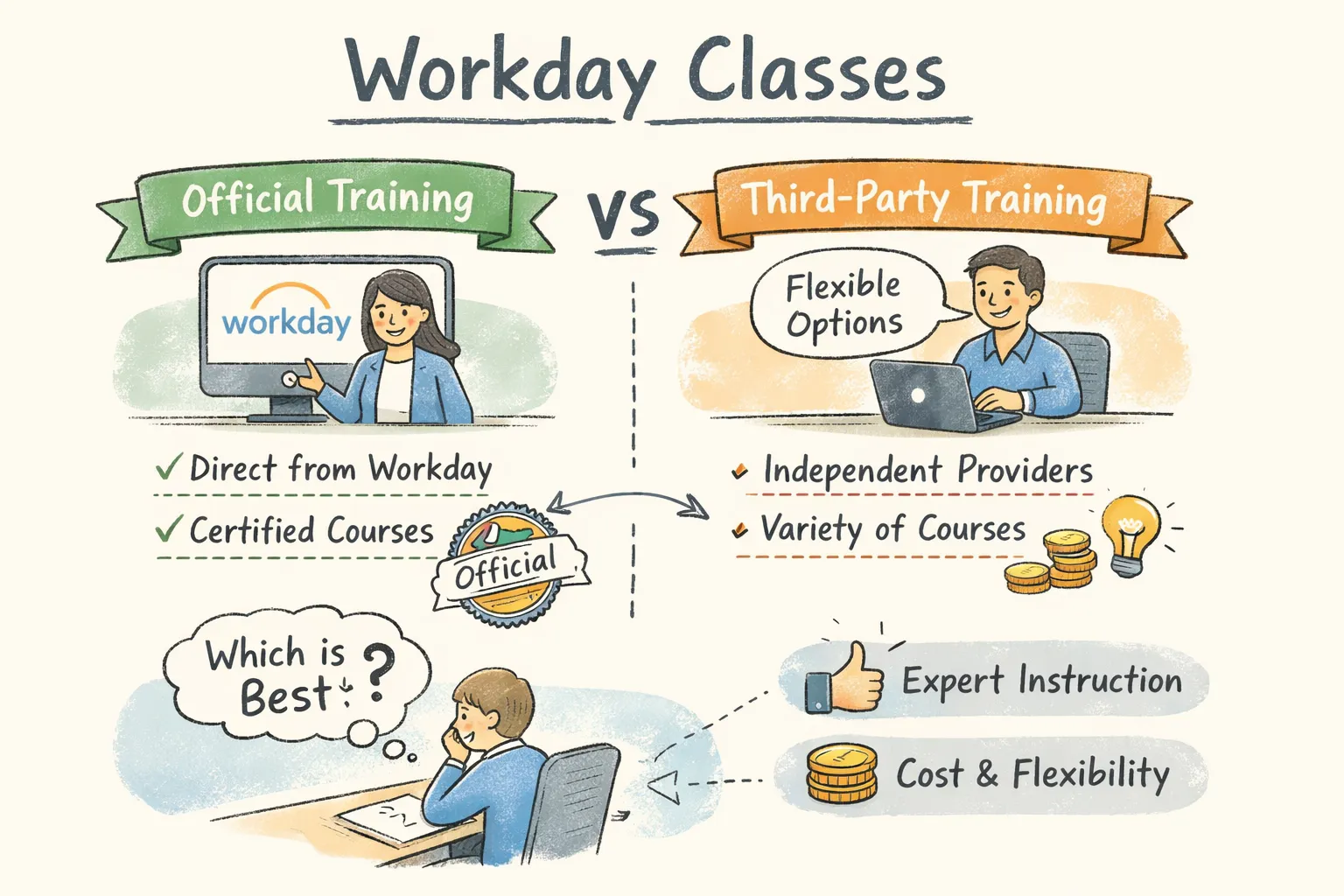
    Direct answer: Workday classes split into two practical routes: the official Workday Academy and Pro certifications (best when your employer or partner sponsors study and you need vendor recognition) or third‑party bootcamps and self‑study (best when you need affordability, hands‑on labs, and placement support). If you want live tenants plus interview practice, CloudShine runs short, practical Workday bootcamps with live instances, mock interviews and placement assistance.

    Official Workday training: what it is, who it’s for, and the tradeoffs

    Quick takeaway: Official training and Workday Pro carry the strongest enterprise credibility but are often gated to customers/partners and typically paid for by employers.

    What the official path covers

    Workday’s official paths center on Workday Pro certifications and module‑focused courses: HCM Core, Advanced Compensation, Payroll (including country‑specific payrolls), Financial Management, Integrations, Platform Administrator, Adaptive Planning, and specialist tracks. Some Pro paths allow exam‑only routes for experienced implementers; many specialty tracks require coursework via Workday Academy.

    Delivery modes and access limits

    Delivery ranges from ten‑hour on‑demand modules (Learn with Workday) to instructor‑led Academy cohorts and enterprise adoption kits. Crucially, many official classrooms and sandboxes are available only to Workday customers, partners, or employees—confirm access before you plan time or money.

    Recertification and rules

    Workday moved to a two‑year recertification cycle (update, 2024). Exam formats are proctored, scenario‑based, and commonly require an 80% passing score. Specific prerequisites and retake policies vary by module.

    Pros and cons (realistic): Official training is widely recognized and often required for enterprise roles; downside is higher cost, restricted access for independents, and limited placement focus.

    Actionable takeaway: If your employer will sponsor certification, follow the official path for credibility. If you’re independent or changing careers, pair third‑party hands‑on training with exam prep instead of relying solely on vendor courses.

    Third‑party Workday courses: providers, price bands, and what to verify

    Quick takeaway: Third‑party providers fill real gaps: lower entry price, flexible schedules, and (when done right) stronger lab access and placement support for job seekers.

    Price and depth vary sharply. Budget primers on marketplaces (example: Udemy-like courses) run under $20 and teach concepts. Midrange instructors and academies charge roughly $200–$600 for module‑level, instructor‑led training with some labs. Premium bootcamps and exam‑prep packages reach $1,000–$2,500 or more.

    CloudShine positions itself in the practical bootcamp tier: cohort training that emphasizes live tenant access, trainer mentorship (15+ years industry experience), project work, resume coaching, mock rounds and placement assistance—designed for candidates who need end‑to‑end job readiness.

    What to verify before you pay

    • Live instance or sandbox access (shared or dedicated) and exact hours available.
    • Number and nature of real projects or lab tasks included.
    • Trainer background—15+ years is a strong signal for enterprise‑grade instruction.
    • Placement support details and realistic timelines for interview help.
    • Recordings, refund policy, and a sample syllabus or a sample lab exercise on request.

    Actionable takeaway: Shortlist one official option (if eligible) and one third‑party provider with verified lab access. Request a sample lab exercise before you commit. For a recent course-level comparison to help shortlist providers, see a Workday certification courses comparison.

    Syllabus, duration, and lab expectations by common module

    Quick takeaway: Typical module coverage runs 27–40 hours (4–8 weeks); the deciding factor for employability is whether you get guided, live labs and real configuration tasks.

    What you’ll actually learn by module:
    – HCM: employee lifecycle, staffing models, compensation basics, business processes, security and reporting.
    – Financials: GL/AP flows, budgets, procurement integration and reporting.
    – Payroll: pay groups, taxes, deductions, retro calculations and compliance processes.
    – Platform/Admin: security configuration, business process troubleshooting and basic integrations (EIB/Core Connectors).

    Lab expectations matter more than lecture hours. Before enrolling, confirm whether the provider supplies a Workday sandbox or guided simulation, the number of hands‑on lab hours, and sample lab tasks (for example: build a compensation plan, configure a supervisory org, or create an EIB integration).

    Prerequisites: Domain familiarity helps—HR for HCM, accounting for Financials, basic scripting for integrations—but most providers accept beginners while recommending 20–40 hours of prep.

    Actionable takeaway: Demand a real lab task and access window in writing before you pay. A syllabus alone is not sufficient evidence of hands‑on training.

    If you have experience with Oracle Fusion or similar ERP systems and want relevant reading, these CloudShine guides can help bridge domain knowledge: Oracle Fusion Sales Order to Shipment Cycle | Order to Cash Life Cycle | CloudShine, Oracle Fusion Financial Control & Reporting Important Roles | Oracle Financials Cloud | CloudShine, and Understanding Fusion Purchasing Approvals Hierachy | Know about Oracle Fusion Approval Methods | CloudShine.

    A practical decision framework — pick by role, experience and budget

    Quick takeaway: Ask three questions: Are you employer‑sponsored? Are you switching careers? What is your budget and timeline? Use answers to choose a targeted path, not every module.

    Persona paths:
    – Enterprise Employee: employer covers cost → Official Academy + Workday Pro cert.
    – The Pivoter (ERP/Finance pro): 2‑month bootcamp on HCM/Finance + Platform Admin; attempt Pro exam if experience supports it.
    – The Aspirant (new grad): start with a low‑cost intro, then a hands‑on third‑party HCM bootcamp; build two projects for interviews.

    Role→Module mapping (quick scan):

    • HR generalist → HCM Core + Advanced Compensation
    • Payroll specialist → Payroll + country payroll module
    • Finance systems analyst → Financial Management + Integrations basics
    • Platform/admin → Platform Administrator + Security

    Timeline examples: Single module interview readiness: 6–8 weeks with daily practice. Broader generalist readiness: 12–16 weeks including projects and mock interviews.

    Actionable takeaway: Choose the shortest path that demonstrates hands‑on competency for your target role—two well‑built projects beat ten half‑finished modules.

    Cost, time commitment and exact enrollment checklist

    Quick takeaway: Budget realistically: official routes often cost $1.5k–$5k (commonly employer‑funded); third‑party ranges from <$20 to $2.5k+. Plan for 27–40 hours per module plus project time.

    Cost bands:
    – Official Academy/certification: typically $2,000+ (many employers cover this); exam packages often reported in the $1,500–$3,500 range.
    – Third‑party: free/cheap intros on marketplaces, midrange bootcamps $200–$600, premium $1,000–$2,500+.

    Exact enrollment checklist (do these before you pay):

    • Pick your target role and module.
    • Confirm whether official Academy access applies to you (customers/partners often have access).
    • Shortlist 2–3 third‑party providers and request a sample lab task and trainer CV.
    • Confirm live tenant or sandbox hours, cohort schedule, and placement support details.
    • Enroll and set a study calendar; only book an exam after completing labs and mock tests.

    If your role involves procurement or order management, see the CloudShine guide on Order to Cash Back to Back Buy Flow, Step 1: Order Creation, CloudShine for practical order flow context. Likewise, if you come from finance and want to avoid common mistakes, read Common Errors in Oracle Fusion Cost Accounting, CloudShine.

    Sample 6‑week study plan:

    • Weeks 1–2: Core concepts + 5 guided lab tasks.
    • Weeks 3–4: Advanced flows + two real projects.
    • Week 5: Full mock configuration + practice exam.
    • Week 6: Portfolio polish, resume bullets, and interview prep.

    Actionable takeaway: Insist on lab access or a clear refund tied to lab availability. If HR will sponsor it, get written approval and an expected timeline for exam reimbursement.

    How certifications convert to jobs, a 30‑day action plan, FAQs and next steps

    Quick takeaway: Certifications open doors—employers prefer certified candidates and certified professionals often see 10–35% salary uplifts—but hands‑on evidence (projects, tenant screenshots, interview performance) is what closes offers.

    Convert training into a hireable profile:
    – Build two short case studies with screenshots and concise outcomes.
    – Add precise resume bullets listing module, tenant exposure, and key tasks.
    – Run at least three mock interviews (CloudShine includes mock rounds and resume reviews in placement support).

    30‑day action plan (weekly, executable):

    • Week 1: Get tenant access, complete orientation tasks, and finish five basic labs.
    • Week 2: Complete project #1 (configuration + report) and document screenshots.
    • Week 3: Complete project #2 and refine your one‑page case study for interviews.
    • Week 4: Three mock interviews, finalize resume, and apply to prioritized roles.

    For more on why certification matters and how it helps your career trajectory, see this primer on the 8 reasons to become a Workday certified professional. For a concise take on the broader value of certification, this write-up on the value of Workday certification is also useful.

    Recommended providers by need

    Employer‑funded: Workday Academy. Job readiness + live labs: CloudShine bootcamps (practical labs, mentor support, mock interviews). Self‑paced basics: marketplace courses. Certification prep: select mid‑to‑premium third‑party bootcamps with exam practice. If you want a straight how‑to guide on certification steps, read how to become Workday certified.

    FAQs

    Q: How much do Workday certifications cost? A: Varies—combined training and exam commonly range $1,500–$5,000; many candidates get employer sponsorship.

    Q: How long until I’m job‑ready? A: With hands‑on training and two projects expect 6–12 weeks to be interview‑ready.

    Q: Are official classes available to individuals? A: Some on‑demand materials exist, but full Academy access and many certification paths are reserved for customers and partners.

    Q: How often must I recertify? A: Workday moved recertification to a two‑year cycle (verify for your module).

    Final summary: If your employer or partner will sponsor training, choose the official Workday Academy for maximum enterprise credibility. If you’re paying yourself or pivoting careers, pick a third‑party bootcamp that guarantees live tenant access, project work, and placement support—those elements determine hiring success. CloudShine’s short, practical bootcamps combine live instances, experienced mentors, and mock interview rounds to convert learning into job offers. For an extra perspective when choosing vendors, consult a recent Workday certification courses comparison to validate features and pricing.

    Next step: Pick a target role, ask providers for a sample lab task, and schedule your first tenant session within seven days. If you want a placement‑focused route with real tenants and mock interview rounds, check CloudShine’s upcoming Workday bootcamps.

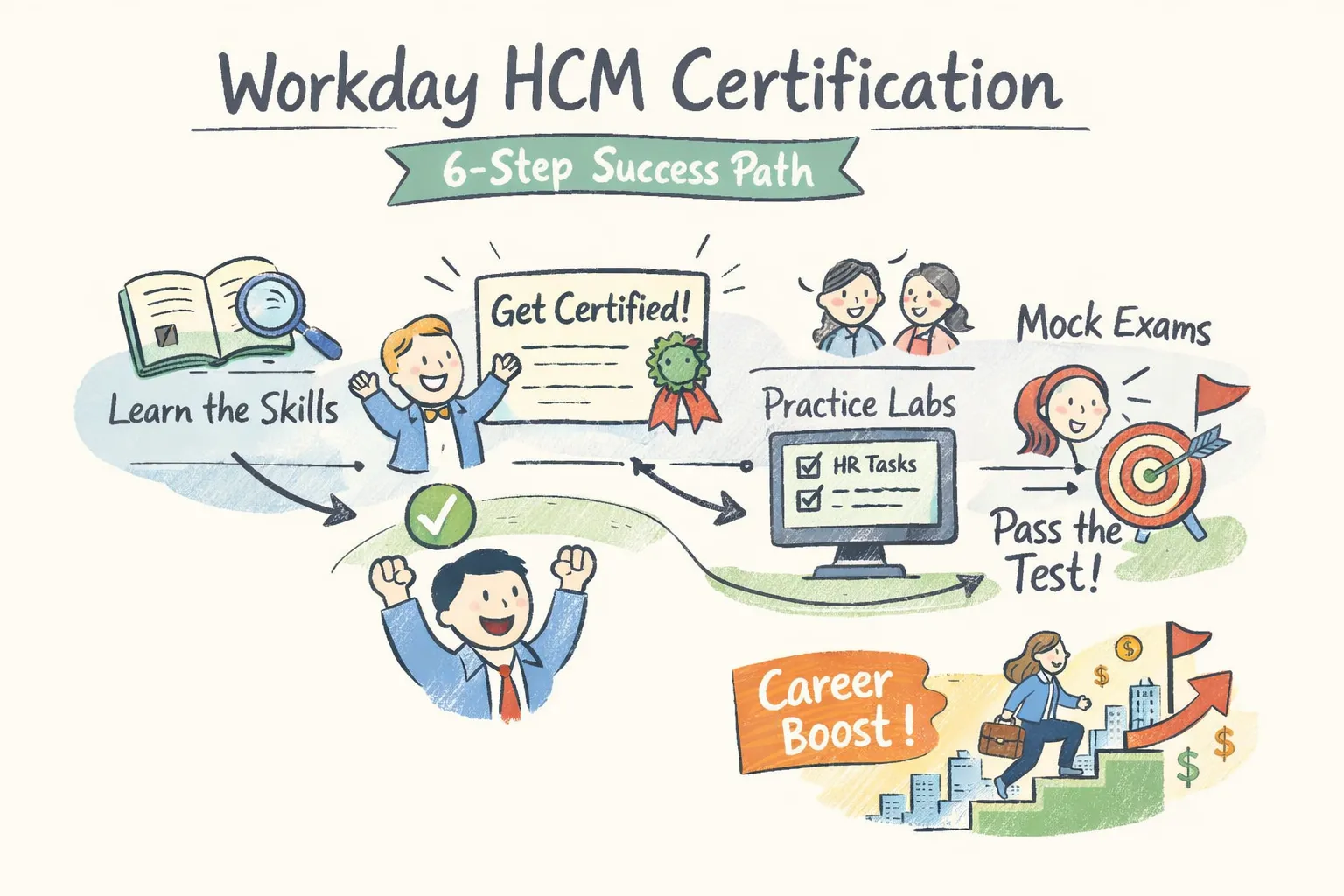
  • Workday HCM Certification: The Practical 6‑Step Plan

    Workday HCM Certification: The Practical 6‑Step Plan

    Yes — you can pursue Workday HCM certification as an independent learner, a customer, or through a partner organization; this article lays out a practical six-step roadmap (courses, hands‑on practice, exam details, costs and timeline) so you can start today. Earning a Workday credential shortens the path to HR/consulting roles and demonstrates platform fluency employers pay for. At CloudShine we train consultants with live instance labs and placement support — below I’ll show you how to replicate that path whether you join a bootcamp or self‑study.

    Who’s eligible — a quick decision checklist

    Most Workday HCM tracks and prep options are available to customers, partners and independent learners via official coursework or third‑party bootcamps. That said, some vendor‑gated exams and advanced tracks are managed through employer relationships (partners or customer accounts) — check access before you pay for a course.

    • Do you have employer/partner access to Workday Learning? If yes, you often get direct course and exam enrollment.
    • Are you targeting consulting (implementer) roles or admin/analyst positions? Consulting often expects partner affiliation or verified project experience.
    • Can you commit 4–8 weeks of focused study? That’s the realistic window for a first certification.

    If you’re unsure: reach out to Workday Learning for access questions, enroll in a third‑party prep bootcamp that includes instance labs, or start with Workday Basics free resources to validate interest before investing.

    The exact 6‑step path (with realistic timeline)

    The path is straightforward: pick a track, learn the foundations, take targeted training or a bootcamp, get hands‑on practice, drill with mocks, and sit the proctored exam. Expect 4–8 weeks if you’re new to HCM systems; experienced admins can compress this to 2–4 weeks.

    1. Pick the right HCM track and confirm eligibility (1–3 days)

    Decide Core vs specialized tracks (Reporting, Payroll, Recruiting). Core is the universal entry point; choose reporting or payroll if you want analyst or payroll specialist roles. Verify whether your employer or the provider gives exam enrollment.

    2. Take foundational courses (Workday Basics or equivalent) (1 week)

    Workday Basics covers navigation, common business processes, and basic security. This week establishes vocabulary and lets you follow configuration walkthroughs instead of getting lost in UI details.

    3. Enroll in HCM Core training or a targeted bootcamp (1–2 weeks)

    Instructor‑led sessions teach configuration, business process design, and common implementation patterns. Expect 2–4 live days or 10–20 hours of structured content from reputable providers.

    4. Hands‑on practice in a live instance or quality lab (minimum 20–40 hours)

    Spend time executing hire‑to‑retire flows, building condition rules, setting security, and writing simple reports. Aim for scenario work (e.g., create an off‑cycle payroll event) rather than passive clicks.

    5. Practice tests and weak‑spot drilling (3–7 days)

    Take two full timed mocks, mark question types you miss, and do targeted drills on business processes, calculated fields, and security. Simulate the exam environment once or twice.

    6. Sit the proctored exam and next steps (day of exam + post‑exam)

    Book the proctored slot, follow ID/proctor rules, and plan for quick post‑exam actions: update your resume and notify your network. If you pass, add the certification to LinkedIn and prepare job‑ready bullets showing real‑world scenarios you can support.

    Exam specifics: Industry reporting for Workday Pro HCM Core lists roughly 50 multiple‑choice questions, ~100–120 minutes, an ~80% passing threshold, and two attempts (policies change — confirm on Workday’s site). Many learners report a 2‑year recertification cadence for individual certificates; verify current validity with official pages.

    Preparation track Typical timeline
    Beginner 4–8 weeks (foundations + bootcamp + 20–40 hours lab + mocks)
    Experienced admin 2–4 weeks (targeted course + focused labs + 1–2 mocks)

    Which HCM tracks exist — pick the right credential

    Choosing the right track increases hiring ROI: align the credential to job titles you want to target (HR admin, reporting analyst, payroll specialist, or functional consultant).

    HCM Core — Foundational credential for administrators and functional consultants; minimal prereqs and the recommended starting point.
    HCM Reporting — For analysts; expects familiarity with calculated fields and basic report writing.
    Payroll — Specialized track for payroll config and compliance; requires payroll domain knowledge.
    Recruiting / Talent & Performance / Learning / Benefits / Compensation — Module‑specific tracks for HR specialty roles; pick based on the function you want to own.
    Integrations / Studio — Technical tracks for integration specialists; requires integration concepts and sometimes Studio exposure.

    If this is your first Workday credential, start with HCM Core and add Reporting or Recruiting depending on the role you want to land.

    Real costs and training options — how to budget and choose a provider

    Be realistic: price depends on whether you use official Workday training, a third‑party bootcamp, and whether live instance access is included. Expect total investments (training + exam prep) in the $1,500–$2,500 range for third‑party programs; exam‑only fees reported in the market run roughly $300–$800.

    Official Workday training is typically enterprise‑priced and often free to partner or customer employees; third‑party bootcamps cost less and add placement/mentorship. Exam fees and policies vary by track and region.

    When choosing a provider, prioritize: live instance access, trainer experience (real implementers), dedicated lab hours, realistic mock exams, and placement support or resume/mocking services. Also review refund/retake terms before you enroll.

    CloudShine spotlight: CloudShine delivers 100% practical labs with live instance access, mentorship from practitioners with 15+ years’ experience, and a placement cell that includes resume building and mock interviews. Choose CloudShine if you need hands‑on instance time plus guided job support rather than theory‑only classes. For readers evaluating cloud platforms side‑by‑side, you may also find useful background in our Oracle Fusion Cloud overview.

    Other legitimate vendors include Multisoft Virtual Academy, comparison guides from Online IT Guru, and CloudFoundation’s Workday training — each trades off price, lab depth, and placement services. Match the provider to your budget and the level of support you need. For broader certification mapping and recommended course lists, see an industry guide like the Workday certifications guide.

    A practical study plan & exam‑day checklist you can use (week‑by‑week)

    This is the “do this” section. Block time and follow the weekly targets below; adjust hours based on experience.

    Week 1 — Orientation & basics: Study Workday basics, HR process maps, and navigation; 8–12 hours. Understand terminology and the core business processes.

    Week 2 — Core HCM modules: Focus on hire‑to‑retire flows, worker data, and security basics; 12–15 hours. Start small labs recreating hiring and termination scenarios.

    Week 3 — Configuration & business processes: Build condition rules, approvals, and transactional flows; 10–15 hours. Create scenarios with parallel approvals and exceptions. If you work across ERP disciplines, reviewing how order and fulfillment cycles are modeled (for example, our order‑to‑cash cycle) can help you understand process orchestration and integrations.

    Week 4 — Reporting & practical tasks: Write simple operational reports and calculated fields; 10–12 hours. Practice filtering data and exporting results. For readers with a finance or reporting focus, our piece on financial control & reporting roles illustrates typical responsibilities that map closely to Workday reporting tasks.

    Week 5 — Mock exams & practice scenarios: Take two full timed mocks, review errors, and drill weak areas (business processes, report writing).

    Week 6 — Exam readiness: Light review, confirm exam logistics, tidy up your resume phrasing to highlight Workday tasks. Prepare for interviews that probe scenario‑based experience.

    Daily routine: 1–2 hours on weekdays and two longer practice blocks (4–6 hours) across the weekend; increase lab hours if you lack real Workday access.

    • Exam‑day checklist: confirm proctor software, valid photo ID, charged device, stable wired internet if possible, quiet room, and pen/paper for scratch work.

    After you pass: add the credential on LinkedIn (certifications section), include 2–3 bullet points showing concrete tasks you can run (e.g., “Configured hire‑to‑retire business process for US employees”), and follow a 30/60/90 plan to apply for roles. If you fail, map missed topics, do a 7–10 day focused re‑study, then rebook.

    FAQs & next steps

    Can independent learners get Workday HCM certified?

    Yes — many tracks and prep routes are accessible to independent learners via official courses (if you have customer/partner access) or third‑party bootcamps that prepare you for the proctored exam. Confirm access requirements for the specific track you want.

    How long does it take to prepare?

    Typically 4–8 weeks for beginners and 2–4 weeks for experienced admins, assuming 8–15 hours of weekly study plus labs.

    How much will it cost?

    Expect $1,500–$2,500 for third‑party bootcamps with labs; standalone exam fees reported in the market range from $300–$800. Official enterprise pricing varies.

    What does the exam look like?

    Workday Pro HCM Core is commonly reported as ~50 multiple‑choice questions with ~100–120 minutes and an ~80% pass score; verify current format on Workday’s certification pages. For practical tips on the certification process and study pathways, see Indeed’s guide on getting Workday HCM certification.

    Do I need Workday access for practice?

    Strongly recommended. If you don’t have employer access, use vendor labs or CloudShine’s live instance sessions to get the hands‑on experience employers expect. If you’re coming from other ERP backgrounds and want to compare module responsibilities, our posts on Oracle Fusion inventory management roles and self‑service procurement roles show how role responsibilities and hands‑on tasks align across platforms.

    Next steps: pick a track, block a 6‑week plan on your calendar, and trial one short lab or module before committing. If you want guided, hands‑on training with placement support, request CloudShine’s Workday HCM bootcamp syllabus or a free consult call to see whether live instance access and mentorship fit your needs. If you’re considering a career change into training roles or simply want another example of a structured certification pathway, review this step‑by‑step guide to becoming a fitness trainer for inspiration on pacing and credential milestones.

    Final note: rules and exam formats change. Always verify eligibility, fees, and exam details on Workday’s official certification pages before booking an exam. You can get certified — but only with a practical plan and the right practice environment.

  • Workday Learning: Practical Guide for HR Leaders 2026

    Workday Learning: Practical Guide for HR Leaders 2026

    Quick takeaway: Workday Learning is a strong fit when your HR stack already runs Workday HCM and you need skills-driven learning tied directly to employee and org data. If your priority is best-in-class content authoring or a low‑cost standalone LMS, evaluate alternatives first.

    This guide shows what the platform actually does, how it plugs into your tech stack, realistic timelines and cost signals, common deployment pitfalls, and a compact POC / RFP checklist you can use immediately. If you want a hands‑on pilot, CloudShine runs practical Workday Learning POCs and admin upskilling to validate fit quickly.

    Quick verdict for HR leaders — should you evaluate it now?

    If your priority is seamless integration with Workday HCM, skills-based development, and centralized compliance reporting, open a formal evaluation now. If your top needs are advanced SCORM/xAPI authoring, gamification, or the lowest possible price, shortlist alternatives first.

    Signals that push to “Yes”: teams already on Workday HCM; a roadmap that requires Skills Cloud and talent mobility; heavy centralized compliance or audit reporting needs. Signals to consider alternatives: heavy internal authoring workflows or xAPI-first analytics needs; a tight licensing budget where a cloud LMS or open‑source option wins on price.

    How CloudShine helps: we run focused POCs and day‑one admin workshops so HR teams can prove integration, surface gaps, and estimate TCO without long ramp-up.

    What the platform actually does — features that matter to HR

    AI personalization and recommendations

    The platform layers machine learning (and Sana capabilities) on top of profile, performance and skills data to recommend learning pathways, micro‑content and mentor or project matches. Practically, this reduces manual assignment work; for example, new hires receive role‑specific onboarding modules plus manager‑recommended stretch tasks based on their Skills Cloud profile. Read a practical breakdown of Workday’s recent AI features to see how these capabilities can amplify human performance.

    Learning paths tied to Skills Cloud

    Learning maps to job profiles and skill taxonomies so completion can update skill records automatically. Use case: identify a 20% skills gap in a sales cohort, auto‑assign a remediation path, and track progress at the team level—tying learning directly to mobility or succession planning. (For an example of how operational role definitions map to learning, see Oracle Fusion Inventory Management Important Roles.)

    Reporting and workforce analytics

    Reports cover completion rates, skills‑gap dashboards, trainer utilization and compliance transcripts. The value to HR and Finance is consolidated evidence for audits and a single source of truth when modeling training ROI or headcount planning. (Related reading: Oracle Fusion Financial Control & Reporting Important Roles.)

    Content types, libraries and limits

    The platform supports video, quizzes, instructor‑led sessions, and SCORM 1.2/2004. LinkedIn Learning can be integrated as a content feed (EIB/SFTP workflows). For vendor guidance on LinkedIn integration and learning experience platforms, consult the official LinkedIn Learning integration guidance and the Workday Marketplace listing for setup details on the LinkedIn, Workday Learning integration. Where documentation is thin: native xAPI hosting is limited—many teams use an external LRS or embed xAPI inside SCORM as a workaround.

    Mobile UX and compliance workflows

    Learner UX is modern and mobile-friendly with enrollment approvals, reminders and audit trails for regulated training. For compliance programs the platform centralizes transcripts and audit logs, which simplifies reporting to regulators or internal auditors.

    Practical tip: expect gaps in advanced gamification and enterprise authoring—many orgs pair the platform with Docebo/Adobe authoring tools or buy third‑party authoring and use SCORM imports. Plan for that integration up front.

    How it connects to your tech stack — integrations, content, identity and data flows

    High‑level pattern: Workday HCM is the source of truth (workers, job codes, org hierarchy, skills) → Skills Cloud and Learning feed personalized assignments → Learning completions feed analytics and talent processes. Most connectors are native or use Workday EIB/SFTP for batch exchange.

    Key integration points

    HCM syncs (job codes, org data, skills) are critical because they make recommendations meaningful and enable lineage in compliance reports. LinkedIn Learning commonly integrates via EIB-outbound + SFTP with scheduled weekly syncs—expect mapping work for content IDs. SCORM works natively; xAPI typically requires an external LRS or an embedded “sidecar” approach. SSO uses SAML/OAuth—IT should validate IdP attributes and session policies before pilot.

    • Integration checklist for IT: required approvals and integration owner; sample data mappings (worker ID, job code, skill IDs); confirm SCORM support and LRS plan; collect API/SFTP credentials; define sync cadence (daily/weekly); confirm data residency and encryption requirements.

    Example data flow: learner completes a module → Learning records completion → Skills Cloud updates inferred skill level → manager and workforce analytics dashboards reflect changed skill totals for succession models. This aligns with common order‑to‑cash workflows (see Oracle Fusion Sales Order to Shipment Cycle) and can be triggered by transactional events.

    Implementation reality — timelines, people, common configuration headaches and pricing signals

    Realistic timeline follows pilot → adapt → evolve. Expect a focused pilot of 8–12 weeks to validate core flows, a core configuration and integrations phase of 3–6 months, and a broader rollout over 6–12+ months depending on content migration and global localization needs. These estimates align with typical Workday module deployments.

    Required roles: executive sponsor; HR product owner; L&D SMEs; IT integration lead; data conversion specialist; and a change manager. (Also consult What is Oracle Fusion Cloud and Why Does It Matter, CloudShine for role mappings in ERP‑centric organizations.) Contract your implementation partner for tenant‑level tasks and escalation procedures.

    Common traps include confusing content hierarchies (lessons vs campaigns), localization gaps, SCORM import errors from certain authoring tools, over‑customized reports that are hard to maintain, and weak governance around who owns learning data. Mitigations: clear naming conventions, early test imports, and a governance RACI set at project start.

    Pricing signals: public list signals show ~$100 PEPM as list pricing in market chatter; typical enterprise discounts of 10–30% are common, and implementation fees can approach an annual subscription in many deals. Treat these as heuristics—request a sample TCO that includes implementation, migration, and support.

    Negotiation levers include bundling other Workday modules, fixed‑scope implementation caps, tying milestone payments to acceptance criteria, SLAs for support, and explicit data ownership clauses.

    CloudShine offering: our 100% practical POCs, live‑instance labs and admin workshops shorten the “adapt” phase and reduce adoption risk by giving your admins real hands‑on experience before go‑live.

    Consider also how transactional triggers can feed learning events—if your org ties training to commerce or fulfillment events, review typical back‑to‑back flows (see Order to Cash Back to Back Buy Flow, Step 1: Order Creation).

    Alternatives, trade-offs and a shortlist for procurement

    Vendor When it wins
    Cornerstone OnDemand Feature‑rich enterprise LMS with deep compliance features.
    SAP SuccessFactors Learning Best if you’re already in an SAP ecosystem.
    Docebo Modern UX and strong AI learning tools for mid‑market.
    Adobe Learning Manager Advanced authoring and sophisticated analytics.
    LinkedIn Learning Content library but not a full LMS.
    Moodle/Totara Open‑source, cost‑effective, but requires more IT support.

    Decision grid in practice: if integration fit is priority, Workday wins; for authoring and deep content features, Adobe/Docebo lead; for price or open‑source control, consider Moodle/Totara. Shortlist based on your top two axes (integration vs authoring vs price).

    POC idea: run identical pilots across 2–3 finalists using the same scope (three courses, SSO, SCORM import, skills tagging, two admin reports) and compare time‑to‑value and admin effort.

    Action plan: compact 30/60/90 checklist, POC scope, vendor questions and KPIs

    Phase Key activities
    0–30 days Executive sign‑off, shortlist vendors, select pilot group, map data fields, assign roles.
    30–60 days Run POC (3 courses, SSO, SCORM import, LinkedIn feed), collect baseline metrics.
    60–90 days Evaluate POC, finalize vendor, negotiate contract, plan training and rollout schedule.

    Compact POC scope: three learner roles, three courses (one compliance, one onboarding, one role‑specific), SCORM import, SSO, skills tagging, and two admin reports (completion + skills gap).

    • Vendor / RFP questions you can copy: provide integration APIs and documentation; confirm SCORM/xAPI and LRS support; share SSO types and a sample SAML config; detail LinkedIn sync (EIB/SFTP) setup; provide a sample implementation timeline and deployment team; explain reporting customization limits; confirm data residency & security certifications; show licensing model (PEPM, discounts); describe renewal escalation; provide customer references of similar size/industry.

    KPIs to track in the brief: completion rate, time‑to‑proficiency, percent of targeted skill gaps closed, compliance completion rate, training cost per learner, and manager recommendation/adoption rate. Stakeholder brief should include objective, pilot scope, success metrics, budget estimate, risks & mitigations, and asks from IT/Legal.

    Final practical step: if you want a hands‑on pilot, CloudShine can run the POC, train day‑one admins, and produce the stakeholder brief so your team can decide with evidence rather than assumptions.

    FAQs

    Q: How is this different from a generic LMS?
    A: The main difference is embeddedness—this learning platform is part of the HCM ecosystem, so its primary advantage is integration with skills, performance and payroll data rather than offering the deepest authoring features. For the vendor’s official product listing, see the Workday Learning product page.

    Q: Does it support SCORM/xAPI and SSO?
    A: It supports SCORM 1.2/2004 natively and SSO via SAML/OAuth; xAPI hosting typically requires an external LRS or a sidecar approach—confirm specifics with your tenant admin and vendor docs.

    Q: How much does it cost?
    A: Market signals show list pricing around $100 PEPM in public commentary, but enterprise deals are negotiated—expect 10–30% discounts and ask vendors for a detailed TCO including implementation fees.

    Q: What’s a realistic rollout time?
    A: Pilot 8–12 weeks, core configuration 3–6 months, enterprise rollout 6–12+ months depending on integrations and content migration.

    Q: Who should run the POC internally?
    A: A small cross‑functional team: an HR/L&D lead, HRIS/IT lead, 1–2 content SMEs, and an executive sponsor for decisions and budget.

    Summary: If integration with Workday HCM, skills-driven development and centralized compliance are strategic priorities, this learning cloud deserves a formal POC. If authoring depth or minimal cost is first, evaluate alternatives first. When you’re ready to validate fit, a tight POC with real integrations and live content will reveal the trade‑offs fast—CloudShine can help run that pilot and train your admins to a day‑one competence level.

  • E-Learning vs. In-Person Training for Oracle Fusion Manufacturing

    E-Learning vs. In-Person Training for Oracle Fusion Manufacturing

    In today’s evolving business environment, staying updated with the latest technologies is crucial for success. One such system is Oracle Fusion Manufacturing, designed to streamline production operations, manage supply chains and improve overall efficiency. Professionals aiming to master this comprehensive platform are faced with a major decision—whether to undertake their learning journey through e learning platforms or traditional in person training.

    Choosing the right training mode can significantly affect how well you understand the system, apply its functionalities in real-world scenarios, and grow your career in an increasingly competitive market.

    Understanding the Two Training Modes

    When it comes to learning cloud based Oracle courses like Oracle Fusion Manufacturing, two primary options stand out: self-directed e learning and conventional in person training.

    E learning provides the flexibility to study at your own pace from anywhere in the world. With recorded lectures, interactive labs, quizzes, and mentorship available remotely, it is particularly suited for busy professionals who cannot commit to fixed schedules. It also enables revisiting complex modules multiple times, ensuring a deeper understanding.

    Conversely, in person training delivers a structured and immersive experience. This method promotes immediate clarification of doubts and peer-to-peer learning, often accelerating the understanding of the subject.

    For a holistic learning experience that extends beyond manufacturing into broader Oracle ecosystems, enrolling in Oracle Fusion applications training can be very valuable, offering exposure to several business modules.

    Key Differences Between E-Learning and In-Person Training

    The ongoing discussion of in person learning vs online learning often circles factors like flexibility, cost, engagement, and effectiveness.

    E learning offers unparalleled freedom: learners can study during lunch breaks, weekends, or late nights, adapting education to their lifestyles. The content is often updated quickly to align with Oracle’s latest software releases, ensuring learners stay current.

    On the other hand, in person training creates a highly engaging environment where learners are encouraged to interact, ask questions, and participate in team activities. The immediate feedback loop accelerates learning, while networking opportunities often lead to professional growth and collaboration even after the course ends.

    Modern programs like Oracle Cloud training online have bridged many of the gaps previously found in remote education, offering live instructor sessions, cloud-based labs, and collaborative project work.

    Does Online Training Result in More Learning?

    When comparing in person learning vs online learning, it’s essential to evaluate effectiveness, not just convenience.

    E learning has gamified elements, video simulations, real-world projects, and adaptive assessments that enhance understanding by appealing to different learning styles.

    However, success in e learning needs a proactive mindset. Without the structured accountability of regular classes, learners need strong discipline and intrinsic motivation to complete modules and apply concepts practically.

    In contrast, in person training naturally enforces discipline through fixed schedules, face-to-face mentor guidance, and collective goal-setting with peers.

    Pros and Cons of Each Approach

    E-Learning for Oracle Fusion Manufacturing

    Advantages:

    • Accessibility: Learn anytime, anywhere, without geographical barriers.
    • Cost Efficiency: No travel or accommodation expenses.
    • Personalised Learning Pace: Focus on topics that need more attention.
    • Regular Content Updates: Immediate updates align with Oracle’s software advancements.

    Limitations:

    • Self-Motivation Required: No external push to keep up.
    • Limited Face-to-Face Interactions: Harder to build immediate professional relationships.
    • Technical Challenges: Requires stable internet and compatible devices.

    In-Person Training for Oracle Fusion Manufacturing

    Advantages:

    • Immediate Doubt Resolution: Real-time clarifications help avoid conceptual gaps.
    • Enhanced Networking: Direct peer and mentor interaction.
    • Structured Environment: Encourages routine and focus.

    Limitations:

    • Higher Cost: Includes tuition, travel, and possibly lodging.
    • Rigid Scheduling: Limited flexibility for busy professionals.
    • Location Dependency: Access may be limited to urban areas with training centres.

    Professionals seeking specialised integration skills alongside manufacturing expertise could also consider enhancing their profiles with Oracle Integration Cloud certifications, combining best practices from both learning modes.

    Choosing the Right Training Mode for Oracle Fusion Manufacturing

    Selecting between e learning and in person training depends largely on your lifestyle, goals, and personal learning preferences.

    If you value flexibility, affordability, and the ability to customise your learning journey, e learning is a strong choice. It’s particularly beneficial for working professionals, individuals with families, or those who prefer learning independently at their own pace.

    If, however, you learn best through immediate interaction, structured classes, and practical teamwork, traditional in person training could be more suitable. Direct interaction with mentors often accelerates problem-solving and strengthens practical expertise far more effectively.

    Another approach is a blended learning model—beginning with self-paced e learning courses to learn the basics, followed by focused, in-person workshops for sharpening advanced skills through real-world application. Regardless of the method chosen, building expertise in Oracle Fusion Manufacturing is bound to give long-term professional benefits across multiple industries.

    Industry Trends and Recommendations

    The rising preference for e-learning reflects how organisations are leveraging technology to streamline training expenses, minimise operational interruptions, and expand access to a wider, geographically dispersed workforce. Online learning platforms, powered by cloud technology, offer realistic, hands-on practice environments where learners can simulate end-to-end manufacturing scenarios all by themselves.

    However, many companies continue to value the effectiveness of in person training for complex topics that demand deeper interaction. Companies are realising that this human touch is magical, for sure. As a result, organisations are increasingly offering a mix—starting with foundational Oracle Fusion Cloud training online modules, followed by in-person boot camps for advanced, collaborative work.

    Microlearning, gamification, and cloud-based simulations are shaping how professionals master platforms like Oracle Fusion Manufacturing. Those who adapt quickly to these blended learning models will be better positioned to lead digital transformation initiatives within their organisations.

    In summary, whether you prefer the independence of e learning or the engagement of in person training, the ultimate goal is mastery over Oracle Fusion Manufacturing—a skill highly sought after in today’s dynamic industries.

    CloudShine understands that no two learners are alike. With flexible programs tailored to various learning styles and professional needs, seasoned instructors, updated courseware, and robust support systems, attendees, without a doubt, receive top-notch training—online or in person.

    If you’re ready to accelerate your career with expert-led cloud based Oracle Fusion training, explore the possibilities at CloudShine today. For more information contact our team at +91-7587 123 123

  • How Oracle Fusion SCM Training Can Boost Your Career

    How Oracle Fusion SCM Training Can Boost Your Career

    Supply chain management has evolved into a critical pillar for organisational success. Managing the end-to-end flow of goods, information, and finances requires suave technology and highly skilled professionals. This is where Oracle Fusion SCM steps in. As one of the most powerful cloud-based supply chain management platforms, it offers companies the flexibility and insight they need to thrive. But how can Oracle Fusion SCM training India transform your career? Let’s explore.

    What is Oracle Fusion SCM Training?

    Oracle Fusion SCM training is an in-depth course with various modules on the Oracle Fusion SCM suite.

    The training equips you to handle supply chain management interview questions with ease and ensures you stand out in an increasingly competitive job market. Whether you’re an experienced professional or a fresh graduate, enrolling in a recognised Oracle SCM cloud training course can open doors you never imagined.

    Career Benefits of Oracle Fusion SCM Training

    When you pursue Oracle Fusion SCM training India, you invest in a career path packed with opportunities:

    • High demand for SCM professionals: As businesses move to cloud-based solutions, companies across industries seek experts proficient in Oracle Fusion SCM.
    • Global career opportunities: Skills in Oracle Fusion SCM are recognised internationally, widening your reach abroad.
    • Excellent salary prospects: Certification and expertise in Oracle Fusion SCM often translate into lucrative compensation packages.

    Skills Gained Through Oracle Fusion SCM Training

    The skill set you develop through structured Online Oracle Cloud training is vast and multifaceted. Here, you can learn:

    • Comprehension of SCM workflows: Understand the supply chain process, from procurement to shipping.
    • Problem-solving and analytical skills: Learn how to optimise supply chain operations by interpreting and acting on data.
    • Technical expertise: Master navigation through the Oracle Cloud platform, integration with other modules, and automation of key supply chain tasks.
    • Effective communication for SCM: Translate complex processes into actionable strategies — a critical ability when responding to supply chain management interview questions.

    Furthermore, you’ll be equipped to tackle even the toughest interview questions with confidence and expertise.

    How Oracle Fusion SCM Training Stands Out

    Oracle Fusion SCM training India focuses on one of the industry’s leading platforms.
    What makes this training truly special?

    • Tailored, role-specific learning: Whether you aim to become a procurement specialist, inventory manager, or supply chain analyst, Oracle SCM cloud training aligns with your career goals.
    • Hands-on labs and simulations: Practical exposure is prioritised to ensure you’re ready for the job and the interview questions and answers.
    • Updated curriculum: As Oracle Fusion SCM evolves, so does the training, incorporating the latest tools, best practices, and industry standards.

    Steps to Get Started with Oracle Fusion SCM Training

    Thinking about beginning your journey with Oracle Fusion SCM? Here’s a roadmap to success:

    1. Research thoroughly and identify training programs offering the best value — like those from CloudShine.
    2. Understand your career goals and pick a training path that matches — procurement, logistics, inventory, etc.
    3. Choose the right learning mode— whether you prefer in-person classes or Online classes for Oracle Cloud training.
    4. Dedicate time for practice through live projects, case studies, and mock interviews.
    5. Prepare for certification exams that will validate your skills and enhance your resume.

    By following these steps, you’ll not only become proficient in Oracle Fusion SCM, but you’ll also be ready to handle any supply chain management interview questions thrown your way.

    Enroll in CloudShine SCM Training Courses Today!

    If you’re serious about levelling up your career with Oracle Fusion SCM training India, CloudShine is a great place to start. With top-tier Oracle Cloud training online, CloudShine combines expertise and hands-on learning to maintain a successful track record.

    Their curriculum prepares you for interview questions and answers. Additionally, they provide flexible learning options, personal mentorship, and cutting-edge resources designed for the real-world challenges of supply chain management.

    Don’t wait for the right opportunity — create it by enrolling today with CloudShine!

    In an economy run by efficiency and innovation, a robust understanding of supply chain management through Oracle Fusion SCM cloud service can be your golden ticket.

    With guidance from a premier provider, CloudShine, and consistent effort, you can transform your career, future-proof your skills, and confidently walk into any interview.

    Start today — because your future in Oracle Fusion SCM is waiting!

  • A Step-by-Step Guide to Implementing Oracle Integration Cloud

    A Step-by-Step Guide to Implementing Oracle Integration Cloud

    Today’s fast-moving digital landscape demands that businesses be agile, connected, and smart. Oracle Integration Cloud (OIC) is designed precisely to meet these needs. OIC streamlines integration with its pre-built adapters and low-code tools. Companies can innovate faster without facing complex technicalities.

    With Oracle Integration Cloud service, corporations can drastically lessen operational silos and enhance their decision-making abilities.

    Pinpoint Business Requirements and Objectives

    Before rushing into implementation, audit existing systems, and processes, and recognise the pain points. Identify which applications should communicate and why. Clear goals ensure focused efforts.

    Defining precise integration objectives early allows you to tailor your approach, selecting features within Oracle Fusion integration that align perfectly with business outcomes.

    Explore Oracle Integration Cloud Features

    Oracle Integration Cloud service brings a powerful set of features to the table. Designed for IT specialists and business teams, OIC empowers organisations with intelligent process automation, effortless API orchestration, insightful predictive analytics, and real-time performance tracking — all housed within a robust cloud-native environment.

    By integrating robotic process automation (RPA) and embedded AI/ML capabilities, businesses can move beyond simple connectivity, into fully adaptive, smart ecosystems. Having a deep grasp of these features through Oracle Integration Cloud online training empowers teams to unleash the full potential of OIC.

    Craft a Comprehensive Integration Plan

    A well-crafted plan can be done by mapping every critical application and understanding the nature of the data exchanges needed. Identify dependencies, risks, and potential bottlenecks. Break the implementation into phases, focusing first on high-impact integrations.

    Assign clear ownership to each phase, ensuring accountability across technical and business teams. Leveraging the architecture flexibility in Oracle Integration Cloud ensures that even as business needs evolve, your integration backbone remains future-proof.

    Initialise Oracle Integration Cloud Setup

    Once the plan is firm, it’s time to initialise your OIC setup. Provision your instance via Oracle Cloud Infrastructure (OCI). Choose the right size and region that matches your operational footprint. Configuration at this stage includes setting up user roles, network connections, and identity management.

    Establishing high-availability clusters ensures that mission-critical integrations stay resilient even during unexpected outages. Implementing best practices for Oracle Integration Cloud security right at the start is crucial to safeguard sensitive data flows.

    Establish and Configure System Connections

    With the environment ready, you can start establishing system connections. Oracle Integration Cloud service makes this remarkably straightforward through its ready-made connectors.

    Adapters handle authentication, data transformations, and error handling automatically, reducing development time dramatically. Handshake testing at this stage ensures your connections are robust and resilient under real-world conditions.

    Build and Customise Integration Workflows

    After connecting systems, it’s time to build your workflows. Using Oracle Fusion integration, you can visually design integrations with drag-and-drop simplicity. Define triggers, set up routing rules, map fields across systems, and create conditional logic without writing complex code.

    Customisation is key here. No two businesses operate alike, so your integrations must reflect your unique processes. Smart features like business indicators and real-time tracking let you monitor workflows closely.

    Set Up Security Protocols and Monitoring Tools

    Security must be baked into every layer of your integration. With Oracle Integration Cloud security, you can configure secure APIs, restrict roles based on least-privilege principles, and establish compliance monitoring.

    OIC’s native dashboards give you visibility into traffic, errors, and performance trends. Alerts can be configured to warn about anomalies, helping your team respond proactively to potential issues. Regular security reviews and updates keep your integration ecosystem safe from emerging threats.

    Run Rigorous Testing and Validation Procedures

    Before moving to production, every integration should undergo rigorous testing. Start with unit tests to verify each integration individually. Later, conduct system integration testing (SIT) to ensure seamless interoperability.

    Document every test case and result meticulously. This validation process often becomes easier after comprehensive Oracle Integration Cloud service online training, where real-world examples are covered in depth.

    Implementing Oracle Integration Cloud is a strategic move towards achieving digital maturity. However, success requires the right technology and expertise. That’s where CloudShine steps in.

    At CloudShine, our Oracle Integration Cloud service training guides you from planning to post-deployment support. Our hands-on approach ensures that your teams become proficient in real-world skills that drive real results.
    Serious about learning OIC and accelerating your digital transformation? Partner with CloudShine today!

  • Integrating On-Premise Applications with Cloud Services

    Integrating On-Premise Applications with Cloud Services

    Are you planning on integrating cloud and on-prem applications? Well, integrating cloud solutions with on-prem applications can offer you a lot of perks. It can increase the performance and reliability of your solution. It can save you some costs to run your environment. Here, we will talk about the various aspects of integrating on-prem applications with cloud-based solutions.

    Understanding on-prem applications and cloud services:

    On-prem applications refer to the hardware infrastructure that you have in your environment. These applications are mainly used to host internal software and data. These on-prem applications offer you greater control over your system. Also, all your sensitive data remains stored within the boundaries of your organisation.

    On the other hand, cloud services refer to the resources that are hosted on remote servers. These servers can be accessed over the network. These solutions are known for their increased scalability and reliability. They are also a lot more cost-effective as compared to on-prem infrastructure. One such reliable cloud solution is Oracle Integration Cloud services

    Integrating in-house environments with cloud services comes with certain challenges along with various perks. An in-depth understanding of the various systems in your environment can help you to decide on cloud integration.

    Challenges associated with integrating on-prem infrastructure with cloud solutions:

    Legacy system compatibility: A lot of companies have old and outdated systems in their environment. These legacy systems often lack Application Programming Interfaces (APIs) or offer limited API support. This restricts their ability to communicate with cloud solutions seamlessly.

    Data security and compliance concerns: Data security is a multifaceted challenge in cloud integration. As companies exchange huge volumes of data between various cloud applications and services, maintaining data security and compliance can be highly challenging. Any discrepancy can cause huge compliance issues for organisations.

    Latency and performance issues: Latency can be a serious issue for cloud integration. It can significantly impact the speed and efficiency of data transfer. This can bring about performance issues in your system. It can also impact business deliverables and restrict your ability to perform business operations smoothly.

    Key Benefits of the integration:

    There are multiple benefits associated with on-prem app integration cloud service:

    Enhanced scalability and flexibility: Cloud services offer excellent flexibility and scalability for your data needs. You can easily scale up during peak demand or scale down during a slower period using cloud resources. This ensures that you are only paying for how much you consume. This helps in reducing costs and increasing business efficiency.

    Enhanced collaboration: By integrating on-prem applications with the cloud, you get to ensure better collaboration among the team members. Data and insights can be accessed from anywhere and by any person. This helps in making maximum use of data. The various business processes can also be streamlined.

    Disaster recovery and business continuity: Cloud-based systems come with robust disaster recovery capabilities. This ensures that your data remains safe and can be restored quickly even during a disaster. This helps in business continuity planning.

    Data security: Cloud platforms offer robust security features that are more comprehensive than what’s possible in on-prem systems. The security measures like encryption and access control help to keep your data safe at all times.

    Real-time analytics: The cloud platform supports real-time analytics. This allows your business to adapt faster to changing conditions. This is especially true in the case of the fintech industry where real-time insights can offer you a competitive advantage.

    Common Integration Methods:

    APIs and middleware solutions: You can easily make use of Application Programming Interfaces (APIs) and middleware programs to allow effective communication between on-prem infrastructure and cloud services.

    Hybrid cloud models: These models are used to integrate both on-prem systems and cloud solutions. That way, you can enjoy the benefits of cloud services while still retaining connectivity to the on-prem infrastructure.

    Enterprise Service Bus (ESB) and integration platforms: This method of integration consists of rules for how applications can connect to a communication bus middleware. Once an application connects to the bus, it can transform its data and share it with any other connected application.

    Best Practices for Successful Integration:

    Here is a list of some of the best practices that you must follow:

    • Understand the workings and the compatibility of the various systems in your environment.
    • Check for compliance and data security-related issues.
    • Bolster network efficiency to prevent any kind of latency issues.
    • Carefully choose between APIs and File Transfer Protocols.

    You can also opt for Oracle integration cloud service training to know more about the best integration practices.

    Real-World Use Cases:

    Listed below are some of the real-world examples of on-prem infrastructure integration with cloud services:

    Netflix: Netflix happens to be one of the biggest video service streaming service providers. It needs a huge amount of storage to store its various contents. During peak hours, the traffic and demand for its various web services increase. For this, Netflix required scalability. To handle this situation, it has integrated Amazon Web Services into its on-prem infrastructure. Based on the traffic, AWS scales the resources significantly.

    This helps save a huge amount of money on infrastructure costs. It also improves the streaming experience of the users.

    Airbnb: Airbnb has also integrated AWS with its on-prem infrastructure to scale its web applications based on user traffic during peak hours. Before switching to the cloud, the user satisfaction rate was not that high as the site would frequently go down. However, this problem was easily dealt with after integration with AWS. Now the traffic is managed more efficiently and the downtime is also reduced. This has helped in improving the overall experience of the users.

    NASA: NASA has also integrated cloud-based services for data processing and analytics into its on-prem infrastructure. This has been done for its various space exploration missions. These missions require huge amounts of data that need large storage and huge computation power. The integration of cloud-based solutions with on-prem infrastructure has allowed for faster processing and analysis of data. This helps in the decision-making process.

    Conclusion:

    In this dynamic business scenario, companies are rapidly shifting to cloud-based services from on-prem infrastructure. So, if you are willing to integrate into the cloud, then it is high time that you implement Oracle Integration Cloud Services at your organization. This will allow you to ensure that the entire integration process takes place smoothly without leaving any business impact.