CloudshinePro

Author: csp@admin

  • Software Training Institutes in Chennai with Placement 2026

    Software Training Institutes in Chennai with Placement 2026

    Quick verdict: yes — Chennai has many placement‑oriented software training centres, but only a handful publish verifiable proof. This article reviews software training institutes in Chennai with placement and shows exactly how to verify claims before you enroll. As a practitioner‑trainer at CloudShine I’ll also flag the practical indicators of credible placement support (live instances, recruiter lists, mock interviews) so you can compare objectively.

    What “placement assistance” really means — proof, red flags and a Practical‑Pro checklist

    “Placement assistance” is a service. It can range from a list of job links to a staffed placement cell arranging interviews. A “placement guarantee” is contractual and must list terms, timeframes and refund or replacement provisions. Treat them differently.

    • Time‑stamped placement lists (batch‑wise) — Look for cohort dates and names or initials with joining dates. If lists are generic (“1000 placed since 2010”) it’s marketing, not proof.
    • Sample / anonymized offer letters — Must show employer name, role, CTC, and date. These prove the institute’s students received paid offers; ask for at least two per recent batch.
    • Contactable alumni — Request three recent LinkedIn profiles per batch and the recruiter names who hired them. If alumni disappear or profiles are inactive, treat claims cautiously.
    • Placement conversion rate + median salary — Ask for both conversion percentage and median/average salary. Percentage alone can hide low pay or irrelevant roles.
    • Placement process overview — Who runs interviews: the institute, a recruiting partner, or job boards? A clear pathway (shortlist → institute‑conducted mock → employer interview) is a good sign.
    • Written placement policy — Insist on a published policy: refund terms, re‑training timelines, and replacement guarantees if applicable.

    Red flags: vague “100% placements” claims with no alumni contact, placement only via general job boards, conditional small print charging extra fees for interviews, or inconsistent timelines for when offers are made.

    At‑a‑glance: 10 Chennai institutes that claim placement support — what to verify

    I built a simple comparison grid in my head: claim, verified evidence, flagship courses, fees band, delivery mode, address/contact, verdict (Trust / Verify / Caution). Below are concise notes you can use as the starting row for each provider.

    Besant Technologies — Claims 20,000+ placements (claim; unverified). Has a Velachery address listed. Ask for batch‑wise placement lists and recruiter names. VERIFY. See their placement training in Chennai page for published claims and contact details.

    Softlogic Systems (SLA) — Wide network, claims 90,000+ placements and lifetime career support; contact numbers listed for counselling. Request a recruiter partner list and recent alumni links. VERIFY. Their local details can be checked on the placement training institute in Chennai page.

    Aimore Technologies — Publicises ~15,000 placements and alumni stories; shows more verifiable success stories than most. Still ask for sample offer letters and employer names for data roles. VERIFY.

    Infibee Technologies — Advertises 100% placement assistance across many courses and claims 3,000+ placements. No batch‑wise public lists found — request employer names and counts. VERIFY. You can also confirm local presence via their Infibee Chennai listing.

    Naresh i Technologies — Budget option with recorded video support; some course fees published (e.g., Python with videos). Ask for verified placement evidence and timelines. VERIFY.

    Greens Technologys — Bootcamp style courses (Python/AWS) with placement messaging; check weekend vs regular batch outcomes and employer names. VERIFY. Their software testing course content page lists topics and lab expectations you can compare to advertised placement promises.

    ACTE — Aggressive placement claims (“No.1”); demand the terms behind that badge and audited evidence. VERIFY.

    QuickXpert Infotech — Live online and classroom modes advertised; request alumni contacts and sample offers. VERIFY.

    FITA Academy — Popular for testing and web stacks; confirm placement process, recruiters and median salary per course. VERIFY.

    Credo Systemz — Placement assistance claimed; verify by asking for batch‑wise placements and sample employer confirmations. VERIFY.

    Spotlight — CloudShine (Chennai‑friendly alternative) — CloudShine focuses on enterprise technologies (Oracle Fusion Cloud, Workday, SAP) with a 100% practical model: live cloud/Oracle instances, a 60:24 instructor:lab hour approach, and placement preparation (resume-building and mock interviews). For ERP/enterprise roles this practical depth and mentor experience often matters more than volume placement claims (see our notes on inventory management roles, self‑service procurement roles and supplier portal roles).

    Shortlist 3–5 picks by persona

    Method: I score providers on transparency, verifiable placement evidence, employer list quality, hands‑on labs, and the structure of the placement process. Then I prioritize evidence over marketing.

    Freshers seeking volume placements: consider larger networks like Softlogic or Besant — but verify median salary and role relevance before committing. Career pivoter (ERP/Finance → Order to Cash / Oracle/Workday): CloudShine or other enterprise‑focused trainers — look for live instances and domain mentors. Data roles (Data Science / BI): Aimore or Greens — prioritise real project exposure and employer names. Weekend / working professionals: pick institutes that run verified weekend live batches with recordings and long‑tail placement follow‑up like Naresh or QuickXpert.

    How I would test my shortlist in 72 hours: attend two demo classes, ask each institute for three alumni LinkedIn links, request two anonymized offer letters, and quickly compare the syllabus against current job ads for the roles you want.

    Fees, course duration and syllabus expectations

    Typical fee bands in Chennai range widely: short test/automation courses can be under ₹10k; full job‑ready bootcamps with live cloud labs commonly sit between ₹20k–₹70k depending on depth and live instance access. Duration ranges from 4 weeks (short tracks) to 24 weeks (comprehensive data/ERP programs).

    Java / Full‑Stack: 8–16 weeks; expect hands‑on projects, Git, basic system design and at least one end‑to‑end app. Python / Data Science: 10–20 weeks; expect Pandas, scikit‑learn, notebooks and an end‑to‑end project. Data Science / Analytics: 12–24 weeks; expect multiple portfolio projects and an internship simulation if placement‑focused. AWS / Cloud: 6–12 weeks; labs with live console access and real provisioning tasks are critical. Selenium / QA Automation: 4–8 weeks; expect automation frameworks, CI integration and sample scripts you can run locally.

    When you review syllabi, prioritise real projects, guaranteed console or instance access, stated lab hours, a specific count of mock interviews, and placement‑focused modules (resume + aptitude + HR round prep). For payment, ask for instalments, request a trial/demo refund policy, and require written placement clauses before paying a deposit.

    How to verify claims and apply — scripts, email template and a short checklist

    1. Initial call/demo: Request batch‑wise placement lists and the placement policy document during the demo.
    2. Email placement cell: Ask for three alumni LinkedIn links per recent batch and two anonymized offer letters.
    3. Contact alumni: Ask role, time‑to‑placement, and how much the institute actually helped.
    4. Inspect offers: Verify employer names and dates; call HR if necessary to confirm the offer format.
    5. Attend a demo class: Assess trainer experience and whether labs are live instances or canned recordings.
    6. Negotiate a written placement promise: timeframe, conditions, and refund/replacement terms.

    Email template (single paragraph you can paste): “Hello — I’m evaluating your <course name> batch starting on <date>. Please share (1) the batch‑wise placement list for the last two cohorts, (2) three alumni LinkedIn profiles, (3) two anonymized offer letters, and (4) your written placement policy. I’ll attend the demo after that. — <Your name>.”

    Phone first‑two‑minutes check: confirm who runs placement interviews, ask if placement lists are batch‑wise, confirm demo timing, and ask if they publish median salaries. On LinkedIn check dates, job titles, and employer legitimacy; suspicious patterns include many profile updates on the same day or junior titles inconsistent with claimed roles.

    Deal breakers: no alumni contacts, no sample offers, and no written placement policy — walk away or demand a deposit holdback until proof is provided.

    Decision checklist, next steps and FAQs

    • Shortlist 5 providers
    • Request batch‑wise proof
    • Confirm 2 alumni per provider
    • Attend demos for top 2
    • Evaluate syllabus and lab access
    • Obtain written placement terms
    • Enroll with instalment option if needed
    • Start a 30‑day plan immediately (profile + projects + mocks)

    30‑day starter plan: polish LinkedIn and resume, complete the first project in the syllabus, schedule weekly mock interviews, and apply to openings that match the course outcomes.

    FAQs

    Q: Does “100% placement” mean I’m guaranteed a job?
    A: No. Read the terms. A true guarantee is contractual and should include a timeframe, role type, salary floor, and refund/replace clauses.

    Q: How long after course completion should I expect placement calls?
    A: Realistic timelines vary: 30–90 days for most bootcamps; enterprise roles can take longer. Ask the institute for their median time‑to‑offer metric.

    Q: How can I verify sample offer letters?
    A: Check employer names, offer dates, CTC, and contact a listed HR person if possible. Two recent, verifiable offers are a good minimum.

    Q: Are remote/online batches from Chennai institutes accepted by employers?
    A: Yes — but only if the program is live instructor‑led with real projects and lab access. Recorded‑only courses are weaker signals.

    Q: What minimum evidence should I accept before paying a deposit?
    A: Batch‑wise placement list, three alumni contacts, two anonymized offer letters, and a written placement policy are reasonable minimums.

    Final takeaway: prioritise verifiable placement evidence over broad marketing claims. Shortlist three providers, use the email template above, and insist on written placement terms before you pay. If you want enterprise‑level ERP/Cloud training with live instances and dedicated placement prep, book a free counselling/demo with CloudShine to see how our 60:24 practical model and placement cell prepare candidates for enterprise roles.
  • Oracle HCM Certification: Clear Path, Cost & 8‑Week Plan

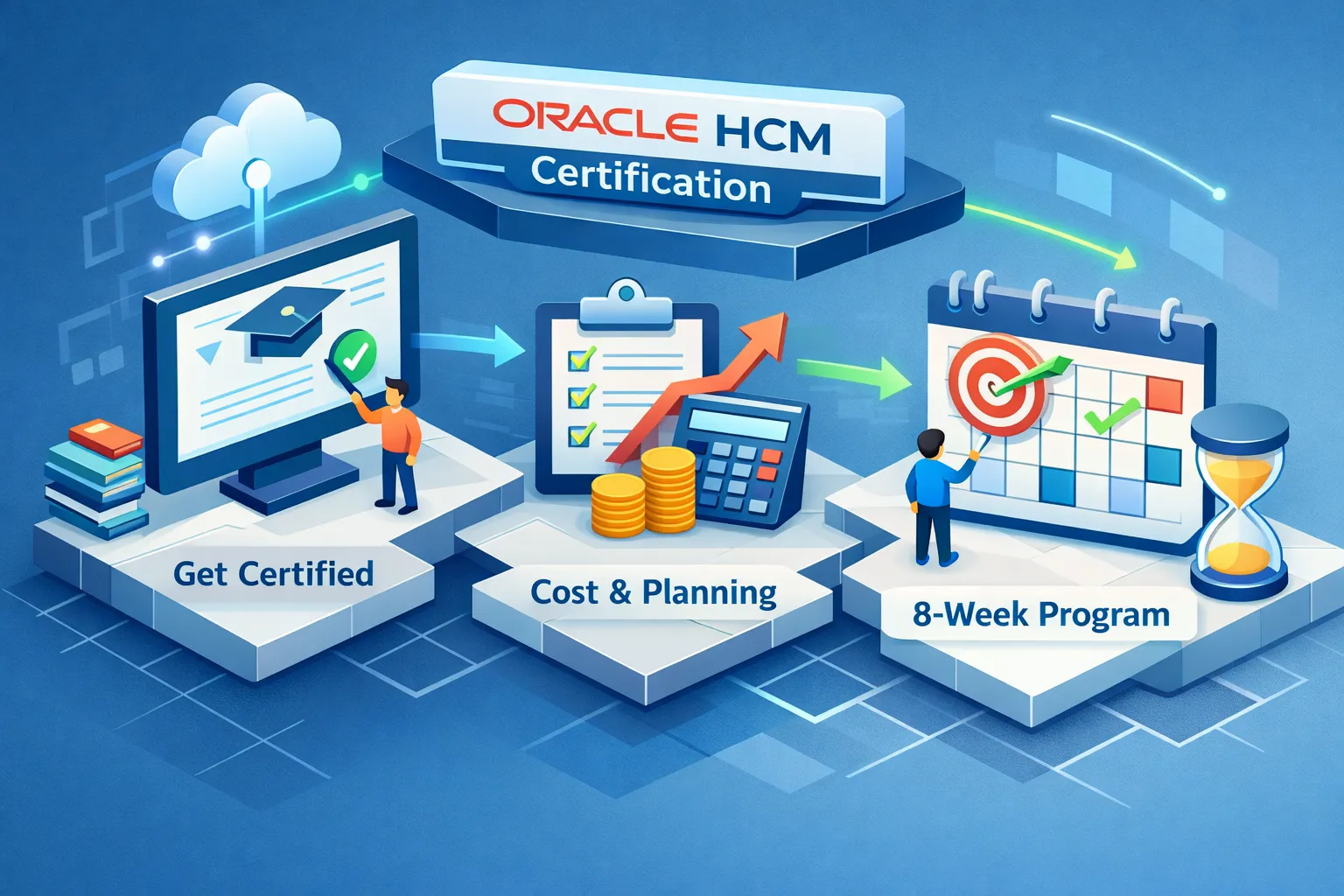
    Oracle HCM Certification: Clear Path, Cost & 8‑Week Plan

    If you need a fast, reliable route to certification, start with the Global HR (Core HR) implementation path, plan for 6–8 weeks at about 10–12 hours per week, and budget roughly $200–$300 per exam (many sit near $245). Use Oracle University blueprints plus hands‑on labs; at CloudShine we train candidates on live Fusion instances and run a tested 8‑week plan that follows the schedule below.

    This guide is for career pivoters, recent aspirants and enterprise teams. Read on to pick the right exam, register correctly, follow a practical week‑by‑week study plan and choose the training route that actually gets you job‑ready.

    Which Oracle Fusion Cloud HCM certification path fits your goals

    Oracle’s HCM credentials are modular: Global HR (Core HR) is the standard entry point, while Payroll, Compensation, Benefits, Recruiting and Talent are specialist tracks. Pick a path that maps to the role you want to perform day‑to‑day.

    Decide by three factors: job role (implementer vs admin vs specialist), your current experience, and employer needs/support. Examples you’ll see on Oracle University include Global Human Resources Cloud Implementation Professional (example code: 1Z0‑1046‑24) and Compensation or Payroll implementation exams (codes vary). Always verify exact codes and prerequisites on Oracle University before booking.

    Simple decision rule:

    • No prior HCM experience → start with Global HR (Core HR).
    • HR practitioner focused on payroll/compensation → select the corresponding specialist module.
    • Employer sponsoring you → pick the role your employer needs for current projects.

    Quick task: open Oracle University’s certification catalog now and copy the exact exam code and blueprint link for your chosen path. Save that screenshot — it will direct everything that follows.

    Exam format, fees and registration — facts you must know

    Format varies by module and over time. Many HCM exams remain multiple‑choice (MCQ), while recent implementation professional exams combine MCQs with hands‑on, performance‑based tasks in a lab environment. Check the blueprint for format, topic weights and recommended materials.

    Typical expectations: question counts commonly sit between ~60–110 items for MCQ‑heavy exams; some performance sections are timed tasks. Pricing usually falls in the $200–$300 band (many Oracle Cloud HCM exams are ~$245 USD), though region/currency differences apply.

    How to register (short):

    • Open the exam page on Oracle University and read the blueprint and prerequisites.
    • Create or log into your Pearson VUE/Oracle testing account.
    • Choose remote proctored or test‑centre delivery, pay, and schedule the slot.
    • Save confirmation email and the exam code screenshot.

    Money‑saving tips: an annual Oracle Cloud Learning Subscription often includes three exam attempts and broad course access; self‑paced labs can be rented (examples: $29/month or $299/year through OU in some offers). Ask your employer for reimbursement—many corporate upskilling budgets cover these subscriptions.

    Short checklist to capture now: Oracle exam page URL, exam code screenshot, acceptable photo ID, a credit card for payment, and a test day plan (remote or centre).

    The 8‑week study plan you can follow

    Plan for 10–12 hours/week (60–100 total). If you can block more time, compress to 6 weeks; if you work full time, spread across 8 weeks. The goal: concept → hands‑on → mock under time pressure.

    Weeks 1–2: Foundation (10–12 hrs/week)

    Read the blueprint start‑to‑finish. Complete Oracle University “Getting Started” and HCM Process Essentials. Build a one‑page cheat sheet listing core entities (Legal Entity, Business Unit, Person Record). Milestone: hit ~70% on module quizzes.

    Weeks 3–4: Core modules and lab practice (12–15 hrs/week)

    Deep dive Core HR, People Management, Security and Data Structures. In a live instance, configure a sample legal entity, create person records and assign roles. Milestone: complete three real tasks on a live Fusion instance (hire, transfer, terminate sequence).

    Weeks 5–6: Specialist areas & integrations (12–15 hrs/week)

    Study Talent, Absence/Time, Benefits and basic Payroll integration points. Run scenario labs that cross modules (hire → payroll eligibility → benefits enrollment). Take timed module practice tests and focus remediation on weak topics. Milestone: 85%+ on module practice tests.

    Weeks 7–8: Mock exams & polish (10 hrs/week)

    Run two full timed mocks (one MCQ, one hands‑on where applicable). Re‑run weak labs and review the latest release notes for any quarterly changes. Milestone: consistent 90%+ on two full mocks; schedule the exam.

    Resources each week: Oracle University lessons & lab subscriptions, curated Udemy practice sets (use only high‑rated ones), and CloudShine lab exercises + mock interviews if you need placement support. If you already have strong HCM experience, compress Weeks 1–4 into three weeks and use the remaining weeks for exam polish.

    Best training routes — and why CloudShine matters

    Options in plain terms: Oracle University (canonical content, paid labs), self‑study + paid practice tests (cheapest but variable quality), and instructor‑led bootcamps/mentorship programs (faster, costlier). The differentiators are live‑instance access, mentor quality and post‑training placement help.

    Route Speed Hands‑on access Placement help
    Oracle University Moderate Paid labs Limited
    Self‑study + Udemy Slow–Moderate Depends (often none) None
    CloudShine instructor‑led Fast Live Fusion instances (continuous) Resume & mock interviews; placement cell

    CloudShine facts: we provide live Oracle Fusion instances, follow a 60:24 instructor‑to‑lab hour model, and our mentors have 15+ years of implementation experience. We also operate a placement cell offering resume building and mock interviews. If you lack instance access or interview coaching, choose an instructor‑led program with live labs — that investment shortens time to job‑readiness.

    Exam tactics, hands‑on tips and the exam‑day checklist

    Study the blueprint, practice labs, and learn to trace end‑to‑end processes (hire → payroll eligibility → benefits). Focus on scenarios: what business outcome changes when you modify X configuration?

    During the exam, quick scan all questions first, answer the easy MCQs, then methodically complete hands‑on tasks while saving time for review.

    Common pitfalls: ignoring quarterly release notes, using outdated sandbox versions, and rote memorization without understanding business impact.

    • Exam‑day technical checklist: stable internet, updated browser, government ID, test software installed and verified, quiet room, snacks, and a mock‑exam timer synced to the test duration.

    Last‑minute one‑page review: key tables/entities, navigation shortcuts, common configuration screens and six practice actions (create legal entity; hire person; configure job; assign role; run payroll eligibility; build OTBI report). Mini exercise: perform a timed configuration (30–45 minutes) a week before the exam and record the steps—you’ll be faster and less error‑prone on test day.

    After you pass: getting hired, next steps and FAQs

    Immediately add your certification badge to LinkedIn and include 3–4 bullets showing hands‑on tasks you completed (for example: configured legal entities, completed hire‑to‑retire flows, built an OTBI report). If you trained with CloudShine, engage the placement cell for mock interviews and system demo practice.

    Career roadmap: specialize in Payroll, Compensation or Integrations; add OTBI/Reporting, basic Cloud Integration skills or functional testing to stand out. Maintain skills by subscribing to Oracle release notes and re‑running two key labs each quarter.

    FAQs

    How much does an HCM Cloud exam usually cost? Most HCM Cloud exams are in the ~$200–$300 range (commonly ~$245 USD); check Oracle University guidance on certification costs or Pearson VUE for exact regional pricing.

    Which exam should I take first if I’m new to HCM? Start with Global HR / Core HR—it covers the foundational entities and processes that other modules build on.

    Can I pass without hands‑on access? You might pass theory questions, but hands‑on tasks and interview readiness require live lab practice—strongly recommended.

    When should I book the exam and what’s the retake policy? Book once you consistently score 90%+ on full mocks. Retake policies vary; Oracle generally allows retakes but check the specific exam page for rules and waiting periods.

    Does CloudShine provide lab access and placement assistance? Yes—CloudShine offers continuous live Fusion instances, mentor hours, and a placement cell with resume help and mock interviews; confirm batch schedules and pricing with admissions.

    Final 3‑step checklist: verify the current exam blueprint on Oracle University, build your 8‑week calendar with blocked lab slots, and only book your exam after hitting the mock exam milestones outlined above.

    Direct next step: check the Oracle University exam page for the exact code and blueprint for your chosen path, then either enroll in a CloudShine live‑lab batch or schedule your lab subscription and start Week 1 tasks. Have questions or want a sample week‑by‑week calendar? Comment below or visit the CloudShine training page to see upcoming batches and lab options.

    Short checklist to capture now: Oracle exam page URL, exam code screenshot, acceptable photo ID, a credit card for payment, and a test day plan (remote or centre).

  • Best Software Training Institute in Chennai with Placement

    Best Software Training Institute in Chennai with Placement

    If you want a reliable software training institute in Chennai that actually helps you get hired, choose a centre that publishes cohort placement reports, runs live projects, and provides verifiable alumni outcomes — not just marketing slogans. Below you’ll find a short, practical pick list by job role, a repeatable seven‑point audit to verify placement claims, and a one‑week action plan so you can apply confidently.

    Note: this guide uses Chennai examples but also highlights CloudShine as a practical alternative for enterprise/ERP careers because of its live‑instance labs, project‑based curriculum and layered placement support.

    Quick shortlist: pick by job role, not the loudest promise

    Developer entry roles (Java / Python / Full‑Stack): Besant Technologies, ACTE, and Livewire are common picks. Choose the one that offers a capstone project, public demo recordings, and structured mock interviews — those are the features that actually help you clear interviews.

    Testing / QA and short bootcamps: Hejex Technology and FITA Academy surface often. Prioritise small batches and demonstrated automation capstone projects (Selenium/Appium pipelines and CI/CD test runs), not just scripted lectures.

    Enterprise ERP / Oracle / Cloud roles: CloudShine is the recommended alternative for enterprise tracks. Demand live Oracle Fusion instances, 100% practical labs, mentorship from trainers with 15+ years of experience, and clear placement‑guarantee tiers before you enrol.

    Quick verification to ask up front: cohort placement reports, sample offer letters, and a LinkedIn alumni list for the most recent batch.

    The 7‑point placement audit I use (ask for evidence)

    1. Cohort‑wise placement report. Ask for enrolled vs placed counts by month/year and roles. This shows actual throughput, not marketing percentages.
    2. Anonymized offer letters or employer confirmation. Request company name, role and CTC band. Sample offer letters prove real hires.
    3. LinkedIn alumni export. Ask for a LinkedIn list or alumni URLs for a recent batch — at least 20% of a batch should show job changes if the claim is meaningful.
    4. Recruiter visit logs / campus drive schedules. Dates and employer names indicate an active hiring pipeline rather than ad hoc claims.
    5. Placement guarantee T&Cs. Get the eligibility rules, refund process, and the number of guaranteed interview attempts in writing.
    6. Demo day recordings / capstone presentations. Capstone recordings prove students built interview‑ready work, not toy projects.
    7. Third‑party reviews or audits. Look for independent audits or verified testimonials on platforms that allow contact with former students.

    Red flags: vague “100% placement” claims without cohort data, buried fine print like “eligible students only,” or no alumni you can contact.

    Copy‑paste email to request placement proof:

    Subject: Request for cohort placement report and alumni links
    
    Hi [Placement Officer Name],
    
    I’m evaluating the [Course Name] starting on [start date]. Could you share: (1) the cohort placement report (enrolled vs placed) for the last 12 months, (2) 3–5 anonymized sample offer letters or employer confirmations, and (3) LinkedIn links for recent alumni from Chennai batches? I’ll review and decide within 48 hours.
    
    Regards,
    [Your Name] • [Phone] • [Email]

    Two‑minute phone script for the placement officer:

    Hi, I’m [Name]. I’m shortlisting training programmes for [role]. Before I join, can you confirm: average time‑to‑hire for graduates, whether you provide sample offer letters, and the exact eligibility for any placement guarantee? I have 2 minutes — can you hold those documents ready for email?

    Compare courses, fees, syllabus highlights and realistic outcomes

    Track Typical Duration Fee Range (INR)
    Python / Data Science 3–4 months ₹25,000–45,000
    Full‑Stack 3–6 months ₹30,000–70,000
    Testing / Automation 1–3 months ₹15,000–35,000
    Cloud / AWS 1–3 months ₹20,000–50,000

    Syllabus must‑haves: core language fundamentals, one capstone project with end‑to‑end code, version control (Git), basic deployment, and structured interview prep (live mocks and coding challenges). If a course lacks a capstone or deployment module, expect gaps when interviewers ask about production readiness.

    Interview‑ready outcomes: entry‑level titles you should target include Junior Developer, QA Engineer, and Data Analyst. Realistic time‑to‑hire after course completion is usually 2–6 months depending on market demand and how much interview practice you put in.

    How to map budget to outcome: low‑cost short courses suit immediate, low‑expectation hires; mid‑cost full‑stack or ERP programmes with placement support target longer salary increases and better roles. Prioritise verified placement outcomes over marginal fee differences.

    12‑institute snapshot: claims, evidence gaps and exact questions to ask

    Institute Claim Verified / Not Verified Two verification questions
    Aimore Technologies “100% placement support” Not verified (no cohort data) 1) Cohort placement report for 2023–25? 2) Top 10 recruiters (with dates)?
    Greens Technologys Placement track record, 3–8 LPA claims Not verified (no offer letters) 1) Sample offer letters for 2024; 2) LinkedIn alumni export for Chennai campus?
    Naresh i Technologies Live project training Partially verifiable (old records exist) 1) Recent capstone recordings; 2) Average time‑to‑hire for last 2 batches?
    FITA Academy Campus recruiters visit regularly Not verified (no recruiter logs) 1) Recruiter visit log for Chennai 2024–25; 2) Sample offer letters?
    Credo Systemz Placement assistance Not verified 1) Cohort placement figures; 2) CTC ranges for placed students?
    Besant Technologies Job guarantee courses Partial (some student lists shown; limited verification) 1) T&Cs for guarantee; 2) Alumni contacts for the 2023 cohort?
    Livewire Full‑stack & data science focus Not verified 1) Recent demo day videos; 2) Capstone project repos?
    ACTE 100% placement support Not verified 1) Cohort placement lists; 2) Refund process if guarantee not met?
    Hejex Technology Small batches & live projects Partial (claims unverified) 1) Live project access evidence; 2) Batch size & trainer CVs?
    SLA Institute Tie‑ups with 1,000+ MNCs Not verified 1) Sample recruiter list for Chennai; 2) Recent placement report?
    Payilagam Placements at TCS / Infosys Not verified 1) LinkedIn alumni confirmations; 2) Sample offer letters?
    Aptech (local) National network placements Not verified (no Chennai‑specific stats) 1) Chennai campus placement report; 2) Recruiter visit log?

    Application checklist + contact scripts to convert placement opportunities

    1. Shortlist 2–3 institutes by course fit and budget.
    2. Send the audit email requesting placement report, offer letters and alumni links.
    3. Attend demo classes and verify capstone depth (ask to see a recent capstone in full).
    4. Request written placement T&Cs and a recruiter list; schedule a 10‑minute call with the placement officer.
    5. Negotiate fees — mention you’ll decide within 48 hours if proof is provided; ask for concessions if you bring referrals.
    6. Enrol, get the batch schedule, and start interview prep the day classes begin.

    Final verdict & next steps — pick and apply in 7 days (where CloudShine fits)

    1. Day 1: Shortlist 2–3 programmes by role and budget.
    2. Day 2: Send audit email to each and request demo class links.
    3. Day 3: Attend demos and review capstone recordings.
    4. Day 4: Call placement officers, verify T&Cs, and request sample offer letters.
    5. Day 5: Compare offers, fees, schedules and decide on concessions.
    6. Day 6: Negotiate and finalise enrolment paperwork.
    7. Day 7: Enrol and share your resume + project links with the placement cell.

    If your target is enterprise ERP or Oracle Fusion roles, CloudShine is a practical pick because it provides live Oracle Fusion instances, 100% practical labs, trainers with 15+ years of implementation experience, and a placement cell that offers resume workshops, mock interviews and tiered placement‑guarantee options. If you want a short placement‑clarity call, CloudShine’s placement team offers a 15‑minute review where they’ll: confirm course fit, show sample capstones, and explain placement guarantee eligibility.

    Further reading — Cloud & Oracle resources: For more background and implementation‑level reading, see What is Oracle Fusion Cloud and Why Does It Matter, an intro to SCM modules in Oracle Cloud Applications, the Oracle Fusion Supplier Portal important roles guide, a practical note on Order to Cash back‑to‑back buy flow, and a troubleshooting piece on common errors in Oracle Fusion cost accounting.

    Summary & call to action

    Shortlist two institutes, demand cohort evidence, and prioritise capstone work and verifiable alumni outcomes. If you need help verifying claims or want a neutral placement review, book a 15‑minute placement‑clarity call with CloudShine’s team — they’ll show live‑instance proof and placement T&Cs so you can decide with confidence.

    FAQs

    Q: How do I know a placement guarantee is real?
    A: Ask for written T&Cs that include eligibility, the number of guaranteed interview attempts, and a refund clause. Verify with sample cohort outcomes and offer letters.

    Q: What documents should I prepare before contacting institutes?
    A: One‑page resume, GitHub/portfolio links, two sample projects, and an availability calendar for interviews.

    Q: How long before I can expect a job after a bootcamp?
    A: Typically 2–6 months. Outcomes depend on role, market demand, and interview practice intensity.

    Q: Are online‑only institutes less likely to place me?
    A: Not necessarily. Prioritise evidence of live projects, alumni in real jobs, and an active recruiter pipeline over delivery mode.

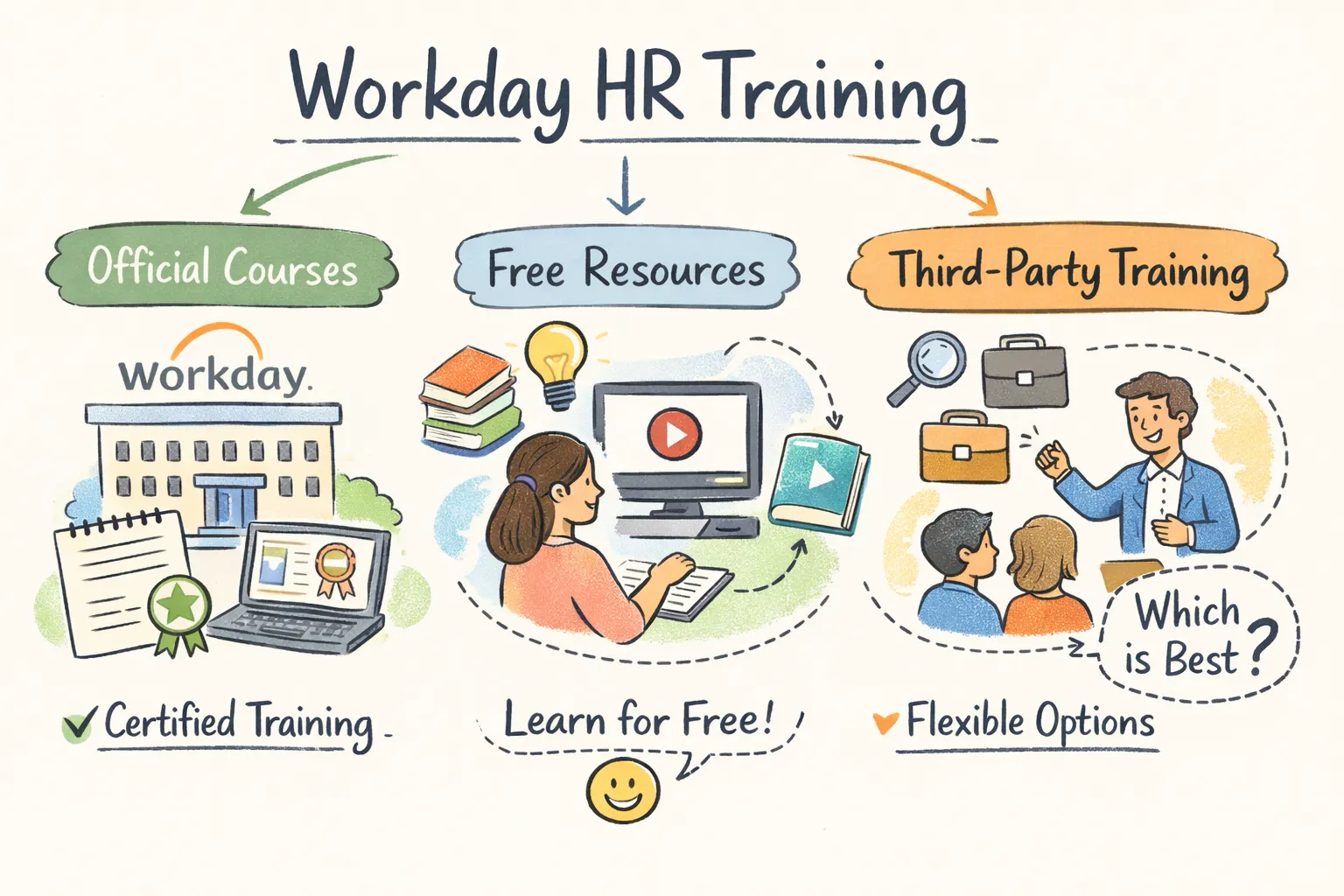
  • Workday Training Certification: Paths, Costs & Exam Plan

    Workday Training Certification: Paths, Costs & Exam Plan

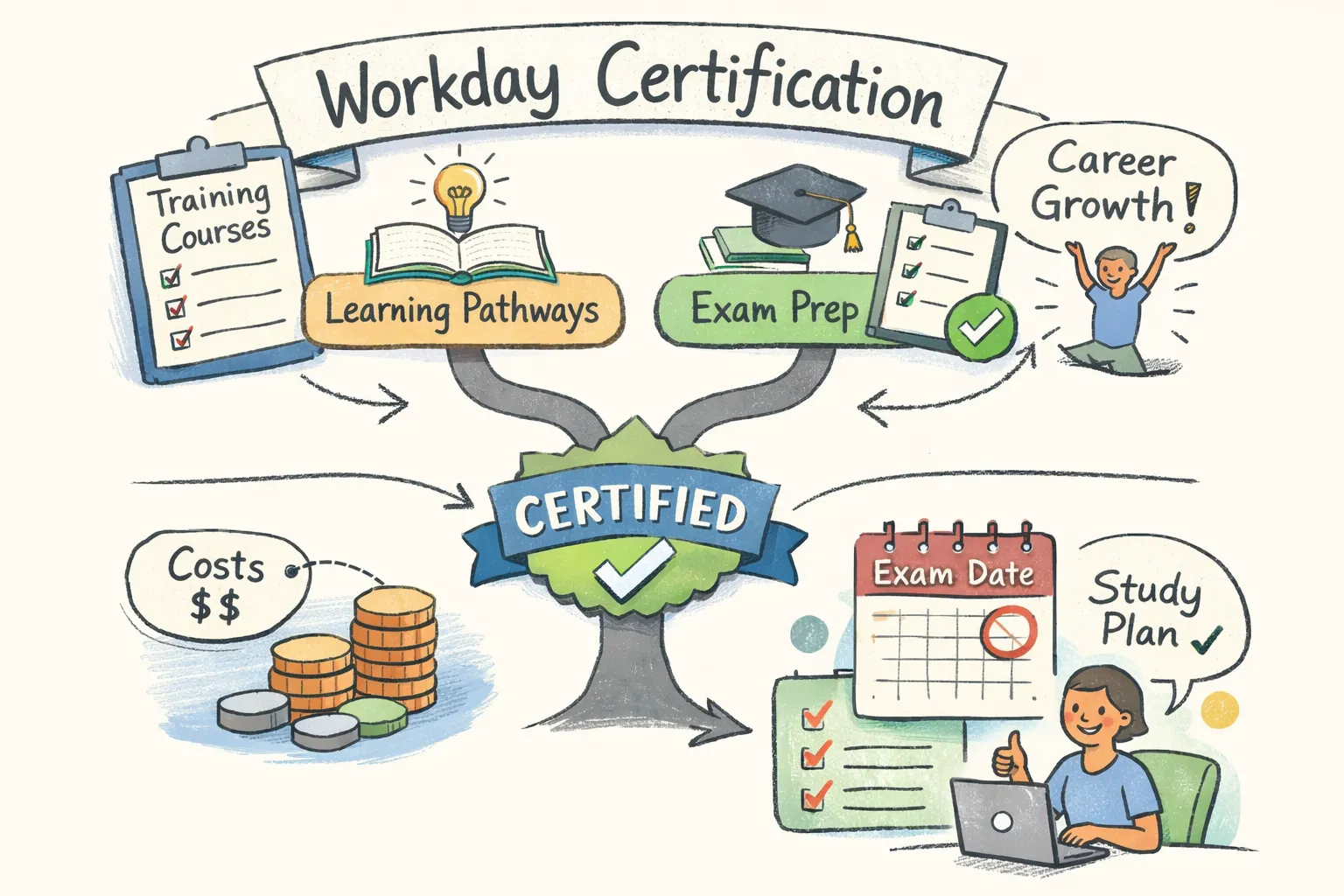
    If you’re an HR, finance, or integrations professional, a Workday training certification can accelerate hiring and salary momentum — but official Workday courses are often restricted and expensive. This guide maps the common certification tracks, gives realistic costs and timelines, and lays out a practical 4–8 week exam plan, including how CloudShine’s hands‑on bootcamps help unaffiliated learners get job‑ready.

    What you’ll get: a quick decision map, training tradeoffs (official vs third‑party), three sample budgets, a concrete study timeline, registration steps, and interview‑ready next actions.

    Quick verdict: Is a Workday certification the right next step for you?

    Short answer: Yes if you need employer recognition or deep product skills; choose third‑party bootcamps if you’re unaffiliated and need hands‑on practice quickly. Official badges matter to employers; practical tenant experience gets you interviews.

    Pivoter (experienced IT/ERP or finance pros)

    If you’re moving from legacy ERP to cloud ERP, certification plus real tenant hours shortens the hiring curve. You should target a functional cert aligned to your background (Financials for finance, Integrations for middleware engineers).

    Aspirant (recent grads or career starters)

    If you need job‑ready artifacts and interview practice, prioritize hands‑on bootcamps and a portfolio project over chasing official partner-only badges you can’t access.

    Enterprise (internal upskilling)

    If your employer will sponsor training and exams, the official Workday Academy route is often the fastest path to internal roles and promoted pay bands.

    Quick checklist to decide now:

    • Employer‑sponsored? Go official.
    • Need tenant/Lab access and placement help? Choose a reputable bootcamp (CloudShine included).
    • Only need basic end‑user skills? Start with self‑paced content.

    Actionable takeaway: If your company will pay, ask HR/Training to enroll you. If not, skip waiting — read section 3 to evaluate bootcamps that include live instance practice and placement help.

    Which Workday certification fits your role?

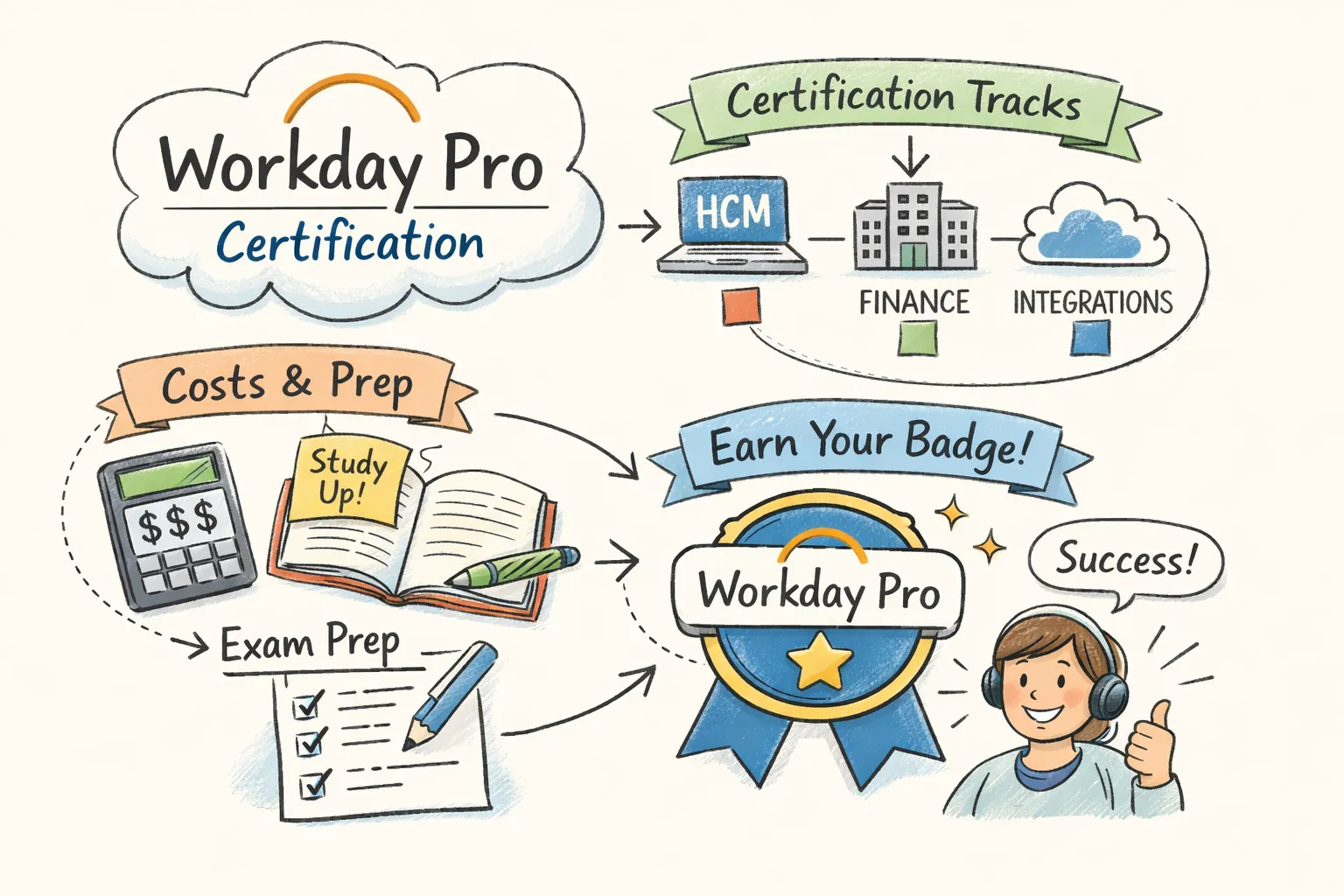
    Direct answer: Pick the certification by the job you want, not by what sounds trendy — HCM for HR, Financials for finance, Integrations for technical roles, Platform Admin for system admins, and Workday Pro for broad operational mastery.

    Workday Pro: Broad operational mastery aimed at customers and service teams; good for administrators who manage security, tenant updates and business processes.

    HCM (Core/Payroll/Recruiting): Covers hire‑to‑retire configuration, payroll, recruiting workflows — ideal for HR practitioners and implementers.

    Financials: Focuses on GL, AR/AP, reporting and period close — choose this if you’re a finance or accounting professional moving into ERP roles.

    Integrations: Workday Studio, connectors and APIs for middleware and technical consultants who build system-to-system flows.

    Platform Admin: Tenant management, configuration testing and release control — aimed at system administrators keeping the instance healthy.

    Prism/Adaptive: Treat analytics and planning (Prism, Adaptive Planning) as complementary skills; they increase hireability but often aren’t the primary cert employers ask for.

    Time & exam expectations (ballpark): HCM / Financials — 4–8 weeks of study with course/lab time; Integrations — 6–10 weeks; Platform Admin — 2–6 weeks depending on prior platform exposure. Exams are typically proctored and require hands‑on familiarity more than pure theory.

    Actionable takeaway: Choose one primary cert and one complementary skill (for example HCM + Integrations). Write a 3‑month goal with weekly milestones: training, 20–40 tenant hours, two mock exams, portfolio artifacts.

    For a quick overview of popular certification tracks, see this list of top Workday certification courses.

    Training routes: Official Workday Academy vs self‑study vs bootcamps — and where CloudShine helps

    Direct answer: Official Workday training is authoritative but often restricted and costly; self‑study is economical for end users; third‑party bootcamps give unaffiliated learners practical tenant access and interview readiness.

    The official Workday Academy provides the definitive curriculum and is required for some partner roles. It’s recognized by employers but access is usually limited to Workday employees, partners or paying customers and units are expensive (see next section). For enrollment details, refer to the Workday enrollment job aid.

    Self‑paced options (Workday Learning, Coursera integrations) are low cost and useful to learn concepts. They rarely include a live tenant or mentor guidance, so they’re fine for end users but insufficient for consultant‑level interviews.

    Third‑party bootcamps combine live labs, scenario projects and mentor coaching. They’re unofficial but highly practical: students finish with configuration hours, problem logs and interview artifacts employers value.

    At CloudShine we replicate implementation realities: live cloud instance access, scenario‑based projects that mirror hire‑to‑retire and procure‑to‑pay cycles (see related posts on Oracle Fusion Self Service Procurement Important Roles | CloudShine and Oracle Fusion Inventory Management Important Roles | CloudShine), expert mentors with 15+ years of experience, and a placement cell that provides resume reviews and mock interviews. Our 100% practical model (60 instructor hours + 24+ lab hours) is designed to bridge the “no‑employer” gap.

    If your employer pays, go official. If you need hands‑on practice and hiring support, pick a bootcamp with live tenant access. If your goal is basic user knowledge, start self‑paced content and add labs later.

    Actionable takeaway: Decide your delivery method this week and book your first slot — an official course, a CloudShine bootcamp intake, or a start date for self‑study.

    Costs, time and budgeting — realistic numbers you can rely on

    Direct answer: Expect an $800 exam fee plus official training units at roughly $800 per unit; total investment usually falls between $1,500 and $3,500 depending on route and experience.

    Official route: Workday commonly charges about $800 per exam attempt. Instructor‑led courses are often priced by training units at ~$800/unit; typical courses run 1–5 units, so a multi‑day course can be $800–$3,200 on top of the exam fee.

    Third‑party bootcamps: Prices vary widely, from roughly $300 on the low end up to $2,000 for full bootcamps that include labs and placement support. Expect to pay more for guaranteed placement or extended mentorship.

    Extras to factor: retake fees (another $800), paid practice exams, travel for proctored tests (if required), and the opportunity cost of study hours.

    Sample budgets:

    Employer‑sponsored: Employer pays training units and exam; your out‑of‑pocket is typically zero—just schedule time (2–8 weeks).

    Independent bootcamp: Bootcamp $700–$1,500 + exam $800 = $1,500–$2,300 outlay; plan for 6–8 weeks of part‑time study.

    Career pivoter (official + prep): Official course(s) $1,600–$3,200 + exam(s) $800 + mock/interview prep $200–$500 → $2,600–$3,500 total and 8–12 weeks to build a hireable portfolio.

    Actionable takeaway: Pick the sample scenario closest to you and write one line: “Total $ / Weeks to commit / Who pays.” Add an $800 buffer for a possible retake.

    Exam format, passing score, retake policy and a practical 4–8 week study plan

    Direct answer: Most Workday exams are proctored, closed‑book, roughly 50 questions in 120 minutes with a passing threshold commonly around 80%; the effective study mix is course content + tenant practice + timed mocks.

    Exam structure: Expect multiple‑choice and multi‑select scenario questions. Results are typically pass/fail; confirm exact rules for your target exam. Retake rules and wait periods can vary — a short waiting window (several days) is common.

    Study components to prioritize: official course materials, 20–40 hours in a live tenant practicing configuration and business processes, two to three timed mock exams, and focused flashcards for multi‑select logic.

    Practical plan templates:

    • 4‑week fast track (experienced): 6–10 hours/week. Week 1: review fundamentals + 8 tenant hours. Weeks 2–3: deep config labs. Week 4: two timed mocks and weak‑spot remediation.
    • 6‑week standard (novice): 8–12 hours/week. Weeks 1–2 fundamentals and concepts; Weeks 3–4 practical builds and test cases; Week 5 one full mock + fixes; Week 6 final revision + exam.
    • 8+ week deep dive (career pivot): 6–8 hours/week spread over structured projects, integration scripts, reporting exercises and a portfolio deliverable for interviews.

    Exam‑day checklist:

    • Stable internet, quiet room and government ID ready.
    • Device with required browser and proctor software installed; run a 10–15 minute pre‑check.
    • Have notes/flashcards reviewed and two timed mocks completed in the 48 hours before the exam.

    Actionable takeaway: Choose your timeline (4/6/8 weeks), book the exam slot at the end of your calendar, and schedule two mock exams into your plan.

    How to register, take the exam, recertify and convert the cert into a job (plus FAQs)

    Direct answer: Official exams generally require employer or partner enrollment through Workday channels; unaffiliated candidates should use third‑party programs (CloudShine and similar bootcamps) to gain tenant hours and placement support.

    Registration & logistics: If you work for a Workday customer or partner, request enrollment via your learning admin or Workday Education contact. Independent learners should evaluate bootcamps that bundle live tenant access and mock interviews, or contact authorized partners for occasional public seats (see this practical guide on how to get Workday certification for more on pathways).

    Recertification and currency: Workday updates frequently; plan on periodic recertification or continuing education (Workday moved to more structured recert cycles recently — verify the latest schedule for your target cert). For recent changes and what they mean for learners, review this overview of Workday certification and training changes. Keep a log of tenant hours and training activities to demonstrate currency to employers.

    Turning certification into interviews: Put measurable artifacts on your resume — cert name, tenant hours, and concise project bullets (e.g., “Configured hire‑to‑retire business process in a 5,000‑employee mock tenant”). Build three mini‑stories for interviews: a design tradeoff (e.g., approvals and business process design — see Understanding Fusion Purchasing Approvals Hierachy | CloudShine), a bug triage, and an integration troubleshooting case. Export anonymized screenshots, process maps and test scripts as portfolio appendices (example process flows: Oracle Fusion Sales Order to Shipment Cycle | CloudShine).

    CloudShine placement support: Our bootcamps pair live instance practice with resume workshops and mock interviews. We help candidates convert lab work into interview‑ready portfolio items and offer tiered placement‑guarantee tracks for qualified learners.

    FAQs

    Q: Can I get Workday certified without a partner or customer employer?
    A: Official badges are generally restricted; use reputable third‑party bootcamps with live labs to gain practical experience and interview readiness.

    Q: How much does certification cost?
    A: Expect roughly $800 per exam attempt plus training costs. Official instructor‑led courses are often ~$800 per training unit; total outlay typically ranges $1.5k–$3.5k depending on route.

    Q: What’s the exam format and passing score?
    A: Most Workday exams are proctored, ~50 questions in 120 minutes, with a pass threshold commonly near 80%; confirm specifics for your chosen track.

    Q: How long should I study?
    A: Experienced users can prepare in 4 weeks; novices should plan 6–8 weeks with focused tenant practice and mock exams.

    Q: Will certification get me a job?
    A: Certification helps, but hiring decisions hinge on demonstrable tenant hours, project artifacts, and interview performance. Certifications plus a portfolio and mock‑interview practice are the fastest path to offers.


    Summary: If an employer covers it, take the official path; if you’re independent, pick a practical bootcamp with live tenant access and placement support. Commit to one primary cert + one complementary skill (for example SCM — see An Intro to SCM Modules In Oracle Cloud Applications | CloudShine), budget for training + an $800 exam buffer, and follow a 4–8 week, lab‑first study plan.

    Ready to get hands‑on? If you’re unaffiliated and want live tenant practice plus resume and interview coaching, CloudShine’s Workday bootcamps are built to convert lab hours into hireable experience—apply for the next intake or request an orientation call to map your 8‑week plan.

  • Oracle Fusion Training: Complete Course, Cost & Cert Guide

    Oracle Fusion Training: Complete Course, Cost & Cert Guide

    If you need oracle fusion training that lands a job, pick a course with live lab access and a placement track. For consultants, go Implementation Professional; for freshers, start with Foundations + CloudShine’s placement program.

    CloudShine is a practical, hands‑on alternative that pairs live Fusion instances with placement support. Below I compare official vs third‑party options (cost, duration, labs, common exam codes) and give a clear 30/60/90 roadmap so you can enroll with confidence.

    Quick verdict: which Oracle Fusion training fits your role?

    Pivoter (experienced ERP/EBS or finance pros): Target an Implementation Professional track (Financials or HCM). Use Oracle University role paths for official content and add third‑party/live labs as needed — expect a 2–3 month focused program to move into cloud implementations.

    Aspirant (recent grads): Start with the Foundations Associate path, complete 60–80 hours of guided hands‑on work (CloudShine’s 60:24 model fits well), and build a placement‑ready project. Target 45–90 days depending on your starting point.

    Enterprise buyers: Buy Oracle University subscriptions for standardized learning and pair with a corporate upskill partner (CloudShine) to deliver bespoke labs and a Recruit‑Train‑Deliver model so new hires are billable quickly.

    Why this matters: Oracle certs provide recognition, but employers hire people who can configure flows and solve real issues. Official tracks + live instances balance credibility with job readiness.

    What Oracle University actually offers (paths, exams, and what’s included)

    Oracle uses a role‑based learning model: Foundations → Associate → Implementation Professional, with Implementation Professional often delivered as performance‑based, proctored exams. The learning subscription bundles digital courses, recommended paths and often some lab access.

    • Tier structure: Foundations Associate for basics, Associate for functional understanding, Implementation Professional focused on hands‑on scenarios and performance tasks.
    • Subscription & labs (approx): Oracle Cloud Learning Subscriptions typically run 12 months and may include three exam attempts. Self‑paced hands‑on labs are commonly listed at about $29/month or $299/year — confirm current pricing with Oracle.
    • Exam anchors (verify current codes): General Ledger — 1Z0‑1054‑26; Accounts Payable — 1Z0‑1055‑YY; Accounts Receivable — 1Z0‑1056‑YY. Implementation Professional exams may be performance‑based and proctored.

    Practical note: recent updates emphasize modernized processes (Redwood UI, AI‑assisted features). That means exam scenarios and employer expectations favor candidates who know the updated interfaces and end‑to‑end business flows, not just menus.

    Pros & cons: Oracle content is authoritative and certs carry weight, but official offerings can be expensive and sometimes sparse on continuous live instance time unless you buy extra lab subscriptions or partner training.

    Third‑party courses compared: labs, cost, and CloudShine’s practical edge

    Many learners pick third‑party providers to get more hands‑on time, lower cost, and a placement focus. When you evaluate vendors, confirm live instance access, real project labs, trainer industry experience, and placement support.

    Typical market offerings vary: providers run 30–80 hour programs; pricing depends on region and whether placement is included. Some vendors focus on conceptual modules, others on full cycle P2P/O2C or Hire‑to‑Retire lab projects.

    Provider snapshots (typical promise):

    • igmGuru — short to mid‑length ERP courses focused on module fundamentals (typical 30–40 hours).
    • OnboardERP — tailored end‑user and project training for corporate rollouts; emphasis on process adoption and documentation.
    • CloudShine — a 60:24 practical model (60 hours instructor + 24+ lab hours), live Fusion instances, resume and mock interview support, and a Recruit‑Train‑Deliver corporate option; trainers with 15+ years of experience and a track record training 500+ consultants.

    Why CloudShine’s model matters: access to live Fusion instances and scenario‑based labs means students can demonstrate full cycle work (configure a ledger, post journals, run payroll, set approval hierarchies) in interviews rather than reciting slides. The placement cell walks students through project summaries and mock implementations, which is what hiring managers actually ask for.

    Quick buyer tips: ask for a sample lab, request at least one mock interview, and confirm exam‑prep coverage (practice tests + performance task walkthroughs).

    How to choose: a practical checklist and role‑based recommendations

    Decision rule: pick the path that gets you to a demonstrable implementation task you can show on day one of an interview.

    Checklist (short): target role, time to hire, budget, employer sponsorship, required certification and level of live lab access. If lab time is critical, prioritize vendors that provide continuous instance access rather than occasional demos.

    Role recommendations:

    Finance/ERP implementer: Foundations → GL or Payables Implementation Professional. Focus on chart of accounts setup, period close and reconciliations (see Common Errors in Oracle Fusion Cost Accounting).

    HCM implementer: Foundations → Core HR + Payroll → HCM Implementation Professional. Build end‑to‑end hire‑to‑retire labs and payroll runs.

    New grad/aspirant: Foundations Associate + CloudShine placement track to get a CV‑ready project and 2–3 mock interviews.

    Corporate upskill: Oracle University subscription for standardized content + CloudShine corporate delivery for bespoke labs and Recruit‑Train‑Deliver execution (match training to specific procurement roles: Oracle Fusion Purchasing important roles).

    Example scenario: a payroll analyst moving into HCM — a focused 60‑day plan: Foundations (weeks 1–2), payroll configuration labs + 2 real payroll runs (weeks 3–6), mock implementation review and interview prep (weeks 7–8).

    Study plan, labs and exam prep (30/60/90 day roadmap)

    Day 0 checklist: pick your track, confirm the current exam code on Oracle’s site, register for Oracle MyLearn free modules, and reserve lab access (Oracle self‑paced labs or vendor instance). For a quick MyLearn guide see Oracle MyLearn: accelerating your path.

    30‑day sprint — foundations + core labs: Finish Foundations modules, complete 8–10 core labs (configure COA, create journals, basic OTBI report, run a payroll preview). Take an initial practice test to baseline gaps.

    60‑day ramp — configuration + mock projects: Complete full implementation flows (P2P, O2C, Hire‑to‑Retire), finish 2–3 full cycle labs, and present a short implementation playbook to a mentor. CloudShine’s placement track includes a mock implementation review at this stage.

    90‑day polish — exam & placement: Retake practice tests, book the certification window, record a one‑page project summary for interviews, and do 2–3 timed mock interviews with hiring‑grade feedback.

    Example lab task list to practice: configure a ledger and period close, create and post journals, configure pay elements, run payroll end‑to‑end, build an OTBI report, perform a data load with HCM Data Loader.

    Exam‑day tips: review a sample performance task in advance, allocate time to planning vs execution, know how to reference allowed Oracle docs during proctored tasks, and practice under timed conditions.

    Pricing snapshot, five next steps and FAQs

    Pricing (approximate): Oracle exam attempts — ~$245 per attempt; Oracle self‑paced labs — $29/month or $299/year (approx); Oracle Cloud Learning Subscription — request quote (Oracle lists enterprise subscription pricing); third‑party hands‑on courses — typically $500–$2,500 depending on region and placement services. CloudShine offers tiered, affordable packages with placement options — contact admissions for current rates.

    Five immediate next steps

    • Pick your track and verify the exact Oracle exam code for the current year on Oracle’s certification site.
    • Complete the free Oracle MyLearn Foundations modules to confirm the path.
    • Choose lab access: Oracle self‑paced labs or a vendor with live instances (CloudShine recommended if you need placement).
    • Build a 60‑day study plan and book a tentative exam window.
    • Schedule two mock interviews and a CV review (CloudShine placement cell or trusted peers).

    FAQs

    Do I need live instance access to pass Oracle Fusion certification? For Implementation Professional performance exams and real job readiness, yes — live labs make the difference between theory and implementation competence.

    How much do Oracle Fusion Cloud certification exams cost? Expect roughly $245 per attempt for many core exams; subscriptions may include exam attempts — verify current pricing before you book.

    Which certification should I take first as a finance professional? Start with Foundations, then General Ledger or Payables depending on where you want to specialize; move to Implementation Professional once you have hands‑on experience.

    Can third‑party courses replace Oracle University? They can for job readiness and labs, but official certs and Oracle’s role‑based paths come from Oracle — the most efficient route is a mix of official content plus vendor labs and placement support.

    Where can I find free Oracle Fusion Cloud introductory courses? Oracle MyLearn offers free Foundations and product essentials — use those modules to validate the track before paying for labs or paid courses.

    If you want a quick consult to pick the right track, CloudShine’s admissions team can map your profile to a 30/60/90 plan and share current batch pricing.

  • Workday Certification Course: Top Paths, Costs & 90‑Day Plan

    Workday Certification Course: Top Paths, Costs & 90‑Day Plan

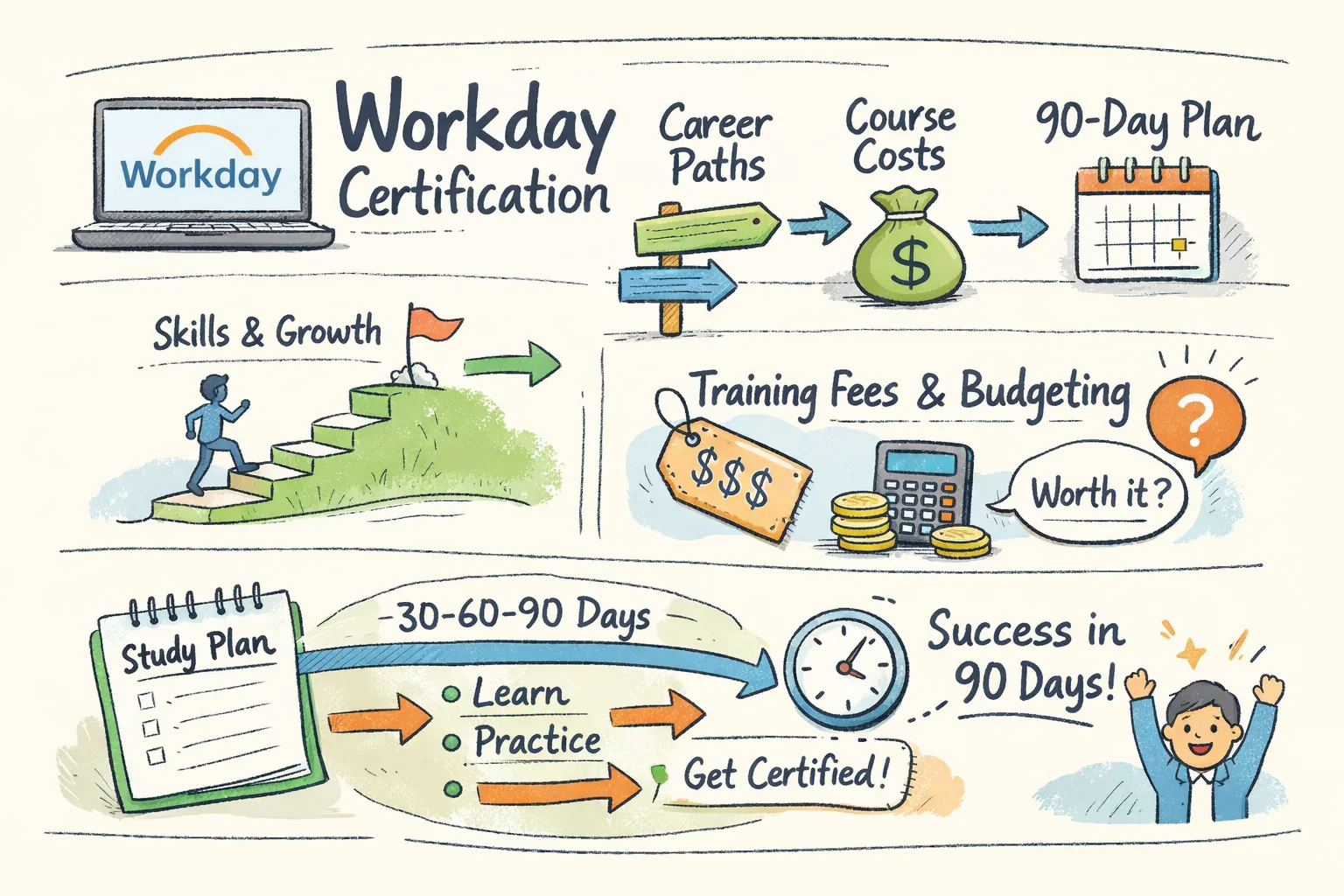
    Short answer: Yes—you can become Workday certified, but the fastest route depends on whether your employer is a Workday customer/partner and can sponsor access to the Workday Learning Center. This workday certification course guide compares official and third‑party routes, lays out costs and exam rules, and gives a week‑by‑week 90‑day study plan you can follow; CloudShine’s practical, placement‑focused approach is used as a job‑ready example.

    Official vs third‑party: which training path is right for you?

    Quick takeaway: If your employer can enroll you as a Workday customer or partner, the official path gives the credential employers recognize; if not, choose a third‑party provider that guarantees sandbox time and placement support. Both paths prepare you for real work, but they serve different access and budget realities.

    Official Workday training and Workday Pro certification carry the strongest brand credibility because exams and transcripts are issued through the Workday Learning Center. The downside is eligibility: many pro-level tracks require employer sponsorship, and official instructor‑led units are billed per “training unit,” which makes upfront cost higher.

    Third‑party programs allow open enrollment, faster starts, and often lower sticker prices. The trade‑off is they cannot issue Workday Pro credentials — instead they must demonstrate job readiness through live labs, projects, and interview prep, which many hiring managers value equally when backed by demonstrable work.

    Decision shortcuts: if you have employer/partner access, pursue official certification. If you need a fast, interview‑ready portfolio, prioritize third‑party training that bundles real instance time and placement coaching. If your independent budget is under roughly $2k, look for bootcamps that include sandbox hours and placement assistance.

    CloudShine note: CloudShine positions itself as a practical route—live Workday labs, mentor support from consultants with 15+ years’ experience, a 60:24 teaching‑to‑lab ratio, and a placement cell focused on resume and mock interviews.

    Which Workday credentials exist — and which jobs they open

    Quick takeaway: Start with a foundational credential—Platform Administrator or HCM Core—then specialize into Compensation, Reporting, Integrations, or Financials depending on the role you want.

    Platform Administrator: targets system/admin roles and technical consultants who maintain security, business processes, and tenant health. HCM Core and module certifications (Compensation, Recruiting, Payroll) map to HRIS analyst, implementation consultant, or HR operations roles. Financials (Record‑to‑Report, Procure‑to‑Pay) feed finance/ERP consultant and GL/AP specialist roles. For related Oracle process coverage see Oracle Fusion Financial Control & Reporting Important Roles | Oracle Financials Cloud | CloudShine.

    Adaptive Planning suits FP&A analysts and financial modelers; Integrations and Security certifications suit integration consultants and security administrators who handle EIBs, Workday Studio, and domain security. Employers usually hire a mix: admins to run the tenant, specialists to own modules, and integrators for cross‑system work.

    Choose by persona: The Pivoter (ERP or finance background) often begins with Platform Admin or HCM Core plus a specialist module. The Aspirant (recent graduate) should focus on HCM Core and reporting, then build a portfolio of reports and small integration demos. Enterprise buyers should certify people for the exact process they own (e.g., Hire‑to‑Retire or Procure‑to‑Pay) — see also Oracle Fusion Sales Order to Shipment Cycle | Order to Cash Life Cycle | CloudShine for an Order‑to‑Cash perspective.

    Actionable choice: target HCM Core or Platform Administrator as your first certified area; plan specialization after 6–12 months of sandbox experience.

    Cost, formats and what hands‑on practice must include

    Quick takeaway: Official training and exams are pricier but authoritative; third‑party pricing varies widely—prioritize providers that include live sandboxes and configuration tasks rather than video-only syllabi.

    Reality check on prices (verify before you buy): official instructor‑led courses are often billed by training unit, commonly around $800 per unit; exams are commonly reported at ≈ $800 per attempt. That puts many official paths in the $1,500–$4,000 range depending on units required. Third‑party bootcamps span roughly $500–$3,000 depending on depth and whether sandbox/placement is included. (Workday’s official education datasheet outlines typical training formats and unit concepts: Workday Education & Training datasheet.)

    • Essential hands‑on items any serious program must provide: an admin sandbox for orgs and positions, data‑load practice (iLoads and EIBs), reporting and calculated fields labs, security & business process configuration with testing scenarios, and at least a basic integrations lab.

    What to ask a provider: “Do I get dedicated sandbox access and how many lab hours are included?” “Can I practice iLoads and EIBs?” “How many mock interviews and resume reviews are included?” “What real project work will I submit?”

    CloudShine as a template: CloudShine’s curriculum is 100% practical, provides live tenant access, pairs experienced trainers (15+ years) with a 60:24 instruction‑to‑lab model, and includes a placement cell for resume and mock interview coaching — the package you should expect from a job‑focused vendor.

    Actionable takeaway: if a vendor can’t promise sandbox time and mock interviews, budget an extra ~20% for supplemental lab access or choose a different provider. For broader context on third‑party certification routes and comparisons, see this third‑party guide to Workday certification.

    Exam mechanics: format, pass score, retakes and recertification

    Quick takeaway: Workday exams are proctored, closed‑book and scenario‑heavy. Plan your study around timed mocks plus targeted sandbox drills rather than just watching videos.

    • Format and rules: most module exams contain around 50 multiple‑choice and scenario questions, timed at roughly 100–120 minutes, closed‑book and proctored through the Workday Learning Center. Passing thresholds commonly fall between 70–80% (verify the exact score for your module). Retakes usually require a training credit or fee (reported ≈ $800) and may have a short waiting period. Recertification cadence is commonly two years.

    Exam‑day checklist: secure a quiet room, stable internet, webcam and a valid photo ID; do two full timed mocks in the final week; bring a one‑page error log of topics you struggled with for quick last‑minute review (noting, not to consult during the exam). For official enrollment and proctoring procedures see the Workday Pro enrollment job aid: Enrollment: WorkdayPro Job Aid.

    Actionable takeaway: schedule your exam only after completing three full timed mocks and at least 20 hours of targeted sandbox practice on your weakest topic areas.

    A practical 90‑day study & enrollment plan

    Quick takeaway: A focused 12‑week plan splits into onboarding, core builds, integrations/reporting, then consolidation and exams. Adjust hours for working learners versus full‑time bootcampers.

    Time budgets: working professionals — plan 10–15 hours/week (evenings + weekends); full‑time learners — 25–35 hours/week for bootcamp intensity.

    1. Week 1 — Orientation & baseline: decide official vs third‑party, enroll, get sandbox access, create a study tracker and tentatively schedule your exam. Deliverable: sandbox login and calendar.
    2. Weeks 2–4 — Core fundamentals: navigation, org structures, positions, staffing, and basic business processes. Deliverable: three sandbox configuration tasks completed.
    3. Weeks 5–6 — Security & business processes: configure end‑to‑end hire→comp→termination flows and test approvals. Deliverable: recorded business process walkthrough. For practical guidance on approval hierarchies, see Understanding Fusion Purchasing Approvals Hierachy | Know about Oracle Fusion Approval Methods | CloudShine.
    4. Weeks 7–8 — Reporting & calculated fields: build five reports (headcount, comp, turnover, open requisitions, cost center summary) and one dashboard. Deliverable: saved reports and dashboard.
    5. Week 9 — Integrations & data loading: practice EIBs and iLoads, run validation and reconciliation. Deliverable: successful data load and EIB run.
    6. Week 10 — Consolidation: rework weak labs, document errors, and prepare a remediation log. Deliverable: gap list and fixes.
    7. Week 11 — Timed mocks & interview prep: do three full mocks, update your resume for Workday roles, and run two technical mock interviews. Deliverable: mock scores and interviewable resume.
    8. Week 12 — Final review & exam: light topic drills, final checklist, sit the proctored exam. Deliverable: exam completed.

    If you don’t have native Workday access, enroll with a vendor that guarantees sandbox hours (CloudShine is an example) or combine self‑study with paid lab rentals and guided sessions. Locking your exam date at the start of week 1 improves completion rates significantly.

    Next steps, budget cheat‑sheet and FAQs

    Quick next steps: Check whether your employer can sponsor access, shortlist two third‑party programs that include sandbox and placement support, then build your 90‑day calendar and reserve an exam slot in week 12. For certification route comparisons and job outcomes, this Indeed guide to Workday HCM certification is a helpful independent primer.

    Route Ballpark cost
    Official Workday training + exam $1,500–$4,000 for courses + ≈ $800 per exam attempt (verify current rates)
    Third‑party bootcamp $500–$3,000 depending on sandbox & placement inclusion
    Hidden costs Sandbox rental, retake fees, extra mock interviews, time off for exams

    FAQs

    Can I get Workday certified as an independent individual?

    Short answer: Generally no for many Workday Pro exams—official pro‑level certifications usually require employer sponsorship (customer/partner). Independent learners should complete third‑party training and pursue employer sponsorship for the official credential. For independent learners looking for step‑by‑step options, see this practical third‑party perspective: Workday certification guide.

    How much does a Workday certification cost?

    Expect roughly $800 per official exam attempt plus course fees. Instructor‑led official courses are often billed per training unit (≈ $800/unit). Always confirm current pricing with Workday or your chosen provider.

    How long does preparation take?

    With 10–15 hours/week, a focused 90‑day plan is realistic to prepare for a single module if you pair video learning with at least 20–40 hours of sandbox practice and repeated timed mocks.

    Do employers prefer official Workday certification?

    Official certs are a clear signal of vendor‑validated competence, but hiring managers often value demonstrable hands‑on experience—reports, integrations, and real tenant work—equally or more, especially for junior roles. For role‑focused guidance on finance/ERP roles, review Oracle Fusion Finance Important Roles | Roles in Fusion Applications | CloudShine.

    Is hands‑on lab access necessary?

    Yes. Exams and on‑the‑job tasks assume you can configure, test, and troubleshoot in a sandbox. If a program lacks real instance time, treat it as incomplete for practical readiness. For adjacent process and SCM context, see An Intro to SCM Modules In Oracle Cloud Applications, CloudShine.

    Summary: pick the official path if you have employer access; otherwise choose a third‑party program that guarantees sandbox hours, timed mocks and placement coaching. If you want a job‑ready option that pairs live instances, mentor hours, mock interviews and placement help, use those checklist items above to evaluate providers — CloudShine’s programs are designed to match that practical checklist.

  • Best Workday Training in Hyderabad 2026 — Fees & Jobs

    Best Workday Training in Hyderabad 2026 — Fees & Jobs

    If you need practical, job‑ready workday training in hyderabad, shortlist Online IT Guru, CourseJet, CloudFoundation — and consider CloudShine for a live‑instance, placement‑focused path. This guide tells you exactly what to check (tenant access, capstones, placement proof), the fee bands to expect, and the precise questions to ask before you enroll.

    Why this matters: employers hire for demonstrable Workday skills (HCM, payroll, integrations). Classroom theory alone won’t get interviews — verified labs, a capstone you can show, and placement evidence will.

    How to choose the right Workday training (what really matters)

    Decision rule: prioritize live tenant access and real capstones, then confirm trainer implementation experience, verified placement records, relevant module depth (HCM + Integrations), reasonable batch sizes and post‑course mentoring. If any of these are missing, treat the course as introductory only.

    Use this Practical 10‑question demo checklist on the first call — ask these exact lines and insist on specific answers:

    1. Do you provide live Workday tenant access for labs? For how long?
    2. How many real‑time projects and what are the capstones?
    3. What is the trainer’s Workday implementation experience? Can I see a CV?
    4. What placement numbers can you verify (last 12 months)? Share alumni links.
    5. Which employer tie‑ups or hiring partners do you maintain in Hyderabad?
    6. What is the exact syllabus for HCM, Payroll, Integrations, Studio, and Reporting?
    7. Batch size, post‑course mentoring and mock interview frequency?
    8. Refund, EMI, and placement‑guarantee terms (get them in writing).
    9. Do you help with official Workday certification application?
    10. Can I attend a free demo session or try a sample lab?

    Red flags: vague answers on tenant access, no alumni or LinkedIn proof, “100% placement” without written terms, or excessively large classes (>20 students).

    Shortlist — top Workday programs in Hyderabad and how they compare

    Read each provider as a fit for a specific goal: entry job, internal upskill, or corporate cohort.

    Online IT Guru: ~36 hours video + live sessions, lifetime access, guaranteed job support via resume forwarding to 200+ companies. Best for learners who want structured video content plus resume help.

    CourseJet: High public ratings and job‑first curriculum with hands‑on case studies and strong trainer support. Best for learners who prioritize ratings and active trainer access.

    CloudFoundation: Large enrolments, 35‑hour formats (self‑paced / live / classroom), placement assistance and interview Q&A. Best for flexible delivery and broad hiring pipelines.

    TechPratham / Brolly Academy / igmGuru: Regional classroom options in Ameerpet/Madhapur with weekend batches and practical projects. Best for local learners who want in‑person labs.

    CloudShine (practical pick): Built around a “100% practical” curriculum with direct live cloud instance access, trainers with 15+ years of implementation experience, and a Recruit‑Train‑Deliver placement pathway. CloudShine offers a placement‑guarantee tier — ask for batch dates and the written guarantee terms. Best for professionals pivoting to Workday who need implementation‑level training and placement coaching.

    How to pick: match delivery mode, verified placement evidence, and price to your goal (entry job vs internal upskill). If placement is your priority, make tenant access and capstones non‑negotiable.

    What a complete Workday syllabus (and outcomes) should include

    A credible Workday HCM course covers HCM fundamentals and integrations, plus hands‑on reporting and a capstone that ties everything together.

    Expected outcomes: after 30–40 hours you should be able to configure core HCM processes, run a payroll simulation, build an inbound EIB or connector, and create at least three job‑ready reports. The capstone should be a hire‑to‑retire implementation plus payroll and one integration.

    Sample capstone projects that prove hands‑on capability:

    • Full employee lifecycle implementation: orgs, staffing models, hiring, onboarding and terminations.
    • End‑to‑end payroll run with a tax/retro scenario and reconciliation reports.
    • A Workday Studio or EIB integration that loads employee data from CSV and triggers onboarding tasks.

    Fees, batch durations and delivery modes — what to expect (and budget for)

    Typical price bands (Hyderabad, 2026):

    Format Typical Fee (₹) What to expect
    Self‑paced / Video 14,999–25,000 Recorded sessions, limited live labs
    Live online 25,000–35,000 Instructor‑led, some tenant access, placement support
    Classroom / Bootcamp 40,000–55,000 Smaller batches, more labs, stronger placement services

    Duration and scheduling: expect 35–40 contact hours over 4–8 weeks; weekend batches for working professionals; corporate cohorts compressed into 25–30 days. Official Workday certification exams cost extra (roughly ₹30,000–₹70,000).

    Negotiation tips: ask for a trial lab or demo class, request alumni referrals, confirm EMI plans, and get placement‑assistance SLAs in writing before paying.

    Projects, certification prep, and placement — how to verify claims

    Real‑time projects mean tenant access (not video walkthroughs), at least two capstones (HCM + an integration), graded assignments and trainer feedback. If a provider can’t show a sample lab or recorded capstone demo, treat the project claim skeptically.

    To verify placement claims request alumni LinkedIn links, recent job titles and anonymized placement stats. If a school refuses names, ask for a written breakdown of roles, companies and time‑to‑placement for the last 12 months.

    Good placement support includes resume review, 3–5 mock interviews, curated referrals and soft‑skill coaching. CloudShine packages placement through a Recruit‑Train‑Deliver model with a placement‑guarantee tier; mock interviews and resume coaching are included — confirm the written guarantee and any time cap before enrolling.

    Red flags: staged interviews, vague “100% placement” claims without evidence, or placements into irrelevant low‑skill roles.

    Final checklist, next steps to enroll, and FAQs

    Before you pay, run this 10‑point pre‑enrolment checklist on the provider:

    1. Confirm live tenant access and duration.
    2. Review full module syllabus and capstone descriptions.
    3. See trainer CVs and ask about implementation experience.
    4. Request sample lab or demo session.
    5. Ask for alumni LinkedIn contacts or recorded success stories.
    6. Get placement assistance scope and written terms (SLA).
    7. Confirm batch size, schedule, and post‑course mentor hours.
    8. Check refund/transfer/EMI policy.
    9. Compare official certification cost and support offered.
    10. Negotiate trial assignment or introductory discount.

    Sample outreach email you can send:

    Hi — I’m evaluating Workday training in Hyderabad. Can you share the full syllabus, trainer profiles, sample lab session access, placement stats for 2025–26, and batch dates? I’d like to attend a demo.

    Short CTA: If you want a Hyderabad‑focused, live‑instance Workday program with placement coaching, CloudShine runs regular batches and can share trainer CVs, demo labs and placement‑guarantee terms on request. Ask for the written SLA before you enroll.

    FAQs

    How much does Workday training typically cost in Hyderabad?

    Self‑paced courses: ~₹15k–25k. Live online: ~₹25k–35k. Classroom/bootcamps: ~₹40k–55k. Official certification exams are extra (~₹30k–70k).

    Do I need HR or technical experience to learn Workday?

    No. HCM tracks suit HR or business backgrounds; integrations/Studio require technical aptitude (XML, web services) or developer experience. Pick the track that matches your career goal.

    Will a training course get me a job?

    A course helps if it includes live tenant labs, a capstone you can show, and verified placement support. Verify alumni placements and insist on mock interviews — skills + demonstrable projects + placement aid produce results.

    How long until I’m job‑ready?

    Focused learners with a capstone and regular mock interviews can be job‑ready in 6–12 weeks. Expect 30–40 hours of training plus deliberate practice on tenant labs.

    Key takeaways: insist on live tenant access and at least one end‑to‑end capstone; verify trainer experience and placement proof before you pay. If placement is the priority, choose a provider that puts written SLAs behind their placement claims — CloudShine offers a placement‑guarantee tier and can provide demo labs and trainer CVs on request.

  • Workday HR Training: Choose Official, Free, or Third‑Party

    Workday HR Training: Choose Official, Free, or Third‑Party

    If you’re choosing workday hr training, pick the path that matches your outcome: official training for employer/partner recognition, third‑party bootcamps for fast, job‑ready skill development with tenant practice, or free/open courses for everyday user skills. At CloudShine we run a placement‑focused Workday HCM bootcamp that follows this exact rubric — live labs, project portfolio, and interview support for career pivoters.

    How to decide: a simple rubric for picking the right path

    Match the learning pathway to the role you want. Simple rules cut wasted time and money.

    • Outcome: Business user, admin, or consultant? Your end role determines the depth required.
    • Access: Do you need tenant access and real configuration labs or only guided demos?
    • Time & Budget: Short audit (free) → ₹700 Udemy; hands‑on bootcamp or partner training → ₹20,000–$2,500+ depending on live instance and placement support.

    Role guidance in one line each: an HR generalist can start with free Workday Basics and an employer sandbox; an admin aspirant needs targeted third‑party or official admin tracks with labs; a career pivoter or aspiring consultant should choose a partner‑backed or premium bootcamp that includes live projects and placement help.

    Actionable takeaway: eliminate 1–2 options immediately. If you need admin rights or consulting roles, cross out purely video courses; if you only need basic day‑to‑day use, cross out paid bootcamps.

    Official Workday programs: what they cover, who qualifies, and typical costs

    Workday’s official learning ranges from Workday Basics and Workday in Action (open, on‑demand business user content) to Workday Pro certifications (HCM Core, Benefits, Compensation, Recruiting, Payroll, Learning, Platform Admin). Basics are accessible to everyone; Pro certifications are commonly available to Workday employees, customers, or partner staff.

    Eligibility & access: Expect official Pro tracks to require employer or partner sponsorship for tenant access and exam enrollment. Some partners can enroll individuals via learning credits, so partner‑mediated routes exist.

    Exam format (example): Pro Core exams are frequently described as ~50 questions, ~100 minutes, with an ~80% pass threshold and certificate validity often cited around two years. Confirm live details on Workday’s learning portal before booking.

    Pricing reality check: Workday’s public pages rarely list full prices; industry reporting and provider data place exam fees around $800 per attempt and course bundles or partner packages starting in the low thousands. Corporate sponsorship is often the cleanest path to avoid these costs.

    Pros: official badge, direct materials, employer recognition. Cons: limited direct access for independents, enterprise pricing, and certification availability often restricted to sponsored learners.

    Actionable takeaway: if your employer will sponsor you, take the official route. If not, use partner‑mediated enrollment or a third‑party provider that provides tenant access and project work.

    Third‑party courses that actually get you job‑ready — what to look for and a provider shortlist

    Not all third‑party training is equal. Prioritize providers that give configuration access, project experience, and career support. Compare providers such as Online IT Guru for live+LMS formats and demonstrable placement outcomes.

    • Tenant or simulated instance access for real configuration practice.
    • Several hands‑on projects that you can include in a portfolio.
    • Trainer industry experience and active mentor support.
    • Placement help: resume review, mock interviews, and hiring introductions.
    • Transparent pricing and replay or lifetime access to materials.
    Provider Format Hands‑On Placement Price (approx.)
    Online IT Guru Live + LMS 2 projects Yes ₹18,040
    Multisoft Virtual Academy Instructor‑led Yes Limited ₹30,000
    ERP Cloud Training Live Projects Yes $2,499+
    Udemy Self‑paced No No ₹700
    CloudFoundation / ZaranTech Self‑paced + labs Some labs Varies Free → $599

    Where CloudShine fits: our Workday HCM offering follows a 100% practical curriculum with live cloud instance access where available, mentors with 15+ years of implementation experience, and a dedicated placement cell that covers resume building and mock interviews. If your projects touch procurement or supply chain, see our intro to SCM modules in cloud applications to understand common integration points. We position the program for career pivoters and aspirants who need a short, practical route to employability and real project artifacts.

    Tradeoffs and price guidance: low‑cost options are fine for familiarization; justify higher spend when the course includes verified tenant access and placement outcomes. Ask for a lab demo and recent placement stats before you pay.

    Free and open‑enrollment routes: what they teach and when they’re enough

    Useful free resources exist and are a smart first step. Workday Basics (Learn with Workday) is roughly a ten‑hour on‑demand series open to everyone and covers navigation, basic business processes, and fundamental reporting. Coursera offers a Workday HCM business user course free to audit. CloudFoundation and several YouTube walkthroughs provide additional no‑cost orientation.

    What they do well: teach navigation, day‑to‑day HR tasks, and reporting awareness — ideal for HR users or to test interest. What they don’t do: provide admin privileges, partner‑level tenant access, or directly qualify you for Pro certification.

    Two‑week audit plan (practical): Week 1 — complete Workday Basics and one Coursera module; practice navigation and take notes on data model terms. Week 2 — follow a CloudFoundation walkthrough to create one sample report and evaluate whether you need live tenant practice. Use these results to decide on bootcamp investment.

    Actionable takeaway: start free to validate fit; only pay for bootcamps when you need tenant practice and placement outcomes.

    A practical learning path to Workday HCM certification — week‑by‑week plans and exam checklist

    Sequence the learning: HCM Core first (shared vocabulary and data model), then Recruiting, then Payroll, followed by Compensation/Benefits/Talent as needed. Core is the foundation for configuration and integrations.

    Estimated study hours: HCM Core 40–80 hours (including labs); Recruiting 20–40 hours; Payroll 40–60 hours depending on payroll rules. Expect a realistic path to basic certification in 2–3 months full‑time or 3–6 months part‑time.

    Sample fast track (8 weeks): weeks 1–3 HCM Core with daily labs; weeks 4–5 Recruiting and mock scenarios; weeks 6–7 Payroll basics and one portfolio project; week 8 mock exams and interview preparation. Steady track (12 weeks): evenings/weekends covering the same modules with extended lab practice and staged portfolio reviews.

    Exam day checklist: stable internet, proctoring software installed, government ID, quiet room. Study checklist: hands‑on practice, business process scenarios, sample report writing. Passing strategy: aim for 80%+ in practice quizzes, time management on the real test, and re‑run key configuration exercises until you can reproduce them confidently.

    Portfolio items hiring managers want: a hire‑to‑retire business process configuration, one custom report, a security role exercise such as an Inventory Management View Only Role Creation, and a sample data load/migration worksheet.

    Actionable takeaway: pick one real business problem (for example, hire‑to‑retire) and rebuild it in your lab — that’s the single most effective hiring display.

    Enrollment logistics, access workarounds, and FAQs

    Enrollment checklist — Official: confirm employer/partner sponsorship, request Workday Learn access, then schedule core courses. Partner route: identify an authorized partner who can purchase tenant seats and enroll individuals. Third‑party: verify tenant and project claims, request a sample lab, and check placement statistics. Coursera/free: enroll and save screenshots of completion for your portfolio.

    Common access workarounds: employer training budgets, partner‑bought seats, or high‑quality simulators and recorded tenant walkthroughs when live tenant access is unavailable.

    Sample email to request employer sponsorship:
    Subject: Request: Workday HCM Training Sponsorship
    Hi [Manager], I’d like to request sponsorship for Workday HCM training (core + recruiting). This will reduce support tickets and speed up process configuration for our team. Course includes live labs and a placement/project deliverable I can use to immediately support [project]. Cost estimate: [amount]. Happy to discuss ROI and timing.
    

    How to verify a provider: ask for a recorded lab demo, trainer CVs, LinkedIn outcomes for recent graduates, and verifiable testimonials. Ask specifically for role configuration examples (for instance, self‑service procurement roles or inventory management roles) so you can validate real configuration experience. For payment, look for EMI options, student discounts, or employer reimbursement.

    Can I get Workday Pro certification if I’m not a partner or customer?

    Short answer: sometimes. Workday Basics is open to everyone; many Pro certifications require partner/customer status, but partner‑mediated enrollment or paid third‑party routes can create access. For practical steps and industry tips on getting certified independently, see resources like how to get Workday HCM certification.

    How long does a Workday HCM certification stay valid?

    Community reporting commonly cites a two‑year validity for individual certifications; verify the current policy on Workday’s learning portal.

    Will employers accept third‑party training?

    Yes — if it includes demonstrable hands‑on projects, a portfolio, and mentor validation. Third‑party credentials plus real artifacts often beat theoretical certificates alone.

    How long until I can land a Workday HR job?

    With focused labs, a portfolio, and placement support, motivated learners can land roles in roughly 2–4 months; without hands‑on practice it typically takes longer.

    Is a free course enough to become an admin?

    No. Free courses are excellent for users; admins and consultants need tenant practice, configuration work, and exposure to business processes that free materials rarely provide.

    • Audit Workday Basics today and save completion badges.
    • Shortlist two providers and request a recorded lab demo before paying.
    • If you want placement support, book a 30‑minute career call to review portfolio and role fit with a CloudShine mentor.

    Summary: Choose the learning path that matches the role you want — basics for users, partner/official for employer‑recognized certification, and third‑party bootcamps for fast, job‑ready transition with tenant practice. If you need a placement‑focused route with live labs and interview coaching, CloudShine’s practical bootcamp is built exactly for that outcome; book a short career call to evaluate fit. If you’re exploring career pivot frameworks outside tech, you may also find a step‑by‑step guide for becoming a fitness trainer useful: Szeretnél fitness edző lenni? Lépésről lépésre 2026-ban.

  • Workday Pro Certification: Tracks, Costs, Prep & Badges

    Workday Pro Certification: Tracks, Costs, Prep & Badges

    workday pro certification is a practical, employer-focused credential that proves hands-on product skills in reporting, platform administration, integrations and analytics. If you work with Workday or plan to support implementations, choose the track that mirrors the tasks you perform every day.

    If you want live-instance practice and placement support, CloudShine runs targeted Workday bootcamps featuring real tenants, mentor feedback, mock interviews and an active placement cell. This article shows how to pick a track, the exact registration steps, realistic cost and time estimates, a 6–8 week study plan, and how to claim and share your Credly badge.

    Quick verdict and a fast way to pick your track

    Short answer: Workday Pro is best for practitioners who configure, maintain, or report from Workday—not for casual users. Start with the track that maps to your day‑to‑day work and broaden later.

    Decision shortcut: HR analysts → HCM Reporting; Finance pros → Financials Reporting; Integrations engineers → Integrations; System administrators → Platform Administrator; BI/data teams → Prism Analytics or Adaptive Planning.

    Fast filter: if you’re a Workday employee, partner or a customer admin, most tracks are available through your Learning Center. If you’re external, Platform Administrator has public options (and third‑party bundles exist for non-affiliated learners).

    CloudShine nudge: if you’re unsure which track fits, run a short lab session on a live tenant to confirm. Actionable takeaway: pick the track that matches your current weekly tasks — not the one that sounds most prestigious.

    What each Workday Pro track actually tests

    Direct answer: exams focus on applied configuration and operational tasks rather than abstract theory; questions map to routine tasks you’d perform in a production tenant.

    HCM Reporting — building, securing and troubleshooting operational HR reports, calculated fields and dashboards used by HR teams.

    Financials Reporting — using the financial report writer, creating ledger and reconciliation reports, and validating accounting outputs.

    Platform Administrator — tenant housekeeping: security configuration, business process design, simple EIBs and everyday administration tasks.

    Prism Analytics — data modeling, dataset creation, calculated fields and workbook/report sharing for analytics teams.

    Adaptive Planning — building models, setting up planning cycles, dimensions and data loads for FP&A workflows.

    Grants Management — lifecycle configuration for grants, related ledgers and compliance reporting.

    Integrations — Enterprise Interface Builder (EIB) basics, connectors, troubleshooting logs and integration maintenance.

    Common exam facts: most Workday Pro exams are about 50 multiple‑choice questions, proctored, with an 80% passing threshold (roughly 40/50). Timeline and delivery can vary by track and affiliation.

    Eligibility nuance: many tracks require Workday customer/partner/employee affiliation; Platform Administrator and select public programs are the primary external entry points. Actionable takeaway: list three tasks you do this week and map them to the competencies above — that identifies the best track quickly.

    If you’re evaluating other cloud ERP ecosystems as part of your career planning, see our primer on What is Oracle Fusion Cloud and Why Does It Matter for a comparison of platform design and typical roles.

    Eligibility, exact registration steps and typical timelines

    Direct answer: registration is handled inside the Workday Learning Center and usually requires Training Coordinator or manager approval; external routes exist but are limited. For a concise overview of certification offerings, check the Workday certifications page.

    1. Locate your desired Workday Pro track in the Workday Learning Center and click “Request.”
    2. Ask your Training Coordinator/manager to approve the request (their approval triggers the course activation email).
    3. Accept the Terms of Service from the Workday email and activate the coursework on your transcript.
    4. Complete the required courses within the activation window (commonly four months from activation).
    5. Schedule and take the proctored exam once coursework shows as complete.

    Typical timelines: core coursework often takes 1–4 weeks for focused study; the Platform Administrator self‑paced route commonly uses a 30‑day access window. Overall you normally have four months to finish a track after activation. Retakes require a training services case and administrative processing — expect wait windows and extra fees.

    Actionable takeaway: copy the five-step checklist above into an email and request Training Coordinator approval with a proposed start date this week. If you’re new to the certification process, guides such as Indeed’s guide to Workday HCM certification can clarify common eligibility questions and practical next steps for external candidates.

    True cost breakdown and how to budget

    Direct answer: costs are meaningful but typically employer-covered. If you’re self-funding, budget for the exam plus course units or third‑party bundles.

    Item Typical cost (approx.) Notes
    Workday Pro exam attempt ~$800 Per attempt; verify current price with Workday
    Training unit ~$800 / unit Courses range 1–5 units; instructor‑led pricing varies
    Retake fee ~$650 or 1 training unit (varies) Some tracks treat retake as a training credit
    Third‑party public bundle (Platform Admin example) ~$1,600 Includes course + exam access for external learners (ASU Platform Administrator program is an example)
    Full multi‑unit training + exam (estimate) $2,500 – $4,000 Depends on units and provider

    Example scenarios: employer‑sponsored candidates often pay $0 out‑of‑pocket; self‑funding Platform Admin via public bundles runs ≈$1,600; a full multi‑unit track with instructor‑led courses plus exam can reach $2.5k–$4k.

    Money‑saving tips: check whether your org has a Workday Success Plan (may waive fees), request training units from HR, use partner discounts, or combine training slots when hiring a few staff at once.

    Actionable takeaway: ask HR these three questions today — “Do we have Workday Success Plan coverage?”, “Can training units be used for certification?”, and “Who is my Training Coordinator who approves requests?”

    A practical 6–8 week study plan and exam‑day tactics

    Direct answer: you can clear the exam with disciplined hands‑on practice, focused labs, and two timed mock exams. Prioritize doing the tasks in a tenant over rote memorization.

    Weekly blueprint (6–8 weeks, 6–10 hrs/week)

    Week 1

    Register, confirm required courses, set calendar study blocks and read the track objectives and exam blueprint.

    Weeks 2–3

    Complete core Workday courses and follow each module with direct practice in a live lab: reporting candidates should build three operational reports; integrations candidates should create at least one EIB and review logs; platform admins should configure a security group and a business process.

    Week 4

    Remediate weak areas: document step‑by‑step screenshots from labs for review, and re-run the most important scenarios until you’re fast and confident.

    Week 5

    Take two timed practice exams under exam conditions. Carefully review every missed question and redo the corresponding lab or course material.

    Week 6 (and optional Weeks 7–8)

    Final pass of labs, one last timed mock, and light review. Schedule the proctored exam on the day you’ll be most alert.

    Exam‑day tactics

    Confirm proctor requirements, use a wired connection if possible, have government ID ready, and allocate about 1.5–2 minutes per question. Read scenario stems fully, eliminate obvious wrong answers, and flag uncertain items to review if time permits.

    1. Confirm proctoring software, camera and mic work.
    2. Clear, quiet workspace and stable internet connection.
    3. ID ready and browser windows closed; disable notifications.
    4. Time plan: don’t spend more than 2 minutes on a question initially.
    5. Stay calm; use lab screenshots and notes from your practice (where permitted during study) to guide review before the exam.

    If you fail, open a training services case through your Training Coordinator, schedule the retake, and focus remediation on the lab tasks tied to your missed objectives. If you want focused coaching, CloudShine offers mentor‑led lab sessions and mock interviews to shorten remediation time.

    For candidates working with supply chain or inventory teams, supplement Workday practice with domain primers such as An Intro to SCM Modules In Oracle Cloud Applications, CloudShine to better understand cross‑platform processes and terminology.

    Claiming and using your Credly badge — share, verify and next steps

    Direct answer: after you pass you’ll receive an invitation email to claim your Workday Pro badge on Credly; accept it, make it public, and share the verification link on LinkedIn and your résumé.

    Claiming steps: open the Workday email; sign into or create a Credly account; accept the badge; set visibility to public; then use Credly’s share buttons or copy the public URL.

    What employers see: badge metadata includes the issuing organization, criteria, issue date and any expiry or recertification requirement. Add the public badge URL to your résumé line: “Workday Pro — Platform Administrator (Workday); Credly verification: [URL] — Month Year.” Sample LinkedIn post: “Proud to earn the Workday Pro — Platform Administrator badge. Verification: [Credly URL].”

    For best practice on verified skills and sharing, review Credly’s guide to implementing verified skills for tips on visibility, metadata and employer verification workflows.

    Next steps: list relevant role titles (Workday Administrator, Integration Analyst, Reporting Specialist), pursue adjacent tracks (Integrations, Prism, Adaptive) and use your credential to qualify for implementation project roles or internal promotion discussions. If you’re comparing role responsibilities on other platforms, these CloudShine articles can help:

    CloudShine note: if you prefer guided, practical prep, CloudShine’s Workday bootcamps use live tenants, provide mentor feedback, conduct mock interviews and support placement — contact us to arrange a short consultation or request our Workday Pro exam checklist.

    FAQs

    What score do I need to pass a Workday Pro exam? — You typically need 80% (about 40 out of 50 questions); confirm the specific track page for exceptions.

    Who is eligible for Workday Pro certification? — Primarily Workday employees, partners or customers; a few tracks (like Platform Administrator) have public options.

    How much does the exam cost? — Commonly around $800 per attempt; training courses are priced per training unit (≈$800/unit). Verify current pricing with Workday or your Training Coordinator.

    How do I claim and share my Credly badge? — Accept the Workday email invite, sign into Credly, claim the badge, set visibility to public, then share the verification URL on LinkedIn and your résumé.

    What if I fail the exam? — File a training services case via your Training Coordinator, schedule a retake, and focus remediation on the lab tasks tied to the questions you missed.


    Two key takeaways: choose the track that mirrors what you actually do at work, and build a study plan centered on hands‑on tenant practice rather than memorization. When you’re ready for structured lab time, mentor feedback and placement support, CloudShine’s live‑instance bootcamps are designed to shorten your prep and get you interview‑ready.

  • Workday HCM Training: 90-Day Plan, Courses & Free Tools

    Workday HCM Training: 90-Day Plan, Courses & Free Tools

    Short answer: Yes — focused workday hcm training that combines free study materials, a targeted paid course, and deliberate project practice can make you job‑ready in roughly 90 days; full official certification and tenant access are usually employer‑ or partner‑restricted and cost extra. At CloudShine we train enterprise consultants with project‑based labs and placement support; below you’ll get a decision framework, realistic cost and access rules, a week‑by‑week 30/60/90 plan, and concrete next steps.

    Choose the right Workday HCM training path for your situation

    One‑line takeaway: Match your budget, timeline and career goal to one of three routes — official, third‑party bootcamp, or self‑directed free learning — and commit to two measurable outcomes (an implementation document and a portfolio lab).

    The Pivoter (experienced HR/ERP pro): If you already understand HR systems, pursue employer/partner‑sponsored official courses or a top‑tier third‑party bootcamp that includes integrations and security modules. Prioritize live labs and integration scenarios; recruiters want consultants who can map business requirements to Workday configuration.

    The Aspirant (graduate or career starter): Start with free Workday Basics to learn vocabulary, then take a structured low‑cost course (Coursera audit + an affordable Udemy or bootcamp). Reserve budget for a paid lab program later — hands‑on projects matter more than an early certification badge.

    The Enterprise buyer (HR/IT leader): For teams, go official or partner with a corporate training provider that offers tenant access, custom labs and placement transition services. A provider like CloudShine can deliver scenario‑based upskilling with placement coaching to reduce ramp‑up time for internal hires.

    Quick checklist to vet any course before you pay:

    • Sandbox or simulation access (live tenant vs simulated clearly stated).
    • Trainer industry experience (look for 10–15+ years and consultant background).
    • Placement and mock interview support (resume reviews, interview logs).
    • Syllabus alignment with HCM Core (hire‑to‑retire, security, reporting, integrations).
    • Refund or guarantee policy.

    Actionable step: pick one path, set a 90‑day schedule, and lock two deliverables: a documented implementation spec and one completed portfolio lab.

    Official Workday training vs third‑party courses — what you actually get

    Official Workday training and partner certification are the gold standard for enterprise customers and consulting partners, but they’re expensive and access‑controlled. Third‑party providers sell faster, cheaper, and more hands‑on routes; quality varies widely, so focus on track record and lab type.

    Feature Official Workday Third‑party bootcamps
    Cost High — often several thousand USD (reports near $4k per track) Wide range — from low‑cost courses ($10s) to premium bootcamps ($500–$3k)
    Sandbox access Live tenant for customers/partners only Simulated labs or partner‑mediated tenant access; verify live vs simulated
    Certification eligibility Official certification often restricted to customers/partners Certificates of completion; not official Workday certification
    Duration Varies by track — formal programs can be multi‑week Bootcamps: 4–8 weeks typical; self‑paced varies
    Recruiter credibility High for partner roles Good if provider has proven alumni outcomes and live labs

    Buyer’s final check before you pay: request a sample curriculum, trainer CVs, alumni outcomes (placements), precise lab access details (live tenant versus simulation), and clear refund/placement terms. If you need the official stamp, budget for official tracks; otherwise, pick a reputable provider that gives project artifacts you can show recruiters.

    High‑value free Workday HCM resources and how to use them

    Free resources are excellent for vocabulary, process maps, and early vetting of paid options — but they rarely grant hands‑on tenant access.

    Core free resources to start with:

    • Workday Learn — Workday Basics & Workday in Action: Product map, terminology and business process overviews.
    • Coursera (audit mode): Workday Basics videos and demos you can view without paying.
    • Official Workday resource hub: Whitepapers, product briefs and integration overviews for context.
    • YouTube & community walkthroughs: Good for demos — always cross‑check against official docs.

    How to use free resources efficiently: run a two‑week sprint before you buy anything. Watch core videos, build a one‑page glossary of HCM objects (supervisory orgs, job profiles, business processes), and sketch a hire‑to‑retire process map. Use those notes to form precise questions you’ll take into a paid lab — free content reduces confusion and accelerates hands‑on learning.

    How to get hands‑on legally — sandboxes, simulated labs and portfolio projects

    The reality: public Workday tenants are not available to individuals. Legal hands‑on access comes through employers, partners, or authorized training providers.

    Legal hands‑on options include employer or partner tenant access, accredited training providers with simulated or partner‑mediated labs, and integration practice using middleware sandboxes (MuleSoft, Boomi) or API simulators. At CloudShine we focus on project‑based sessions and scenario‑driven labs so learners finish with shareable artifacts even if they don’t have a production tenant.

    Mini lab project ideas you can complete without an official tenant:

    • Create a hire‑to‑onboard business process and a matching custom report (document steps and screenshots).
    • Design an EIB import plan for 500 employees with field mappings and error‑handling notes.
    • Build a security group matrix and document role assignments and test cases.

    Actionable takeaway: if you can’t get tenant access, produce three demonstrable projects (config snapshots, report exports, integration plans) and keep them in a concise portfolio for interviews.

    A practical 30/60/90‑day Workday HCM learning plan (hours, weekly deliverables)

    Program target: 100–150 focused hours across 90 days (adjust up or down for prior HR experience). Track hours in a simple spreadsheet and set weekly deliverables.

    Days 1–30 — Foundations (30–45 hours)

    Goals: learn navigation, org models, staffing and common business processes. Week tasks: complete Workday Basics videos, map a sample supervisory org, write out a hire‑to‑terminate flow. Deliverable: one documented org model plus a short screencap or annotated screenshots demonstrating navigation and a business process flow.

    Days 31–60 — Intermediate (40–50 hours)

    Goals: security basics, reporting, configurable business processes and entry‑level integrations. Week tasks: build two custom reports, create a security group matrix, sketch an EIB with field mapping and error handling. Deliverable: exported report examples and a written integration plan you could present to a hiring manager.

    Days 61–90 — Advanced & job prep (30–55 hours)

    Goals: complete scenario projects, run mock interviews, and finalize a portfolio. Week tasks: complete a mock implementation (localization or merger scenario), perform three mock interviews, and polish a one‑page project portfolio. Deliverables: 2–3 portfolio pieces, three logged mock interview notes, and a certification prep checklist.

    Course mix recommendation: audit Workday Basics early, use a mid‑tier third‑party bootcamp for guided configuration (weeks 31–60), and add instructor feedback or project sessions late in the plan. CloudShine’s project‑based sessions are designed for weeks 61–90 if you want pragmatic instructor critique and placement coaching.

    Certification, job‑ready next steps and FAQs

    Certification essentials: HCM Core is the logical starting point; other paths include Advanced Compensation, Payroll, Talent and Integration. Official certification tracks are often restricted to customers and partners and can cost several thousand dollars; third‑party credentials vary from modest course certificates to bootcamp diplomas. Reported official track costs have been cited near $4,000, while third‑party courses range widely (from low‑cost self‑study to $1,500–$3,000 for hands‑on bootcamps).

    Job preparation checklist: craft 3–5 resume bullets that show outcomes (for example, “Designed supervisory org and simplified onboarding flow, reducing manual steps”), practice explaining a hire‑to‑retire flow, and be ready to walk through a custom report and an integration plan. Use mock interviews and resume reviews from your training provider — CloudShine includes placement coaching and mock interviews in selected programs.

    Final action: pick your path (free → third‑party labs → official sponsor), schedule the first 14 study days now, and produce your first portfolio deliverable (a documented org model) within 30 days.

    FAQs

    Q: How long to be job‑ready? With focused study and labs, roughly 90 days (100–150 hours); more time is needed if you lack HR fundamentals.

    Q: Can I get a Workday sandbox as an individual? No — production and sandbox tenants are reserved for customers and partners; use authorized training labs or simulated projects instead.

    Q: How much does Workday HCM certification cost? Official tracks vary and can be several thousand dollars; third‑party training ranges widely — confirm exact pricing with each vendor.

    Q: Which course is best for beginners? Start with Workday Basics (free) plus a structured, hands‑on course (Coursera audit + an affordable bootcamp). Upgrade to a paid lab program for practical experience.

    Two final points: 1) Free study will get you fluent in vocabulary and processes; paid labs make you hireable. 2) Convert every lab into a portfolio artifact — recruiters hire demonstrable outcomes, not certificates alone.

    Call to action: Choose a path today, block the next two weeks for a free sprint, and create your first org model deliverable — if you want instructor feedback and placement support, explore CloudShine’s project‑based Workday sessions and placement cell.