CloudshinePro

Author: cloudshine-sync

  • How to Choose the Right Oracle Fusion Course in 2026 (HCM, SCM or Financials?)

    How to Choose the Right Oracle Fusion Course in 2026 (HCM, SCM or Financials?)

    Introduction

    Oracle Fusion has become one of the most talked-about ERP platforms among IT professionals, finance experts, and HR leaders planning their next career move. If you are researching an Oracle Fusion course right now, you are probably wondering which specialisation actually pays off in 2026: HCM, SCM, or Financials.

    The global ERP software market reached $92.6 billion in 2025 and is projected to grow to $106.22 billion in 2026, expanding at a 13% compound annual growth rate, according to Fortune Business Insights. Cloud deployments now account for more than 70% of all ERP implementations worldwide, and Oracle Fusion Cloud ERP posted 22% revenue growth in fiscal 2025, making it one of the fastest-growing enterprise platforms on the market.

    With this kind of momentum behind the platform, choosing the right specialisation is no longer a minor decision. It shapes your salary trajectory, the industries you can work in, and how future-proof your skill set remains as artificial intelligence reshapes enterprise software. This guide breaks down each Oracle Fusion path so you can make a confident, informed choice.

    What Is Oracle Fusion?

    Oracle Fusion is Oracle’s cloud-native suite of enterprise applications that brings together finance, human resources, supply chain, and customer relationship management functions on a single platform. It is the direct successor to Oracle E-Business Suite and JD Edwards, built specifically for organisations that want real-time data, automatic quarterly updates, and a single source of truth across departments.

    Rather than juggling separate systems for payroll, procurement, and general ledger, businesses run all of it through one connected Fusion environment. This unification is exactly why Oracle Fusion training has become such a sought-after skill among IT professionals, functional consultants, and business analysts alike.

    Why Are Oracle Fusion Skills in High Demand in 2026?

    Digital transformation is no longer optional for large enterprises, and Oracle sits right at the centre of that shift. Companies migrating away from legacy on-premises systems need consultants who understand how to configure, implement, and support Fusion applications from day one.

    Oracle has also leaned heavily into artificial intelligence, releasing more than 50 domain-specific AI agents within Fusion Cloud that handle tasks such as expense classification, invoice matching, and contract extraction. This means demand isn’t just for people who know the old way of doing things. It is for professionals who can work alongside AI-powered automation and understand how it changes reporting, analytics, and daily workflows.

    Salary data backs this up. In India, Oracle Fusion Consultants earn an average of around ₹8.6 lakh per year, with top performers crossing ₹20 lakh annually, according to Glassdoor’s 2026 compensation data. Financial specialists tend to sit at the higher end, often earning between ₹10 and ₹20 lakh in India and $120,000 to $160,000 in the United States.

    Recruiters across BFSI, healthcare, manufacturing, and IT services are actively hiring for these roles, and job postings for Oracle Fusion professionals continue to rise every quarter. If you are still deciding on your career path, joining a structured Oracle Fusion training program now positions you ahead of the demand curve rather than behind it. Explore CloudShine’s Oracle Fusion course options to see what fits your goals.

    Understanding the Three Major Oracle Fusion Career Paths

    Every Oracle Fusion learner eventually faces the same question: which Oracle Fusion module should I specialise in first? The answer usually comes down to your existing background, the roles you find interesting, and where the job market is heading.

    Oracle Fusion HCM

    Oracle Fusion Human Capital Management covers workforce processes including Core HR, Payroll, Absence Management, Talent Management, and Goal and Performance tracking. Professionals in this space usually move into roles like HCM Functional Consultant, Payroll Specialist, or HR Systems Analyst. This path suits people who enjoy working with people processes, compliance, and organisational data rather than pure numbers or logistics. If this sounds like your strength, CloudShine’s Oracle Fusion HCM training online program takes you from fundamentals to implementation-ready skills.

    Oracle Fusion SCM

    Supply Chain Management within Oracle Fusion includes Procurement, Inventory Management, Order Management, and Manufacturing. It appeals to professionals who like solving operational puzzles, from supplier relationships to demand planning and order fulfilment. Since global supply chain disruptions pushed companies to modernise their logistics infrastructure, this module has seen a sharp rise in hiring, especially in manufacturing, retail, and CPG sectors. CloudShine’s Oracle Fusion SCM training provides hands-on exposure to procurement and inventory workflows that mirror real-world enterprise projects.

    Oracle Fusion Financials

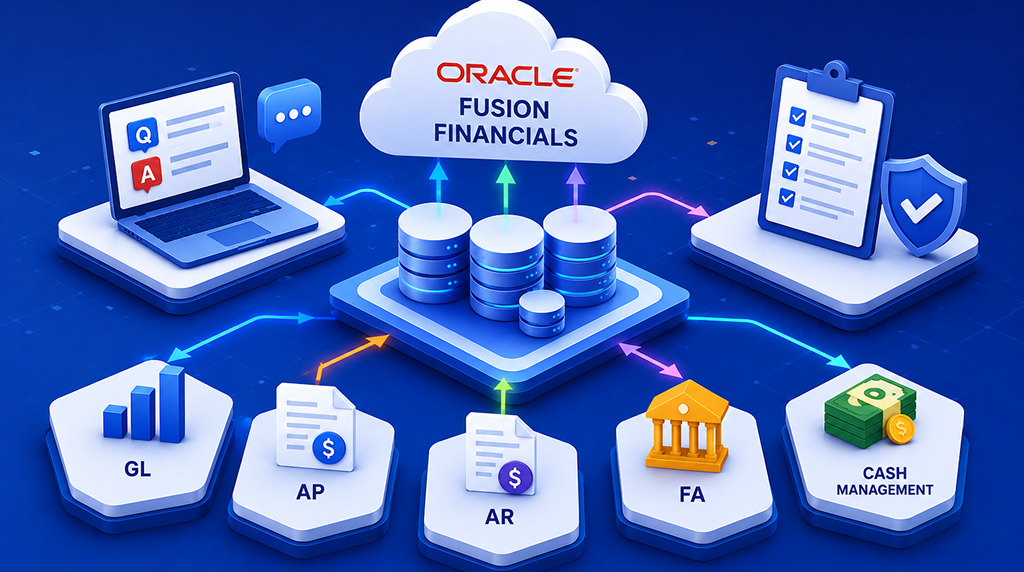
    Financials covers General Ledger, Accounts Payable, Accounts Receivable, and Cash Management, forming the financial backbone of nearly every Oracle implementation. It is the module deployed by virtually every Fusion customer, which keeps demand consistently strong. This path is ideal for finance and accounting professionals who want to move into ERP consulting without having to start from scratch on technical skills. CloudShine’s Oracle Fusion Financials training is designed specifically for finance backgrounds looking to make that switch.

    HCM vs SCM vs Financials: A Quick Comparison

    FactorHCMSCMFinancials
    Core FocusWorkforce & HR processesProcurement, inventory, logisticsAccounting & financial reporting
    Typical RolesHCM Consultant, Payroll LeadSCM Consultant, Procurement AnalystFinancials Consultant, Finance Lead
    Best BackgroundHR, MBA-HR, payrollOperations, logistics, ITFinance, accounting, CA/CPA
    Market DemandStrong, growing in BFSI & healthcareFastest growing, manufacturing & retailConsistently highest, near-universal need
    India Salary Range*₹6 to 15 LPA₹5 to 14 LPA₹10 to 20 LPA
    Learning CurveModerateModerate to steepModerate for finance backgrounds

    Which Oracle Fusion Course Matches Your Background?

    For HR Professionals

    If you already work in recruitment, payroll, or HR operations, Oracle Fusion HCM is the natural next step. Your existing process knowledge translates directly into faster learning and stronger interview performance. Start with an Oracle Fusion HCM training online program that includes real project scenarios rather than theory alone.

    For Supply Chain Professionals

    Warehouse managers, procurement executives, and logistics coordinators tend to pick up SCM concepts quickly because they already understand the business processes behind the software. Oracle Fusion SCM lets you formalise that operational knowledge into a certified, high-demand technical skill.

    For Finance & Accounting Professionals

    Chartered accountants, finance managers, and accounting graduates are often the best fit for Financials. You already understand general ledger, accounts payable, and accounts receivable concepts, so the training mostly teaches you how those processes work inside a cloud ERP environment.

    For Freshers & Non-IT Professionals

    You do not need a technical background to start. Many CloudShine students come from non-IT backgrounds and build careers as functional consultants within months of completing structured training. Freshers are often advised to begin with Financials or HCM since these modules have gentler learning curves and broader entry-level demand than technical or highly specialised SCM tracks.

    Key Factors to Consider Before Choosing an Oracle Fusion Course

    Current Educational & Professional Background

    Your prior work experience is the single biggest factor in how fast you will progress. Someone with finance experience will find Financials intuitive, while someone from an operations background will feel more at home in SCM.

    Career Goals and Preferred Roles

    Think beyond the certification itself. Do you want to become an implementation consultant travelling between client projects, or would you prefer a stable in-house role maintaining one company’s Fusion environment? Your answer affects which module and which learning format suits you best.

    Market Demand and Job Opportunities

    Oracle, SAP, and Microsoft together control more than 70% of the global ERP market, and Oracle Fusion alone is used by organisations ranging from mid-market companies to the largest global enterprises. Financials remains the most universally required module, but SCM and HCM openings are growing fastest as companies expand their cloud footprint beyond core finance.

    Learning Curve and Training Requirements

    HCM and Financials generally have a moderate learning curve for professionals coming from related fields, typically requiring six to eight weeks of structured, hands-on training. SCM can take slightly longer to master because it spans multiple sub-modules, such as Procurement, Inventory, and Order Management. Whichever path you choose, prioritise a program with live instance access rather than theory-only videos. See CloudShine’s Oracle Fusion Applications Training guide for a detailed breakdown of certification paths and timelines.

    How AI Is Changing Oracle Fusion Careers in 2026?

    Artificial intelligence is no longer a side feature in Oracle Fusion; it is being built directly into the platform’s core workflows. As of 2025, roughly 65% of ERP vendors had integrated AI and machine learning capabilities into their products, and Oracle alone shipped more than 50 role-based AI agents across Fusion Cloud, automating tasks from anomaly detection in general ledgers to supply chain disruption recommendations.

    This shift, often called agentic finance and agentic operations, means functional consultants are now expected to understand how AI agents fit into approval workflows, reporting, and exception handling, not just how to configure static setup screens. Professionals who combine module expertise with comfort around AI-assisted analytics and automation are becoming the most employable candidates in the market.

    Whichever module you choose, an Oracle Fusion course that includes exposure to AI-driven reporting tools and automation features will keep your skills relevant well beyond 2026.

    Which Oracle Fusion Course Should You Choose?

    Use this quick decision matrix to match your background with the recommended course and the career outcome you can expect.

    Your BackgroundRecommended CourseLikely Career Outcome
    HR, payroll, or MBA-HROracle Fusion HCMHCM Functional Consultant, Payroll Analyst
    Operations, logistics, procurementOracle Fusion SCMSCM Consultant, Supply Chain Analyst
    Finance, accounting, CA/CPAOracle Fusion FinancialsFinancials Consultant, Cloud Finance Lead
    Fresher or non-IT professionalFinancials or HCM (starter modules)Associate Functional Consultant
    Experienced ERP/EBS professionalAny module, technical or functional trackSenior Consultant, Implementation Lead

    Still unsure which path fits you best? Book a free demo session with CloudShine and speak directly with an Oracle-certified trainer before you enrol.

    Call or WhatsApp +91-7587123123 or email inquiry@cloudshinepro.com to get started.

    Conclusion

    Choosing between HCM, SCM, and Financials ultimately comes down to your background, your career goals, and how quickly you want to enter the job market. Financials offers the broadest and highest-paying demand, HCM suits people-focused professionals, and SCM rewards those who enjoy operational problem-solving. All three are growing steadily as enterprises accelerate cloud adoption and embed AI deeper into daily operations.

    Whichever direction you choose, the most important step is enrolling in a structured Oracle Fusion course that combines real project work with certification support. Explore CloudShine’s full range of Oracle Fusion training programs and take the next step toward a cloud ERP career in 2026.

  • Complete Guide to SAP ABAP Certification: Syllabus, Exam & Career Path

    Complete Guide to SAP ABAP Certification: Syllabus, Exam & Career Path

    If you’ve spent any time around SAP job postings lately, you’ve probably noticed something: “ABAP Cloud” and “RAP” keep showing up next to salary numbers that look a little too good to be true. They’re not. As enterprises race to complete their S/4HANA migrations, SAP ABAP certification has quietly become one of the most dependable ways for both students and working professionals to build a serious, long-term career in enterprise technology.

    This guide is written for two kinds of readers. If you’re a student trying to decide which ERP skill is actually worth your time, you’re in the right place. And if you’re a working professional in classic ABAP wondering whether you need to “upgrade” your skills for the cloud era, you’re in the right place too. We’ll walk through what SAP ABAP actually is, what the certification covers, how the exam works, what it costs, and what kind of salary and career growth you can realistically expect in 2026.

    What Is SAP ABAP? 

    ABAP (Advanced Business Application Programming) is SAP’s proprietary programming language, the backbone that developers use to build, extend, and customize functionality across SAP ERP and SAP S/4HANA systems. Think of it as the engine room of SAP. While functional consultants configure business processes, ABAP developers write the code that makes reports run, screens behave correctly, and custom business logic execute exactly the way a company needs it to.

    Here’s what’s changed, though. In 2026, SAP ABAP is no longer just about writing reports and forms the way it was a decade ago. With SAP’s “Clean Core” strategy taking center stage, ABAP has evolved into a genuinely cloud-native language. Modern ABAP development now happens on the SAP Business Technology Platform (BTP), using the ABAP RESTful Application Programming Model (RAP) and Core Data Services (CDS) to build extensions that stay upgrade-safe even as SAP pushes new releases.

    This shift mirrors what happened when Oracle moved from EBS toward Oracle Fusion Cloud: the underlying skills stay relevant, but the delivery model and tooling change completely. If you’re weighing Oracle Fusion alongside SAP as an ERP career path, our Oracle ERP Cloud (Fusion) vs Oracle EBS comparison is worth a read before you decide where to specialize.

    Why Is SAP ABAP Certification Important in 2026? 

    A few forces are converging right now to make this certification genuinely valuable, not just resume decoration.

    The S/4HANA migration deadline is real. Thousands of enterprises are racing to complete migrations off SAP ECC, and every migration project needs ABAP developers who understand cloud-ready extensibility, not just classic modification techniques.

    Demand has grown sharply. Industry data shows demand for ABAP Cloud developers grew roughly 35% year-over-year as S/4HANA Cloud adoption accelerated. Top SAP consulting firms increasingly list ABAP Cloud certification as a baseline requirement for backend developer roles, not just a nice-to-have.

    BTP and Joule AI integration are reshaping the role. As companies extend SAP systems using side-by-side apps on BTP and adopt SAP’s Joule AI copilot, developers who understand these newer layers are becoming disproportionately valuable.

    For students choosing a specialization or professionals deciding where to reinvest their learning hours, SAP ABAP certification in 2026 sits at a genuinely rare intersection: strong demand, rising salaries, and a skill set that isn’t likely to be automated away any time soon.

    Curious how this compares to other enterprise platforms? Explore CloudShine’s Oracle Fusion Financials training or Oracle Fusion SCM training to see how the two ecosystems stack up for your career goals.

    SAP ABAP Certification Overview 

    What Does SAP ABAP Certification Validate?

    At its core, the certification confirms that you can build scalable, maintainable backend services using RAP and CDS, understand SAP’s clean core philosophy, and work confidently within SAP BTP’s development environment. It’s less about memorizing syntax and more about proving sound architectural judgement, which is why the exam leans heavily on scenario-based questions rather than simple recall.

    Who Should Pursue SAP ABAP Certification?

    • Freshers and students with foundational ABAP or programming knowledge who want a credential that compensates for limited work experience.
    • Traditional ABAP developers transitioning from classic, on-premise development toward cloud-native practices.
    • ERP consultants preparing for cloud migration projects who need to speak the technical language of the developers they’re working alongside.
    • Career switchers coming from adjacent technologies like Java or Python who want structured, credible entry into the SAP ecosystem.

    If you fall into that last category and you’re still deciding between full-stack development and ERP-specific programming, it’s worth talking to CloudShine’s team here before committing, since the day-to-day work looks quite different once you’re several years in.

    SAP ABAP Certification Syllabus 

    The current-generation exam (C_ABAPD_2507, SAP Certified Associate – Back-End Developer – ABAP Cloud) covers six domains, and understanding how they’re weighted helps you plan your study time sensibly instead of spreading yourself too thin.

    Core ABAP Programming Concepts (31 to 40 percent of the exam) This is the largest single domain, covering ABAP syntax, internal table operations, modularization, exception handling, and debugging. The exam leans heavily on modern syntax, expressions like VALUE, CORRESPONDING, and REDUCE, and inline declarations, so if your ABAP knowledge is a few years old, this is the section that needs the most refreshing.

    Data Dictionary and Database Objects, via CDS (21 to 30 percent) Core Data Services views are the foundation of data modeling in ABAP Cloud. You’ll need to understand annotations, associations, compositions, and how CDS views feed into RAP-based applications.

    Object-Oriented ABAP (up to 10 percent) Classes, interfaces, inheritance, and encapsulation. It’s a smaller slice of the exam on paper, but these concepts resurface constantly inside RAP and Core ABAP questions, so skipping this section is a common (and costly) mistake.

    Reports, Forms, and Enhancements, reframed as Clean Core Extensibility (11 to 20 percent) Rather than classic modifications, this domain tests your understanding of key-user versus developer extensibility, released APIs, and side-by-side extensions on BTP.

    SAP ABAP for Cloud and S/4HANA, via RAP (11 to 20 percent) The ABAP RESTful Application Programming Model is the modern framework for building transactional apps: business object behaviors, CRUD operations, actions, validations, and OData service exposure all live here.

    ABAP SQL and Code Pushdown (up to 10 percent) Efficient database access, Open SQL best practices, and AMDP-based code pushdown for performance.

    Want a structured walkthrough of these exact domains with hands-on labs? Reach out to CloudShine here to ask about SAP ABAP on HANA batches that build each of these modules into live project work rather than slide-based theory.

    SAP ABAP Certification Exam Details 

    Exam Structure and Format

    The exam consists of 80 multiple-choice and multiple-response questions, completed in 180 minutes, with a 65 percent passing score (52 out of 80 correct). There are no true or false questions; instead, you’ll see prompts like “there are 2 correct answers to this question,” so partial credit doesn’t exist. Registration happens through training.sap.com, and the exam is delivered as an online, proctored assessment available 24/7, so you can take it from home with a stable connection, a webcam, and a quiet room.

    Recommended Preparation Strategy

    A realistic, sustainable approach looks like this:

    Preparation PhaseDurationFocus
    Foundation buildingWeeks 1 to 2Modern ABAP syntax, internal tables, CDS view basics
    Advanced conceptsWeeks 3 to 4RAP architecture, business object behaviors, clean core extensibility
    Review and mock testingWeeks 5 to 6Full-length timed practice exams, weak-area review

    The single biggest mistake candidates make is relying on theory alone. Since the exam heavily tests practical, scenario-based understanding, aim to spend at least half your prep time actually building RAP applications rather than just reading documentation, whether that’s on a free SAP BTP trial account or inside a guided classroom environment.

    If selfpaced prep feels overwhelming alongside a full-time job, ask CloudShine about online SAP ABAP on HANA batches here built around exactly this six-week structure, with mentor-led project reviews at each phase.

    SAP ABAP Career Opportunities After Certification 

    SAP ABAP Developer: Writes and maintains custom code, builds RAP-based business objects, and works closely with functional consultants to translate business requirements into working applications.

    SAP Technical Consultant: Sits between functional and development teams, translating business processes into technical specifications and overseeing implementation quality.

    SAP S/4HANA Developer: Focuses specifically on cloud-ready extensions for S/4HANA Cloud, working within clean core principles and BTP-based side-by-side extensions.

    SAP Integration Specialist: Manages how SAP systems talk to each other and to external platforms, often blending ABAP knowledge with API and middleware skills.

    Career progression typically starts in support or junior developer roles, moves toward independent feature ownership within two to three years, and eventually reaches architect or technical lead roles, where the focus shifts from writing code to designing how systems fit together.

    What Are the Top SAP ABAP Interview Questions for Freshers in 2026? 

    Interviewers in 2026 focus far less on syntax trivia and much more on applied understanding. Expect questions across these themes:

    • Explain the difference between key-user extensibility and developer extensibility, and when you’d choose one over the other.
    • Walk through how a RAP-based business object handles a create operation from CDS view to OData exposure.
    • What’s the practical difference between classic ABAP modification and the clean core approach, and why does SAP discourage the former?
    • Describe a scenario where you’d use a side-by-side extension on BTP instead of an in-app extension.
    • How do modern ABAP expressions like VALUE and REDUCE improve on older looping constructs?

    Freshers should also expect code-reading questions requiring you to trace logic step by step, so practising with real snippets, not just flashcards, makes a measurable difference on exam and interview day alike.

    SAP ABAP Certification Salary and Career Growth Salary Expectations for Freshers

    Entry-level certified ABAP developers in India typically start within the standard SAP functional salary band, with certification acting as a meaningful differentiator against non-certified applicants for the same entry-level seats.

    Salary Growth for Experienced Professionals

    This is where certification pays off. Experienced, certified SAP ABAP consultants remain among the highest-paid technical professionals in the Indian SAP market, and the 2026 shift toward ABAP Cloud has widened that premium further for developers who understand BTP and RAP-based development.

    Factors Affecting SAP ABAP Salaries

    Experience LevelTypical Annual Salary Range (India, 2026)Key Drivers
    Fresher / entry-levelStandard entry-level SAP band, higher with certificationCertification, hands-on RAP project exposure
    Mid-level (3 to 7 years)Meaningful step up from entry-levelS/4HANA and BTP exposure, real implementation experience
    Experienced consultant (8+ years)Roughly ₹16.4 to ₹21.5 lakhs per annumDepth in ABAP Cloud, RAP, and clean core extensibility
    Architect / top performerRoughly ₹33.2 to ₹47.0 lakhs per annumS/4HANA migration leadership, BTP architecture ownership

    Globally, certified ABAP Cloud developers report average salaries of $104,000 to $140,000 annually in mature markets like the US, generally earning 15 to 25 percent more than non-certified peers with equivalent experience. The certification tends to pay for itself quickly once you factor in that premium plus faster promotion timelines.

    Want a personalised sense of where you’d land on this scale? CloudShine’s career counsellors can map your current experience against these bands, no obligation, book a free consultation here.

    How AI is Transforming SAP ABAP Careers 

    AI isn’t replacing ABAP developers in 2026, but it is changing the daily workflow. SAP’s Joule AI copilot is increasingly embedded into development environments, assisting with code suggestions, test generation, and flagging clean-core violations before code review. Developers who work alongside these tools, rather than against them, are becoming more productive and are being trusted with higher-value architectural decisions instead of routine coding.

    This is exactly why the exam tests scenario-based judgement over rote syntax recall: that’s the kind of thinking AI tools can’t fully replace. If anything, automation is pushing the value of certified developers upward, since companies need people who can validate, architect, and oversee AI-assisted development, not just produce more code.

    Conclusion 

    SAP ABAP certification in 2026 isn’t a nostalgia play for developers who learned classic ABAP years ago, and it isn’t just a fresher’s checkbox either. It’s a current, in-demand credential sitting at the center of the biggest shift in enterprise software right now: the move to cloud-native, AI-assisted SAP development. Whether you’re a student picking your first specialization or a professional modernizing your skill set, the syllabus, exam structure, and salary data all point the same way: this is a good time to get certified, not a late one.

    If you’re ready to move from reading about it to actually building RAP applications and CDS views, CloudShine’s SAP ABAP on HANA training in Hyderabad and online programs are designed to take you from foundational ABAP knowledge to certification-ready in a structured, mentor-supported way. Get in touch here to see current batches and take the next step.

  • The Complete Guide to SAP MM Course and Certification in 2026

    The Complete Guide to SAP MM Course and Certification in 2026

    If you have ever wondered how a company somehow always has the right raw materials on the shelf, at the right cost, from the right vendor, the answer is usually a system quietly working in the background. That system is often SAP MM.

    This guide is for two kinds of readers: students trying to pick a first ERP specialization, and working professionals in procurement, warehousing, or supply chain who are wondering whether it is time to formalize that experience with an SAP credential. Either way, by the end of this blog you will know exactly what SAP MM is, what a good course covers, what it costs, and what kind of career and salary trajectory is realistic in 2026.

    Prefer to talk through your options before reading further? Reach out to CloudShine’s SAP and Oracle training team here for a free consultation.

    What Is SAP MM? 

    SAP MM, short for Materials Management, is one of the core logistics modules inside SAP ERP and SAP S/4HANA. In plain terms, it is the system that keeps materials, raw goods, components, spare parts, whatever a business needs to operate, moving through procurement, storage, and consumption without gaps or waste.

    The module is generally built around a few connected pieces:

    • Master Data: material master, vendor master, and purchasing info records that keep the system’s information consistent.
    • Purchasing: requisitions, request for quotations (RFQs), vendor selection, and purchase order (PO) creation.
    • Inventory Management: goods receipt, goods issue, stock transfers, and physical inventory control.
    • Invoice Verification: matching vendor invoices against POs and goods receipts before payment.
    • Material Requirements Planning (MRP): forecasting what needs to be ordered, and when, based on production plans.
    • Valuation and Account Assignment: costing materials correctly and posting them to the right accounts.

    Because SAP MM integrates tightly with modules like SD (Sales and Distribution), FICO (Finance and Controlling), and PP (Production Planning), professionals who know it well tend to become useful well beyond a single department. They understand how procurement decisions ripple into finance and production.

    It is worth knowing that this is not a problem unique to SAP. Oracle Fusion applications solve a very similar challenge on the Oracle side of the enterprise applications world. If you are comparing ERP ecosystems before committing to one, our breakdown of Oracle ERP Cloud (Fusion) vs Oracle EBS is a useful companion read, since procurement and inventory are core concerns on both platforms.

    Why Is SAP MM Certification a Popular Career Choice in 2026? 

    A few forces are converging to keep SAP MM relevant heading into 2026:

    • S/4HANA migrations are still in full swing. Many enterprises that ran SAP ECC for a decade or more are now migrating to S/4HANA, and each migration needs MM specialists who can reconfigure procurement and inventory workflows for the new architecture.
    • Supply chains are being digitized end to end. From AI-assisted demand forecasting to IoT-based inventory tracking, companies are layering new technology on top of SAP MM rather than replacing it, which means the fundamentals stay valuable even as the tools around them evolve.
    • ERP talent shortages persist. Recruiters and training providers consistently flag a shortage of experienced, certified SAP functional consultants relative to the number of active implementation and support projects, which keeps demand and salaries elevated for certified professionals.

    For someone deciding between multiple ERP specializations, SAP MM certification remains one of the more dependable entry points into supply chain and procurement-focused consulting work.

    What Will You Learn in an SAP MM Course? 

    A well-structured SAP MM course typically walks through the module in this order.

    • Procurement Management: You will learn how purchase requisitions are created and converted into RFQs, how vendor quotations are compared, and how purchase orders get generated, released, and tracked through to delivery.
    • Inventory Management: This covers goods receipt posting, stock transfers between plants or storage locations, inventory valuation methods, and the physical inventory (stock count) process that keeps book and physical stock aligned.
    • Vendor Management: You will work with vendor master records, supplier evaluation criteria, and the lifecycle of a vendor relationship, from onboarding through performance tracking.
    • SAP S/4HANA MM Features: Modern courses now dedicate significant time to S/4HANA-specific capabilities: the simplified data model, Fiori-based apps for procurement, embedded analytics, and how MM integrates with SAP Ariba for sourcing.

    Want a curriculum walkthrough tailored to your background? Book a free demo session with CloudShine here before you commit to a schedule.

    Who Should Enroll in an SAP MM Course? 

    SAP MM courses are built to accommodate a fairly wide range of backgrounds:

    • Students and freshers from commerce, supply chain, or engineering backgrounds looking for a functional consultant entry point.
    • Procurement and supply chain professionals who already understand the business process and want to add SAP system skills on top.
    • Existing SAP end users (in SD, PP, or FICO) who want to broaden their module knowledge.
    • Career switchers moving from unrelated IT or non-IT roles into ERP consulting.

    Most training providers do not require deep technical or coding knowledge. SAP MM is a functional module, not a development one, so business process understanding matters more than programming ability, which is good news if you are coming from a non-technical background.

    SAP MM Course Eligibility and Prerequisites 

    There is no rigid eligibility bar set by SAP itself for taking MM training, but most institutes recommend:

    • A bachelor’s degree, ideally in commerce, business administration, engineering, or supply chain management, though this is not a hard requirement for beginner-level programs.
    • Basic familiarity with procurement or inventory concepts is helpful but not mandatory. Foundational courses typically start from the basics.
    • No prior programming experience is needed, since SAP MM configuration is done through SAP’s GUI and Fiori apps rather than custom code.

    Working professionals already employed in procurement, warehousing, or logistics roles often find the transition smoother, since they are learning the SAP “language” for processes they already understand conceptually. For complete beginners, most reputable training programs build in a short business process primer before diving into system configuration, so a lack of prior exposure just means budgeting a bit more time for the fundamentals early on.

    SAP MM Career Opportunities After Certification 

    Once certified, the typical career paths include:

    • SAP MM Consultant: implements, configures, and supports SAP MM for client organizations, often through a consulting firm.
    • Procurement Consultant: focuses specifically on optimizing purchasing workflows, vendor negotiations, and RFQ processes within SAP.
    • Supply Chain Analyst: uses SAP MM data and reporting to identify inefficiencies in inventory turnover, lead times, and vendor performance.
    • SAP End User / Power User: works inside a single organization, managing day-to-day MM transactions rather than consulting across clients.

    Career progression usually runs from support-level roles in the first couple of years, into functional-ownership positions (leading a module workstream on an implementation) by the third or fourth year, and eventually into senior consultant, solution architect, or SAP MM team lead roles. As your scope expands, so does your exposure to adjacent enterprise systems, which is one reason many SAP MM consultants eventually cross-train into complementary platforms like Oracle Fusion Cloud SCM or SAP Ariba rather than staying narrowly specialized.

    Curious how a similar consultant career path looks on the Oracle side? CloudShine’s Oracle Fusion SCM training and Oracle Fusion Financials training programs are a natural next step for professionals who want to diversify across ERP ecosystems.

    SAP MM Salary Trends in 2026 

    Salary data for SAP MM professionals in India in 2026 varies fairly widely depending on the source, city, and how “average” is calculated, but a consistent pattern shows up across salary trackers.

    A few things worth noting: salaries tend to run meaningfully higher at Global Capability Centres (GCCs) of MNCs, companies like Shell, Walmart, or Bosch running large in-house SAP teams in cities like Bangalore, compared to traditional IT services firms. Professionals with S/4HANA and SAP Ariba integration skills are consistently reported as commanding a premium over those with only classic ECC experience.

    Table: Experience Level vs. Average SAP MM Salary Range (India, 2026)

    Experience LevelTypical Annual Salary Range (₹)Notes
    Fresher (0-1 yr)₹4-7 lakhsVaries by degree, city, and hands-on project exposure during training
    Associate / Junior Consultant (1-4 yrs)₹5-9 lakhsMoves from support tickets toward functional ownership
    Mid-Level Consultant (4-8 yrs)₹9-16 lakhsS/4HANA and Ariba integration skills push toward the higher end
    Senior Consultant (8+ yrs)₹16-22 lakhsBroader range (₹16.5-27.7 lakhs) reported across platforms
    Architect / Principal Consultant (12+ yrs, metro GCCs)₹25-50 lakhsCommon in Bangalore-based GCCs of firms like Shell, Walmart, Bosch

    Figures are indicative averages compiled from multiple salary-benchmarking platforms (Glassdoor, PayScale, 6figr) and vary by city, employer type, and certification or skill mix.

    Want a sense of where you would land on this scale based on your own background? Book a free career consultation with CloudShine here, no obligation.

    SAP MM Interview Preparation 

    Top SAP MM Interview Questions for Freshers and Experienced Professionals

    Interviewers typically probe across a few consistent areas:

    • Configuration basics: difference between a standard PO and a contract, how release strategies work, movement types in inventory management.
    • Process scenarios: “walk me through what happens from a purchase requisition to payment” is a near-universal question.
    • Integration knowledge: how MM connects with FI (for invoice posting) and SD (for stock availability checks).
    • S/4HANA-specific questions: differences in the MM data model between ECC and S/4HANA, and familiarity with Fiori apps for procurement.

    Experienced candidates should expect deeper questions on troubleshooting real configuration issues, handling client-specific customizations, and MRP run behavior in complex plant structures.

    Key Factors to Consider Before Choosing an SAP MM Training Program 

    Not all training providers deliver the same value for the SAP MM course fees they charge. Before enrolling, weigh these factors:

    • Trainer Expertise: Has the trainer actually worked on live SAP MM implementations, or are they teaching purely from course material?
    • Hands-On Practice: Look for access to a live SAP system, not just slides, so you can practice configuration yourself.
    • Real-Time Projects: Case-study-based learning tends to translate far better into interview readiness than theory alone.
    • Certification Support: Some institutes bundle exam guidance, mock tests, and registration assistance into the course.
    • Placement Assistance: Particularly valuable for freshers and career switchers who do not already have an internal transfer path into SAP.

    If you are researching options locally, providers offering SAP MM training in Hyderabad and SAP MM course in Bangalore are worth comparing directly, since both cities host a dense concentration of SAP implementation and support projects, meaning trainers there are often more current on live project practices. CloudShine offers both Oracle and SAP training tracks, and you can check current batch schedules and formats here before deciding.

    SAP MM Course Fees in 2026 

    SAP MM course fees vary based on delivery mode, institute reputation, and depth of curriculum:

    • Online training: generally ranges from roughly ₹15,000 to ₹40,000 for beginner-to-advanced levels.
    • Classroom training: tends to run higher, from around ₹25,000 to ₹60,000, reflecting facility and instructor costs.
    • Official SAP certification exam fee: SAP administers the formal S/4HANA MM certification exam separately from training, and it is typically priced around USD 500 (roughly ₹42,000-₹45,000), regardless of which institute you trained with.
    • Study materials and mock tests: often an additional ₹5,000-₹10,000 if not bundled into your course.

    Many training providers now offer combined training-plus-certification-guidance packages, which can work out more cost-effective than paying for training and exam prep separately. Get in touch with CloudShine here for current SAP course fees and batch options.

    Why SAP MM Certification Is Still Worth It in 2026 

    Put together, the case for SAP MM certification in 2026 comes down to a few durable facts: procurement and inventory management are not going away regardless of how ERP technology evolves, S/4HANA migrations are keeping demand for MM specialists high, and certified professionals continue to report a real salary premium over non-certified peers doing similar work. The module also plays well with adjacent skills, Ariba, embedded analytics, and cross-module integration, giving certified professionals room to specialize further as their careers progress.

    Conclusion 

    SAP MM remains one of the more accessible, dependable entry points into SAP consulting. You do not need a programming background, the career paths are varied across consultant, analyst, end user, and architect roles, and the compensation trajectory rewards experience and S/4HANA fluency. Whether you are a student evaluating your first ERP specialization or a supply chain professional looking to formalize your SAP knowledge, what is SAP MM course really comes down to this: it is the training that turns real-world procurement and inventory experience into a certified, in-demand technical skill set.

    If the numbers and career paths above line up with what you are looking for, the next step is comparing a shortlist of training providers on curriculum depth, hands-on access, and placement support, rather than fee alone. Explore CloudShine’s Oracle and SAP training programs here to see current offerings, or reach out directly to discuss SAP MM batches, fees, and placement outcomes.

  • Workday HCM vs Oracle HCM: Which One to Choose in 2026?

    Workday HCM vs Oracle HCM: Which One to Choose in 2026?

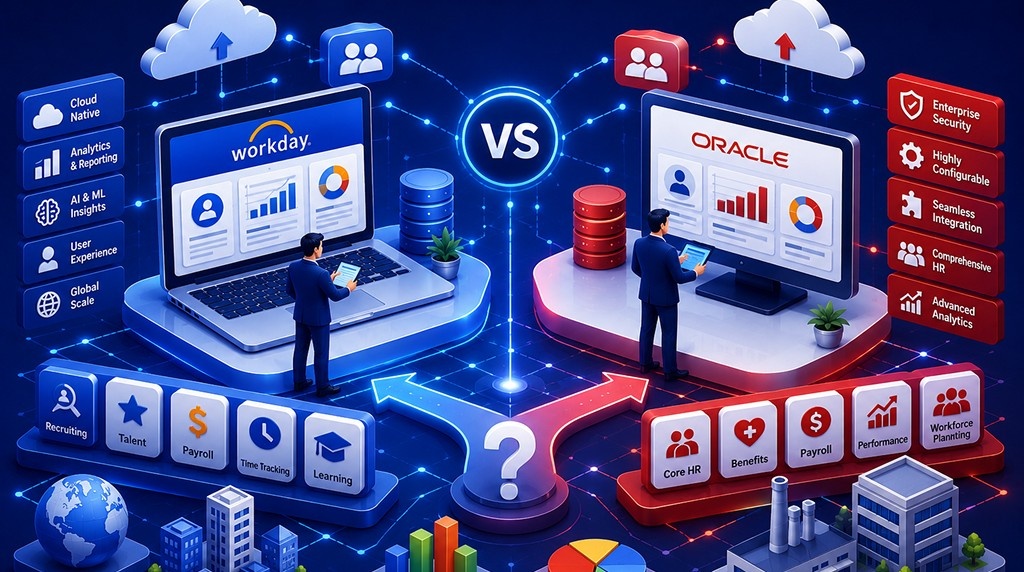
    If you have spent any time browsing HR tech job listings lately, you have probably noticed the same two names popping up again and again. Workday and Oracle HCM Cloud dominate the enterprise HR software conversation and honestly, for good reason.

    Businesses everywhere are shifting away from clunky and on-premise HR systems towards intelligent and cloud-first platforms that can handle everything from recruitment to payroll to workforce analytics in one place.

    This shift is not a small trend either.

    • According to Mordor Intelligence, the global human capital management software market is projected to grow from USD 42.61 billion in 2025 to USD 46.92 billion in 2026, and is forecast to reach USD 71.11 billion by 2031 at an 8.67% CAGR.
    • Fortune Business Insights paints a similarly bullish picture, projecting the broader human capital management market to expand from USD 37.22 billion in 2026 to USD 76.22 billion by 2034.

    That is not a niche corner of enterprise software. That is a genuinely booming industry, and it is exactly why so many professionals are asking themselves the same question: Workday HCM vs Oracle HCM, which one should I actually learn?

    This decision matters more than it might seem. Your choice shapes the kind of projects you will work on, the companies you will interview with, and quite possibly your salary trajectory for years to come. It is not simply a matter of picking whichever platform has the shinier marketing website. Employers hiring for enterprise HR roles are increasingly specific about which system they need and switching ecosystems later in your career, while possible, does take time and effort.

    So, let us properly unpack this HCM comparison and help you figure out which platform genuinely fits your career goals, your existing skills, and the kind of organisations you would like to work with. Whether you are a fresh graduate exploring HR technology for the first time or an experienced consultant weighing up a second certification, this guide should give you a clear, honest picture before you commit your time and money.

    What is Workday HCM?

    Workday HCM is a cloud-native Human Capital Management platform, built from the ground up for the cloud rather than adapted from older, on-premise software. Launched in 2006 by former PeopleSoft executives, Workday set out to solve the exact frustrations that traditional HR systems created, like

    • Clunky interfaces,
    • Slow updates, and
    • Rigid data structures

    It brings together core HR, recruiting, payroll, talent management, and workforce analytics into a single, unified system, updated twice a year with fresh features and improvements.

    What genuinely sets Workday apart is its user experience. It was designed with the end user in mind from day one, which is a big part of why organisations like Netflix, Airbus, and Dell rely on it to manage their global workforces.

    Its talent management tools are spread thoughtfully across payroll, recruiting, and employee training modules to keep the platform feeling connected rather than fragmented. Meanwhile, Workday’s workforce prediction tools calculate the total cost of the workforce from the ground up. This gives HR leaders genuinely useful data to support budget approvals and hiring decisions, often visualised through intuitive dashboards rather than raw spreadsheets.

    If you are researching Workday vs Oracle as a beginner, Workday’s intuitive design is often cited as one of its biggest selling points. Many learners find that within just a few weeks of hands-on practice, navigating the system starts to feel genuinely second nature. This is one of the reasons why it remains such a popular first certification for people new to enterprise HR technology.

    What is Oracle HCM Cloud?

    Oracle HCM Cloud, released in 2011, took a different route. Rather than being built entirely from scratch, it emerged from Oracle’s long history in enterprise software, evolving to compete directly with Workday’s cloud-first approach.

    Oracle HCM Cloud is built on Oracle’s own cloud database infrastructure. It is powered by an AI-based digital assistant that supports everyday HR tasks, from answering employee queries to surfacing relevant workforce insights. As Oracle HCM sits so closely alongside Oracle’s financial and ERP systems, it tends to shine in organisations that already run on Oracle Fusion applications for finance, supply chain, or procurement.

    Its Talent, Recruiting, and Workforce modules operate as distinct, deeply configurable tools, which give larger enterprises significant flexibility, albeit with a steeper learning curve. Oracle’s recruiting tools, for instance, are built:

    • To draw applicants directly from career sites
    • Organise them into searchable, analysable categories within the same Oracle database that runs the rest of the business.

    This becomes a genuine advantage for organisations wanting everything under one roof.

    For professionals already comfortable with Oracle’s broader ecosystem, moving into Oracle Fusion HCM training often feels like a natural next step rather than starting from scratch. Those who already understand Oracle’s data structures, security roles and reporting tools tend to pick up the HCM-specific modules considerably faster than complete newcomers.

    Why Are Cloud HCM Certifications Becoming a Top Career Choice in 2026?

    Certifications alone do not guarantee a job, but they genuinely open doors that would otherwise stay shut. Recruiters and hiring managers use certifications as a fast and reliable filter when they are sifting through hundreds of CVs. Also, in a market this competitive, that filter matters more than most candidates realise.

    The numbers back this up convincingly.

    These figures are a true reflection of making the investment in certification training genuinely worthwhile.

    It is a similar story on the Oracle side. As enterprises continue migrating from legacy PeopleSoft and on-premise HR systems to Oracle Fusion Cloud, demand for certified Oracle HCM consultants keeps climbing steadily. Techno-functional consultants, in particular, who can bridge HCM configuration with broader Oracle Fusion knowledge, are increasingly sought after by consulting firms and large enterprises alike.

    Whichever platform you choose, one thing is clear. Employers are actively rewarding certified, hands-on expertise over generic HR knowledge, and that trend shows no sign of slowing down in 2026.

    If you are weighing up your options, exploring a structured programme like CloudShine’s Oracle Fusion HCM Training is a genuinely sensible place to start comparing course content, live lab access, and placement support before you commit.

    Workday HCM vs Oracle HCM: Comparison Table

    FactorWorkday HCMOracle HCM Cloud
    Launch Year20062011
    ArchitectureBuilt cloud-native from scratchEvolved from Oracle’s broader ERP ecosystem
    User InterfaceHighly intuitive, consumer-grade UXPowerful but comparatively complex
    Learning CurveModerate, beginner-friendlySteeper, benefits from ERP background
    Update CycleTwice-yearly structured releasesContinuous updates within Oracle Cloud
    Best Fit ForMid-size to large global enterprisesEnterprises already using Oracle Fusion apps
    AI CapabilitiesPredictive workforce analytics, Illuminate AI agentsAI-powered digital assistant, embedded across modules
    Career PathWorkday Consultant, HRIS AnalystOracle Fusion HCM Consultant, Techno-Functional Analyst
    Certification Cost (approx.)USD 1,500 to USD 2,500Varies by module and training provider

    Key Factors to Consider Before Choosing

    1. Learning Curve and Training:

    • Workday’s clean, modern interface tends to be friendlier for newcomers, particularly those coming from an HR rather than an IT background. Most learners find they can navigate core screens confidently within the first few weeks of guided practice.
    • Oracle HCM Cloud, on the other hand, rewards those who already understand ERP logic and enterprise data structures. This is exactly why structured Oracle Fusion HCM training makes such a meaningful difference for beginners entering that ecosystem; helping them get comfortable with security roles, business process flows and configuration screens far faster than self-study alone.

    2. Career Opportunities and Demand:

    Both platforms enjoy strong hiring demand globally, though the split often depends on region and industry.

    • Workday tends to dominate in the tech, media and services sectors
    • Oracle HCM frequently shows up in manufacturing, finance-heavy, and government-adjacent organisations that already run Oracle ERP.

    If you have a specific industry in mind, it is genuinely worth researching which platform that sector leans towards before committing to a certification path.

    3. Salary Potential:

    Salaries across both ecosystems remain genuinely competitive, and in many cases, comparable. Specialisation matters more than platform choice here.

    • A certified Workday Payroll consultant and a certified Oracle HCM Techno-Functional consultant can command very similar packages, provided both bring real and hands-on project experience rather than certification alone.

    Location, years of experience and whether you work as a freelance consultant or within a permanent role all influence final numbers considerably.

    4. Certifications and Training:

    Whether you pursue Workday HCM Certification or Oracle’s role-based HCM credentials, structured, instructor-led training with live sandbox access consistently outperforms self-paced video-only courses.

    This is precisely where quality workday HCM training online and Oracle Fusion HCM programmes prove their worth, giving learners the hands-on configuration practice that theory alone simply cannot replicate.

    Look for programmes that include real instance access, mock interviews, and genuine placement support rather than just recorded lecture content.

    5. AI and Future Readiness:

    Both platforms are racing to embed AI deeper into their platforms.

    • Workday has introduced AI Agents under its Illuminate initiative. It is designed to automate and optimise HR and finance workflows, from screening candidates to flagging anomalies in payroll data.
    • Oracle continues expanding its digital assistant capabilities across HCM modules, aiming to reduce manual data entry and surface predictive insights automatically.

    Professionals who understand how to configure, govern, and work alongside these AI features will have a genuine edge over those with purely theoretical knowledge.

    Which Platform Is Better for Career Growth?

    Workday vs Oracle; honestly, this question does not have one universal answer.

    If you are a fresh graduate or an HR professional with no prior ERP exposure, Workday’s cleaner interface often makes for a gentler entry point into cloud HCM. Its structured, twice-yearly release cycle also makes learning feel more predictable and less overwhelming.

    If you come from a finance, SCM or broader Oracle Fusion background, learning Oracle HCM Cloud first will let you leverage skills you already have. It opens the door to techno-functional roles that blend HCM with finance or procurement. These roles often command a premium in the job market precisely because fewer professionals can comfortably straddle both domains.

    Many consultants eventually become proficient in both platforms over the course of their careers; since large enterprises frequently run parallel systems or migrate between them during mergers, acquisitions or digital transformation projects.

    Starting with one does not lock you out of the other. In fact, several experienced consultants we have trained at CloudShine describe their second platform certification as considerably faster to pick up than their first. This is simply because the underlying HR concepts, business processes, and reporting logic carry across so well.

    Tip: If you are still unsure, a genuinely useful exercise is to shortlist 5-10 job postings in your target city or industry and simply count how often each platform appears. That small bit of research often clarifies the decision far more effectively than any single blog post ever could.

    Workday HCM vs Oracle HCM: Who Should Choose Which?

    If you are an HR professional transitioning into HR technology, or you simply want the fastest, most beginner-friendly entry point into cloud HCM, Workday is likely your better starting point. Its intuitive design and strong presence in tech and services sectors make it a smart, practical first certification, particularly if you want to see tangible progress within the first month of learning.

    If you already have experience with Oracle ERP, SCM, or Financials, or you are targeting roles at large, traditionally Oracle-heavy enterprises, then Oracle HCM Cloud will let you build on existing knowledge and access techno-functional career paths. This route particularly suits professionals already working within an Oracle Fusion environment who want to expand their scope into HR-specific modules.

    Expert Suggestion: Professionals from a general HR consulting background often find success starting with Workday and gaining genuine implementation experience, then adding Oracle HCM skills later.

    Those already embedded in enterprise IT or ERP consulting, frequently find Oracle Fusion HCM a more natural fit from day one, since much of the underlying platform logic will already feel familiar.

    There is no shame in changing your mind partway. Plenty of successful consultants started down one path, realised a different specialisation suited them better, and pivoted without losing much momentum.

    Conclusion

    At the end of the day, there is no universally better platform between Workday HCM and Oracle HCM. Both are genuinely powerful, both are in strong demand and both can lead to rewarding, well-paid careers in HR technology.

    What matters far more is matching the platform to your background, your target industry and the kind of projects you actually want to work on. Rushing into a certification simply because it is trending on social media rarely pays off in the long run.

    Take stock of where you are right now. If you are new to enterprise HR software altogether, start with the platform that feels intuitive and lets you build early confidence. If you already have relevant ERP or Oracle experience, use that advantage rather than starting from scratch.

    When choosing a platform, ensure to prioritise training providers who offer live and practical access over anyone promising a shortcut through recorded videos alone.

    If you are ready to move from research to action, CloudShine’s Workday HCM Training and Oracle Fusion HCM Training programmes are built to offer real-world, project-based learning, with live instance access and practical assignments rather than theory alone.

    You can also explore our detailed breakdowns in Workday HCM Tutorial and Oracle HCM Training Online: Top Courses & Certification to dig deeper before making your decision. Browse our blog for more comparisons and career guidance.

    Whichever path you choose, the demand is real, the opportunities are growing and there has genuinely never been a better time to start.

  • Workday HCM Training: Complete Career & Salary Guide 2026 

    Workday HCM Training: Complete Career & Salary Guide 2026 

    If you have been quietly wondering whether now is the right time to learn Workday HCM, here is your answer: yes, and 2026 might just be the best year to start. Organisations across the globe are racing to modernise their HR systems, and Workday sits right at the centre of that shift. Whether you are eyeing a career switch, a fresh start after graduation or simply a more future-proof skill set, structured Workday HCM training genuinely opens doors that were not there five years ago.

    The opportunity is not just theoretical either. Consulting firms, global enterprises, and implementation partners are actively hiring certified Workday professionals, and salaries reflect that demand. This is not one of those trends that is easily forgotten tomorrow. HR technology has become genuinely mission-critical to how businesses run, which means the people who understand these systems are becoming just as essential as the systems themselves.

    This guide walks you through exactly what Workday HCM is, who it suits, what you will learn, what you can realistically earn and how to choose training that actually leads to a job rather than just a certificate on your wall. Grab your cup of tea, settle in and let us work through this properly.

    What Is Workday HCM?

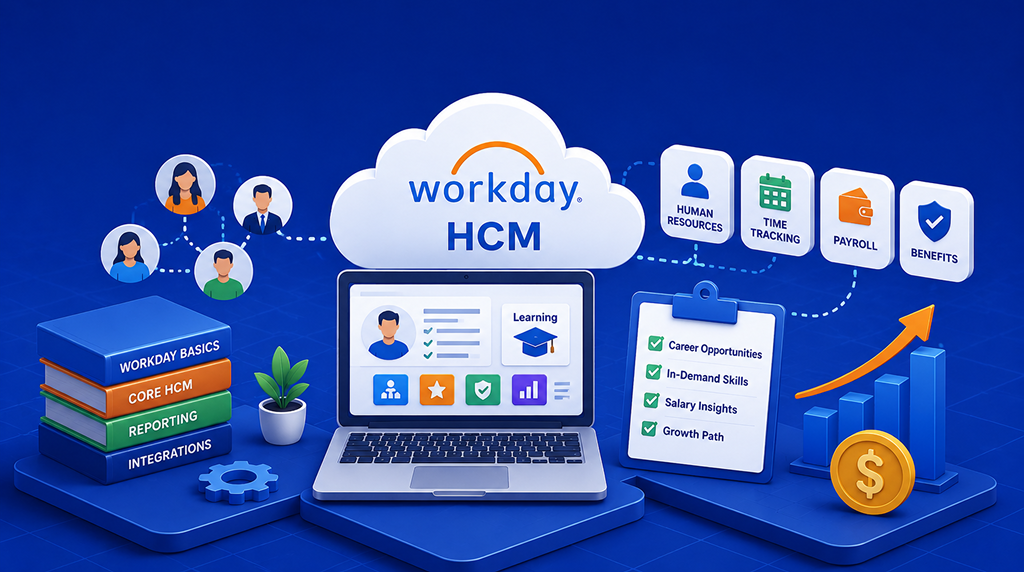
    Workday HCM is a cloud-based Human Capital Management platform that brings together core HR, recruiting, talent management, payroll, and workforce analytics into one unified system. Unlike older, on-premise HR software, Workday was built entirely for the cloud from day one, which means it updates twice a year, feels genuinely modern to use, and scales easily as organisations grow.

    At its core, Workday HCM helps businesses manage the entire employee lifecycle. From hiring and onboarding through to performance, compensation, and eventually offboarding, every process is within a single connected system rather than a patchwork of disconnected tools. This is precisely why organisations like Netflix, Airbus, and Dell rely on it to run HR operations across multiple countries and time zones.

    What makes Workday genuinely different from older enterprise systems is how it was designed from the ground up. Rather than bolting cloud capabilities onto legacy architecture; Workday’s founders built the platform natively for the cloud. This means that updates roll out smoothly twice a year without the disruptive, months-long upgrade cycles that plagued older on-premise HR systems.

    For businesses, that translates into fewer IT headaches. For professionals learning the platform, it means the skills you build today stay relevant, since the underlying architecture is not going anywhere.

    Why Is Workday HCM a High-Demand Skill in 2026?

    Digital HR transformation is not slowing down; it is accelerating. Businesses that once managed HR through spreadsheets and legacy systems are now under real pressure to modernise. Employees expect the same intuitive, mobile-friendly experience from HR software that they get from consumer apps. Nobody wants to file a leave request through a clunky, decade-old portal when they can approve it from their phone in seconds.

    That pressure translates directly into hiring demand.

    • According to Focus Cloud’s Workday Salary and Market Trends Report 2026, 81% of hiring managers had hired Workday professionals within the past 12 months, a clear sign that this is not a slow-burning trend but an active, ongoing hiring push.
    • On the broader market side, Mordor Intelligence report projects the global human capital management software market to reach USD 46.92 billion in 2026, climbing toward USD 71.11 billion by 2031.

    This is the growth that consulting firms and enterprises alike are responding to with expanded Workday teams.

    This growth is not evenly spread either. It is concentrated heavily in sectors undergoing rapid digital transformation, such as technology, financial services, healthcare and professional services in particular. These are the work sectors where workforce complexity makes a unified HR platform genuinely essential rather than a nice-to-have.

    Put simply, businesses need people who can implement, configure, and optimise Workday systems, and right now, supply has not caught up with demand. That gap is exactly where a well-trained, certified professional can step in, and honestly, the earlier you start building that skill set, the more of this growth window you get to benefit from.

    Who Should Learn Workday HCM?

    1. HR Professionals

    If you already understand HR processes such as recruitment, payroll, or performance management, Workday HCM training lets you translate that domain knowledge into a genuinely lucrative technical skill set. Since you already understand the performance factors behind the workflows, your existing HR expertise becomes a real advantage rather than something you need to unlearn.

    2. Freshers

    Graduates with no prior HR or IT experience can absolutely build a career here too. Workday’s intuitive interface makes it a genuinely approachable entry point into enterprise software; provided your training programme includes proper hands-on practice rather than theory alone. Many successful consultants started with zero enterprise software experience and built their entire career from a single and well-structured course.

    3. ERP Professionals

    If you have worked with SAP, Oracle, or other ERP systems before, much of the underlying logic, business processes, security roles, and reporting will feel familiar. You will likely progress through Workday HCM training and placement programmes faster than complete beginners. Also, your existing understanding of enterprise data structures gives you a genuine head start.

    4. IT Professionals

    Developers and system administrators bring a genuine advantage when it comes to integrations, technical configuration and troubleshooting. These are the areas that increasingly separate average consultants from truly sought-after ones. If you already understand APIs, data mapping or system architecture, moving into Workday’s integration layer often feels like a natural extension of skills you already have.

    What Skills Do You Learn in Workday HCM Training?

    • Core HCM: Employee data management, organisational structures, job profiles and the foundational setup that everything else in Workday builds upon.
    • Business Processes: Configuring approval workflows, notifications and automated steps that keep HR processes moving smoothly without constant manual intervention.
    • Security: Setting up role-based access so the right people see the right data, a genuinely critical skill given how sensitive HR information can be.
    • Reporting: Building custom reports and dashboards that turn raw workforce data into insights leadership actually uses to make decisions.
    • Integrations: Connecting Workday with other enterprise systems, including payroll providers, benefits platforms, and increasingly, Oracle Fusion applications, where organisations run hybrid HR and finance ecosystems side by side.

    A genuinely good workday HCM course covers all five areas with real, hands-on configuration practice, not just slides and theory. CloudShine’s Workday HCM Training programme is built around exactly this kind of practical, project-based learning.

    Workday HCM Career Paths

    Once certified, a Workday HCM skill set can take you in several genuinely rewarding directions.

    • HCM Consultant: Implementing and configuring Workday for client organisations, often the natural first step for most newly certified professionals
    • Business Analyst: Bridging HR requirements with technical configuration, translating what stakeholders need into system settings that actually work
    • HRIS Specialist: Managing and optimising the HR information system internally, typically an in-house role rather than consulting
    • Reporting Analyst: Building dashboards and analytics for workforce decisions, ideal for those who genuinely enjoy working with data
    • Integration Consultant: Connecting Workday with other enterprise platforms, a role that rewards technical curiosity and problem-solving

    Many professionals move fluidly between these roles over time and several eventually expand into adjacent ecosystems like Oracle Fusion HCM, particularly at organisations running both platforms in parallel during transitions or acquisitions.

    It is genuinely common to see consultants start as generalist HCM Consultants before specialising in integrations or reporting once they discover which part of the platform they enjoy most.

    How Much Does a Workday HCM Consultant Earn in India vs the US?

    Compensation varies meaningfully by experience, certification, and location, but both markets offer strong earning potential for certified professionals.

    Experience LevelIndia (Annual, INR)United States (Annual, USD)
    Entry-Level (0-2 years)₹7,15,000 approx.USD 93,000 to 100,000 approx.
    Mid-Level (3-6 years)₹11,25,000 approx.USD 127,995 approx.
    Senior/Lead (7+ years)₹17,31,750 to 22,70,000USD 165,242 to 206,749
    • According to Glassdoor’s India salary data as of February 2026, Workday Consultants earn an average of ₹11,25,000 annually; with top earners reaching ₹22,70,000.
    • In the United States, Glassdoor’s data shows an average salary of USD 127,995, with top earners crossing USD 206,749.

    Management consulting firms tend to pay the highest premiums in both markets. Thus; a certification paired with genuine implementation experience at a consulting firm can meaningfully accelerate your earning trajectory.

    Which Companies Hire Workday HCM Consultants in India?

    Demand spans both global implementation partners and the enterprises adopting Workday internally. Major consulting and technology firms, including Deloitte, Accenture, Wipro, IBM, TCS, Fujitsu, PwC, KPMG, Mercer, EY, and Capgemini, regularly hire Workday HCM consultants for client implementation projects.

    Beyond these consulting giants, mid-size Workday implementation partners and enterprises undergoing their own internal HR digital transformation also maintain steady hiring pipelines throughout the year.

    It is worth noting that hiring patterns differ slightly between consulting firms and end-user enterprises. Consulting firms tend to move faster; often hiring in bursts around new project wins and generally offer broader exposure across multiple clients and industries early in your career.

    Enterprises hiring internally, on the other hand, tend to offer more stability and deeper, long-term involvement in a single organisation’s systems, which some professionals genuinely prefer once they have built enough foundational experience.

    If you are based in South India and searching for workday training in Hyderabad, it is worth knowing that the city has become a genuine hub for enterprise software talent. It ensures a strong concentration of consulting firms and IT companies actively hiring Workday-skilled professionals locally and for remote-first roles.

    Hyderabad’s growing cluster of global capability centres has only accelerated this demand further, making it a genuinely strategic location to build your Workday career from.

    What Should You Consider Before Choosing Workday HCM Training?

    1. Trainer Expertise

    Look for instructors with real, hands-on implementation experience; not just presentation skills. Someone who has actually configured Workday for live clients will teach you things no textbook covers, the small workarounds, common pitfalls and practical shortcuts that only come from genuine project experience.

    2. Hands-On Projects

    Theory alone will not prepare you for real client work. Prioritise programmes offering live sandbox access and genuine project-based assignments over recorded video libraries. Employers can usually tell within the first interview whether a candidate has actually configured Workday themselves or simply watched someone else do it.

    3. Certification Support

    A structured path toward official Workday certification, including mock exams and guided preparation, makes a measurable difference to how confidently and quickly you clear it. A workday HCM certification earned through properly guided preparation tends to stick far better than one crammed for at the last minute.

    4. Placement Assistance

    Perhaps the most important factor of all! Genuine workday HCM training and placement support, including resume building, mock interviews, and direct employer connections, is what actually converts a certificate into a job offer.

    Before enrolling anywhere, ask specifically what placement support looks like in practice and not just whether it exists on paper. A vague promise of placement assistance means very little without concrete details on how many learners actually landed roles, and how quickly.

    How Is AI Changing Workday HCM Careers in 2026?

    AI is not replacing Workday consultants; it is reshaping what they focus on. Workday’s own Illuminate initiative has introduced AI Agents designed to automate routine HR tasks, flag anomalies in payroll data, and surface predictive workforce insights automatically. This helps in reducing the manual, repetitive work that once consumed so much consultant time.

    For professionals, this means the value is shifting toward configuring, governing, and fine-tuning these AI-driven workflows rather than simply setting up static business processes. Consultants who understand how to work alongside AI Agents, rather than seeing them as a threat, are positioning themselves for the roles that will matter most over the next few years.

    Think of it less as AI taking over your job and more as AI taking over the repetitive parts of it. This helps in freeing you up to focus on the strategic configuration and problem solving that genuinely requires human judgment.

    This is exactly why forward-looking training programmes are beginning to weave AI-readiness into their curriculum rather than treating it as an afterthought. Consultants entering the field today have a real opportunity to build AI-literacy alongside their core Workday skills from the very start.

    They have the right support and direction to avoid retrofitting that knowledge onto an established career later, which tends to be a slower, more disruptive process.

    Conclusion

    Workday HCM training is not just another certification to add to your CV; it is a genuinely strategic career move in 2026. Demand is strong, salaries are competitive in both India and the US, and the range of career paths, from HCM Consultant to Integration Consultant.

    This means there is genuinely a fit for HR professionals, freshers, ERP specialists, and IT professionals alike. Very few enterprise technology skills offer this combination of accessibility, strong demand, and genuine long-term career runway.

    The difference between a certificate that sits unused and one that actually changes your career often comes down to the quality of your training. It is worth genuinely comparing a handful of programmes before you commit, looking closely at trainer background, project depth and above all, real placement outcomes rather than marketing promises.

    CloudShine’s Workday HCM Training programme combines hands-on projects, experienced trainers, and genuine placement support to help you move from learner to job-ready consultant. You can also explore our Workday HCM Certification guide and Workday HCM Tutorial for a deeper look before enrolling.

    Ready to take the next step? Explore our blog for more career guidance, or reach out today to start your Workday HCM journey.

  • Oracle Fusion HCM vs Traditional HRMS: Why 2026 Is the Year to Migrate

    Oracle Fusion HCM vs Traditional HRMS: Why 2026 Is the Year to Migrate

    It is 9 a.m. on a Monday, payroll closes in four hours, and your HR team is still stitching together data from three disconnected systems just to run one headcount report. If that scenario feels familiar, you already know exactly why this blog exists.

    Whether you are an HR professional eyeing a move into Oracle HCM consulting, an Oracle EBS HRMS specialist, an SAP HCM consultant weighing a switch to Oracle Cloud, or a fresher building a career around ERP, 2026 has become a genuine inflection point for HR technology. Enterprises everywhere are retiring rigid, on-premise HR systems and replacing them with Oracle Fusion HCM, and that shift is quietly reshaping the job market.

    In this blog, we will unpack what traditional HRMS means, how Oracle Fusion HCM is different, why 2026 has become the tipping point for migration, and who stands to gain the most from getting skilled up right now. If you are already thinking about upskilling, CloudShine’s Oracle Fusion HCM Training program is built exactly for professionals navigating this shift.

    Ready to build your Oracle Fusion HCM career? Explore CloudShine’s hands-on Oracle Fusion HCM Training today. 

    What is Traditional HRMS?

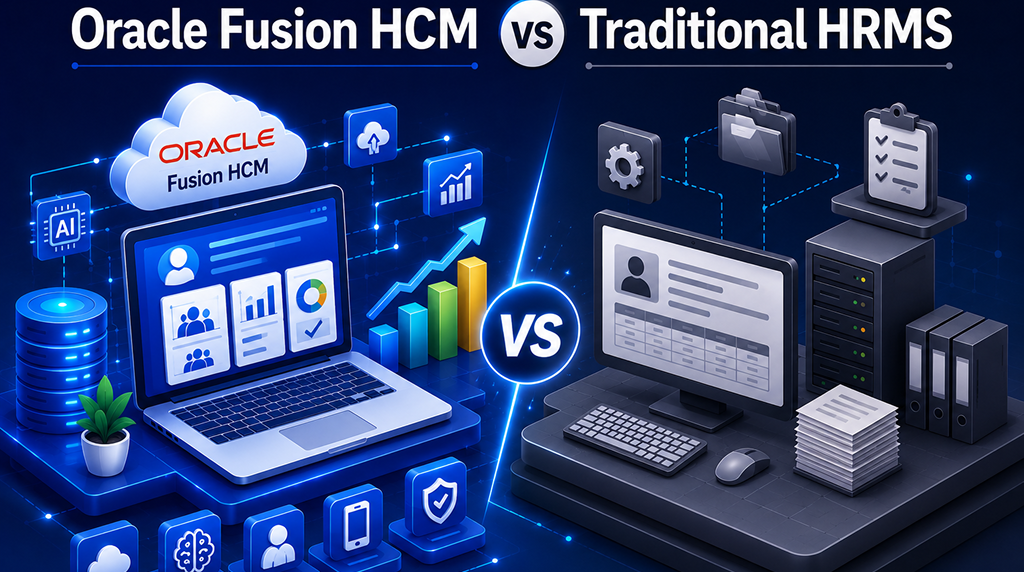
    Traditional HRMS, or Human Resource Management System, refers to on-premise HR software that organizations install, host, and maintain on their own servers. Systems like Oracle E-Business Suite (EBS) HRMS, older PeopleSoft HCM deployments, and legacy SAP HCM installations fall into this category. These platforms were built to digitize core HR administration such as employee records, payroll, and leave management, and for years they did that job well. The catch is that they were designed for a world where HR was mostly transactional, not strategic, and updates happened once every few years rather than every quarter.

    Traditional HRMS platforms are not obsolete overnight. Oracle has extended Premier Support for EBS 12.2 multiple times, most recently through at least 2037, so organizations running EBS are not facing an imminent shutdown, despite what some older articles online still claim about a 2031 deadline. But “supported” does not mean “optimal,” and that distinction matters more each year as expectations around AI, analytics, and employee experience keep rising.

    Key characteristics of traditional HRMS include:

    • Hosted on company-owned or leased servers, requiring in-house IT infrastructure and maintenance
    • Periodic, often disruptive upgrade cycles instead of continuous innovation
    • Limited self-service capabilities for employees and managers
    • Heavy reliance on customizations (code-level changes) that complicate future upgrades
    • Reporting that typically requires IT or technical consultant involvement rather than real-time, self-serve dashboards
    • Security and infrastructure management sitting entirely with the customer, not the vendor

    Upgrade your legacy HRMS skills with CloudShine’s Oracle Fusion HCM Training. 

    What is Oracle Fusion HCM?

    Oracle Fusion HCM, formally known as Oracle Fusion Cloud Human Capital Management, is Oracle’s cloud-native platform for managing the entire employee lifecycle, from recruitment and onboarding to payroll, performance, learning, and workforce analytics. Unlike EBS HRMS, it is delivered as Software-as-a-Service (SaaS), so Oracle owns the infrastructure, security, and quarterly updates, while your organization focuses on configuration rather than code.

    What sets Oracle Fusion HCM apart is its unified data model. Every module, whether it is Core HR, Talent Management, Payroll, or Time and Labor, runs on the same underlying data structure, so information does not need to be reconciled across systems. Oracle has also leaned heavily into embedded AI, with agentic capabilities built directly into workflows for tasks like candidate matching, compensation recommendations, and manager coaching.

    Some of the standout Oracle Fusion HCM features include:

    • A single, unified data model spanning HR, payroll, talent, and analytics
    • Embedded AI and agentic tools for recruiting, performance, and workforce planning
    • Continuous quarterly updates with no forced version upgrades
    • Configurable, low-code workflows instead of rigid, code-level customization
    • Mobile-first employee and manager self-service
    • Real-time, built-in analytics and reporting through HCM Analytics and OTBI
    • Global payroll and compliance support across multiple countries and legislations

    For professionals coming from an EBS, PeopleSoft, or SAP HCM background, this shift from “customize everything” to “configure within guardrails” is one of the biggest mindset changes to prepare for, and it is exactly the kind of practical knowledge covered in CloudShine’s hands-on Oracle Fusion HCM training.

    Learn Oracle Fusion HCM on a real Oracle practice instance with CloudShine. 

    Why Are Companies Migrating in 2026?

    Migration to cloud HCM is not new, but 2026 marks a significant turning point. The global human capital management (HCM) software market is expected to exceed USD 30 billion in 2026. Most of this investment is going towards cloud-based HCM solutions, with adoption continuing to grow at a double-digit annual rate. This shift reflects a bigger change in how businesses view HR. Instead of treating it as a cost centre, organisations now see HR as a strategic function driven by data and technology 

    A few forces are driving this specific wave of migration:

    • AI has matured enough to be genuinely useful in HR operations, from resume screening to attrition prediction, and legacy systems simply were not architected to support it
    • Employee expectations have shifted toward consumer-grade, mobile-first, self-service experiences that older HRMS platforms cannot easily deliver
    • Total cost of ownership increasingly favors cloud subscriptions over the hardware, patching, and in-house administration that on-premise systems demand
    • Competitive and regulatory pressure is pushing HR leaders to modernize faster, especially as more competitors and peers complete their own transitions
    • Data-driven decision-making has become a board-level expectation, and real-time workforce analytics are far easier to deliver on a unified cloud platform
    • Remote and hybrid work models require flexible, globally accessible systems that legacy, server-bound HRMS platforms struggle to support well

    For consultants and IT professionals, this migration wave translates directly into demand. Every organization moving off EBS HRMS, PeopleSoft, or SAP HCM needs people who understand both the old world and the new one, which is precisely why upskilling now, rather than later, tends to pay off. Asia Pacific, including India, is projected to be one of the fastest-growing regions for this shift, driven by digitization initiatives and a large pool of enterprises still running legacy systems.

    Oracle Fusion HCM vs Traditional HRMS

    Here is a side-by-side look at how the two approaches compare across the factors that matter most to HR and IT teams.

    FactorTraditional HRMSOracle Fusion HCM
    DeploymentOn-premise, customer-hosted serversCloud-native SaaS, hosted by Oracle
    UpdatesPeriodic, disruptive upgrade projectsContinuous quarterly updates, no forced upgrades
    CustomizationHeavy code-level customizationConfiguration-first, low-code workflows
    AI capabilitiesMinimal to noneEmbedded generative and agentic AI
    AnalyticsStatic, IT-dependent reportsReal-time, self-serve dashboards (OTBI, HCM Analytics)
    Employee experienceLimited self-serviceMobile-first, Oracle ME self-service
    Total cost of ownershipHigh (hardware, patching, in-house IT)Lower (subscription-based, vendor-managed)
    Security & complianceCustomer’s responsibilityManaged by Oracle, auto-updated for regulations

    As the table shows, the gap between the two systems is not just cosmetic. Traditional HRMS was engineered for a world of stability and predictability, where change happened slowly and IT owned every customization. 

    Oracle Fusion HCM was engineered for the opposite: constant change, embedded intelligence, and configuration that business users, not just developers, can manage.

    Top Benefits of Oracle Fusion HCM

    Beyond the feature list, the real-world Oracle HCM Cloud benefits show up in how HR teams operate day to day. Here is a closer look at five areas where the impact tends to be biggest.

    • AI-Powered HR Operations: Oracle has embedded generative and agentic AI throughout the HCM suite, automating tasks like resume screening, interview scheduling, and compensation benchmarking. Forrester’s 2025 report on the HCM market specifically called out Oracle for delivering the largest set of agentic AI capabilities among major vendors.
    • Better Employee Experience: With Oracle ME and a redesigned, mobile-first interface, employees can manage almost everything themselves, from requesting leave to exploring internal career opportunities, without waiting on HR.
    • Real-Time Analytics: HCM Analytics and OTBI give HR leaders live dashboards instead of static, monthly reports, making it possible to spot attrition risk and compensation anomalies as they happen.
    • Lower Maintenance Costs: Because Oracle manages the infrastructure, security patches, and quarterly updates, organizations no longer need large in-house teams dedicated purely to keeping the HR system running.
    • Enhanced Security and Compliance: Oracle Cloud HCM is built with enterprise-grade security and automated updates for tax and regulatory changes across countries, reducing the compliance burden that typically falls on internal teams running on-premise systems.

    Taken together, these Oracle HCM Cloud benefits explain why the platform dominates conversations about HR modernization. For a deeper look, see our related read on the benefits of Oracle Fusion Human Capital Management.

    Experience Oracle Fusion HCM through practical, hands-on training at CloudShine. 

    Common Challenges During HRMS Migration

    Migration is not effortless, and pretending otherwise does nobody any favors. Understanding where projects typically run into trouble is just as important as understanding the benefits, especially if you are the consultant expected to help solve these problems.

    ChallengeWhy It HappensHow to Manage It
    Data quality issuesLegacy systems carry duplicate or inconsistent recordsRun structured data cleansing before using HCM Data Loader
    Customization gapYears of EBS or SAP customizations do not map directlyRe-evaluate each customization against standard Fusion functionality
    Cutover timingMigration must align with payroll and open enrollment cyclesPlan cutover windows around business-critical HR events
    Legislative configurationEach country needs its own payroll and compliance setupUse experienced consultants for multi-country legislative data groups
    Change managementEmployees and HR teams resist new workflowsInvest in training, communication, and phased rollouts

    Most of these challenges are well understood, and experienced implementation partners exist specifically to help organizations avoid them. This is also where the opportunity lies for professionals building Oracle Fusion HCM skills today: companies need people who already understand data cleanup and change management, not just theoretical knowledge, which is why real-time project training and access to a genuine Oracle practice instance matter so much.

    Who Should Migrate?

    Not every organization needs to migrate immediately, and not every professional needs to specialize the same way. That said, certain groups have the most to gain from moving now.

    • Mid-size and large enterprises still running Oracle EBS HRMS, older PeopleSoft, or fragmented, multi-system HR setups
    • Global or multi-country companies that need standardized payroll, compliance, and reporting across regions
    • Organizations under pressure to modernize employee experience to compete for talent
    • HR professionals and functional consultants who want to move from operational HR into strategic, tech-enabled HR consulting
    • SAP HCM consultants looking to diversify into the fastest-growing segment of the ERP consulting market
    • IT professionals seeking to pivot into ERP or cloud consulting roles with strong long-term demand
    • Freshers who want to enter the Oracle ecosystem through one of its highest-growth modules

     If you fall into any of these categories, structured training that combines conceptual grounding with real project exposure, like CloudShine’s Oracle Fusion HCM course with practice instance access, is usually the fastest way to become job-ready. SAP HCM consultants already understand payroll logic and organizational structures deeply, which shortens the learning curve considerably. If Workday is more relevant to your target employers, CloudShine’s Workday HCM Training covers that path as well.

    Start your Oracle Fusion HCM journey with CloudShine today. 

    Conclusion

    The shift from traditional HRMS to Oracle Fusion HCM is not just a technology upgrade, it is a career opportunity hiding in plain sight. Every enterprise that migrates needs people who understand both the legacy systems they are leaving behind and the cloud platform they are moving toward, and that combination of skills is what makes Oracle Fusion HCM consultants so valuable right now.

    If you are ready to build that expertise, CloudShine can help you get there with real-time project training, access to a genuine Oracle practice instance, trainers who are working consultants themselves, and placement assistance once you are ready for the market. Explore our Oracle Fusion HCM Training program, or reach out to our team to talk through the right learning path for your background. For professionals based in Maharashtra, we also offer Oracle Fusion training in Pune alongside our fully Oracle Fusion training online batches, so location is never a barrier to getting started.

    Join CloudShine’s online or classroom Oracle Fusion HCM Training. 

  • Top 50 Oracle Fusion Financials Interview Questions and Answers (2026)

    Top 50 Oracle Fusion Financials Interview Questions and Answers (2026)

    The global ERP software market is set to cross $106 billion in 2026, with cloud deployments now accounting for nearly four in five new implementations. That is why recruiters are flooded with openings for Oracle-skilled finance talent, and why a strong grip on oracle fusion financials interview questions now separates shortlisted candidates from the rest.

    This guide covers fifty real fusion financials interview questions across General Ledger, Payables, Receivables, Fixed Assets, Cash Management, and a scenario-based round, answered the way you would say them in a panel interview. Let’s get you interview-ready.

    Want hands-on Oracle Fusion Financials experience before your interview? Explore CloudShine’s Oracle Fusion Financials Training

    How This Guide Is Organised

    A quick map of the fifty questions by category, so you can jump to the module you are weakest in.

    CategoryQuestionsKey Topics
    Basic Concepts10 (Q1-Q10)Ledgers, chart of accounts, business units, legal entities
    General Ledger10 (Q11-Q20)Journals, approval workflows, intercompany, period close
    Accounts Payable8 (Q21-Q28)Invoice types, three-way matching, payments, holds
    Accounts Receivable7 (Q29-Q35)AutoInvoice, receipts, credit memos, revenue recognition
    Fixed Assets5 (Q36-Q40)Depreciation, retirement, transfers
    Cash & Expense Management5 (Q41-Q45)Bank reconciliation, expense audit, cash forecasting
    Scenario-Based5 (Q46-Q50)Troubleshooting, optimisation, reporting efficiency

    What is Oracle Fusion Financials?

    Oracle Fusion Financials is the finance and accounting product family within Oracle Fusion Cloud Applications, Oracle’s cloud-based ERP suite. It replaces the finance modules of on-premises systems like Oracle E-Business Suite with a browser-based, continuously updated platform. Organisations use it to record transactions, close their books, manage supplier and customer accounts, track assets, and generate real-time financial reports from a single data model. Core capabilities include:

    • General Ledger (GL) for chart of accounts, journals, and consolidated reporting
    • Accounts Payable (AP) for supplier invoices, approvals, and payments
    • Accounts Receivable (AR) for customer billing, receipts, and collections
    • Fixed Assets (FA) for asset capitalisation, depreciation, and retirement
    • Cash Management and Expenses for bank reconciliation and employee spend
    • Subledger Accounting (SLA), the rules engine converting subledger transactions into accounting entries

    Every subledger ultimately posts into the General Ledger, so interviewers almost always start with GL-related oracle fusion financials interview questions before module-specific rounds.

    Why Oracle Fusion Financials Professionals Are in High Demand in 2026

    Oracle’s extended support timelines are pushing enterprises off legacy systems like E-Business Suite and PeopleSoft, creating a real demand-supply gap for talent that knows the cloud platform, not just the legacy one. Hundreds of Oracle Fusion Financials roles are open in India at any given time, and functional consultants typically earn ₹10 to ₹20 lakhs per annum depending on experience and certification.

    • Legacy migration pressure: enterprises are accelerating cloud migrations before extended support windows close, creating implementation and support roles.
    • AI-driven automation: Oracle keeps embedding AI for invoice matching and anomaly detection, so employers expect candidates to understand these controls, not just manual workflows.
    • Cross-module value: consultants who can also field oracle fusion HCM interview questions often qualify for broader, better-paid ERP generalist roles.

    Explore CloudShine’s Oracle Fusion Financials Training for live instance access before your next interview.

    Build job-ready Oracle Fusion Financials skills with live projects and expert-led training. 

    Basic Oracle Fusion Financials Interview Questions

    1. What is Oracle Fusion Financials?

    Oracle Fusion Financials is Oracle’s cloud-based financial management suite within Oracle Fusion Cloud Applications. It covers General Ledger, Payables, Receivables, Fixed Assets, and Cash Management on a single, continuously updated platform. Built on Oracle Cloud Infrastructure, it replaces on-premises systems like EBS with real-time reporting, automated workflows, and embedded AI-driven controls.

    2. What are the key modules in Oracle Fusion Financials?

    The core modules are General Ledger, Accounts Payable, Accounts Receivable, Fixed Assets, Cash Management, and Expenses, supported by Subledger Accounting. Many implementations also include Revenue Management, Advanced Collections, and Project Portfolio Management depending on business scope. Together they cover the full record-to-report and procure-to-pay cycles.

    3. What is the difference between Oracle EBS and Oracle Fusion Financials?

    Oracle EBS is an on-premises or hosted application requiring manual patching and upgrades, whereas Oracle Fusion Financials is a true SaaS product with quarterly Oracle-managed updates. Fusion also uses a modern Redwood interface, embedded AI features, and a simplified data model compared to EBS’s more rigid architecture.

    4. What are the benefits of Oracle Fusion Financials?

    Benefits include real-time financial visibility, automated period close, multi-currency and multi-ledger support, embedded AI for invoice matching and anomaly detection, reduced IT overhead since Oracle manages infrastructure, and self-service reporting through OTBI and BI Publisher, all of which lower total cost of ownership compared to legacy systems.

    5. What is a Ledger in Oracle Fusion?

    A Ledger is the structure that records accounting transactions for a specific chart of accounts, accounting calendar, currency, and accounting method combination. Every journal entry ultimately posts to a ledger, which forms the basis for trial balances, financial statements, and consolidated reporting.

    6. What is a Chart of Accounts?

    A Chart of Accounts (COA) is the segmented structure used to classify and record every financial transaction, typically including segments like company, cost centre, account, and department. In Oracle Fusion, the COA is built using a flexible structure that supports multiple hierarchies for reporting.

    7. What are Accounting Calendars?

    An Accounting Calendar defines the accounting periods, such as monthly or 4-4-5 periods, used to record and close transactions within a ledger. It controls period statuses like open, closed, or permanently closed, ensuring transactions are recorded in the correct fiscal period.

    8. What is a Business Unit in Oracle Fusion?

    A Business Unit is an organisational entity that processes transactions on behalf of one or more legal entities, such as a specific procurement or sales operation. It groups related transaction data and reporting for functions like Payables, Receivables, and Procurement, independent of the legal entity structure.

    9. What is a Legal Entity?

    A Legal Entity represents a registered company recognised under a specific country’s law, responsible for its own statutory and tax obligations. In Oracle Fusion, transactions trace back to a legal entity to support compliance, intercompany accounting, and statutory financial reporting.

    10. What is a Primary Ledger?

    A Primary Ledger is the main accounting ledger used to record an organisation’s day-to-day transactions, aligned to a specific chart of accounts, calendar, currency, and accounting method. Secondary and reporting currency ledgers can be attached to it for additional reporting or compliance.

    General Ledger (GL) Interview Questions

    11. What is General Ledger in Oracle Fusion?

    General Ledger is the central module where all subledger transactions ultimately post as journal entries. It maintains the chart of accounts, ledgers, and accounting calendars, and produces trial balances and consolidated reports.

    12. How do journals work in Oracle Fusion?

    Journals record debits and credits against specific account combinations. They can be entered manually, imported from subledgers via Subledger Accounting, or generated through recurring or allocation rules, then posted to update account balances.

    13. What are journal approval workflows?

    Journal approval workflows route manually entered or above-threshold journals to designated approvers before posting, based on rules configured in the workflow engine, ensuring no journal updates the ledger without appropriate sign-off.

    14. What is Journal Import?

    Journal Import brings accounting entries into General Ledger from external systems, spreadsheets, or subledgers using a standard interface. It validates data against the chart of accounts and calendar before creating postable journal batches.

    15. What is AutoPost?

    AutoPost is a scheduled process that automatically posts eligible journal batches meeting defined criteria, such as source, category, or ledger, without manual intervention, speeding up period-end processing of routine journals.

    16. What is Intercompany Accounting?

    Intercompany Accounting automates recording transactions between two legal entities within the same organisation, generating balanced intercompany receivable and payable entries automatically, so balances reconcile correctly during consolidation.

    17. What is Secondary Ledger?

    A Secondary Ledger is an additional ledger attached to a primary ledger, recording the same transactions using a different chart of accounts, currency, or accounting method, typically to satisfy standards like IFRS alongside local GAAP.

    18. What is Subledger Accounting (SLA)?

    Subledger Accounting is the rules-based engine converting transactions from Payables, Receivables, Fixed Assets, and other subledgers into detailed accounting entries before they post to General Ledger, without touching source transactions.

    19. What is a Reporting Currency?

    A Reporting Currency is an additional currency maintained alongside a ledger’s primary currency to support statutory or management reporting in a different currency, such as reporting in USD for an INR subsidiary.

    20. How do you perform period-end closing?

    Period-end closing involves completing subledger transactions, running Subledger Accounting to post journals, reconciling intercompany balances, reviewing trial balances, and closing subledger and GL periods once reconciliations are confirmed accurate.

    Accounts Payable (AP) Interview Questions

    21. What is Accounts Payable in Oracle Fusion?

    Accounts Payable manages the procure-to-pay cycle, covering supplier invoice capture, validation, approval, and payment processing. It integrates with Procurement for purchase orders and General Ledger through Subledger Accounting to record liabilities.

    22. What are the different invoice types in AP?

    Common types include Standard invoices for goods or services, Credit Memos for supplier credits, Debit Memos for adjustments owed by the supplier, Prepayment invoices for advances, and Mixed invoices combining debit and credit lines.

    23. What is Invoice Validation?

    Invoice Validation checks an invoice against tolerances, matching rules, budgetary controls, and tax setup before it can be accounted or paid. Invoices that fail are placed on hold until the issue is resolved.

    24. What is Three-Way Matching?

    Three-Way Matching compares the purchase order, the goods or services receipt, and the supplier invoice to confirm quantities and amounts align before payment is approved, preventing overpayment for undelivered goods.

    25. How are supplier payments processed?

    Supplier payments are processed by selecting eligible invoices, grouping them into a Payment Process Request, and generating payment files through a chosen method, such as electronic transfer or cheque, updating invoice and cash accounts.

    26. What is a Payment Process Request (PPR)?

    A Payment Process Request is the mechanism used to select, group, and build payments for approved supplier invoices based on criteria like due date or payment method, before generating the payment file for disbursement.

    27. What are Holds in AP invoices?

    Holds are system-applied or manual restrictions that prevent an invoice from being paid until resolved, commonly triggered by price or quantity mismatches, missing purchase orders, or tax discrepancies. They must be released before payment.

    28. How do you manage supplier records?

    Supplier records are managed through the Supplier Portal and Supplier Model, covering profiles, addresses, banking details, tax registrations, and payment terms. Onboarding workflows validate new suppliers before they can be paid.

    Accounts Receivable (AR) Interview Questions

    29. What is Accounts Receivable in Oracle Fusion?

    Accounts Receivable manages the order-to-cash cycle, covering customer invoicing, receipt application, credit memos, and collections. It integrates with Order Management and General Ledger to track what customers owe.

    30. What is AutoInvoice?

    AutoInvoice imports transaction data from upstream systems, such as Order Management or third-party billing systems, and converts it into AR invoices, credit memos, or debit memos after validating the data.

    31. How are customer invoices created?

    Customer invoices are created manually in the Receivables work area, imported through AutoInvoice from upstream systems, or generated via recurring billing schedules, then completed and posted to update customer balances.

    32. What is Receipt Management?

    Receipt Management covers recording customer payments, whether received manually, via lockbox files, or through electronic formats, and applying them against open invoices. Unapplied receipts can be matched later.

    33. What is Credit Memo?

    A Credit Memo is a document issued to reduce a customer’s outstanding balance, typically for returns, billing errors, or agreed discounts. It can be applied against a specific invoice or left on account.

    34. How is revenue recognised in Oracle Fusion?

    Revenue is recognised using the Revenue Management module, which applies the five-step model from standards like ASC 606 and IFRS 15, allocating transaction price across performance obligations as they are satisfied.

    35. What is Customer Account Management?

    Customer Account Management covers maintaining customer profiles, credit limits, payment terms, and billing hierarchies. It supports collections strategies by giving a consolidated view of a customer’s transaction history.

    Fixed Assets (FA) Interview Questions

    36. What is Oracle Fusion Fixed Assets?

    Oracle Fusion Fixed Assets tracks the full lifecycle of capital assets, from addition and capitalisation through depreciation, transfers, and retirement, integrating with Payables for acquisition and General Ledger for accounting entries.

    37. What are depreciation methods?

    Common methods include Straight-Line, where cost spreads evenly over useful life, and Declining Balance, which front-loads depreciation. Oracle Fusion also supports units-of-production and flat-rate methods per asset category.

    38. How is asset depreciation calculated?

    Depreciation is calculated automatically each period based on the asset’s cost, salvage value, useful life, and assigned method. The depreciation program generates journal entries posting to General Ledger through Subledger Accounting.

    39. What is asset retirement?

    Asset retirement is removing an asset from active use, through sale, disposal, or write-off. Oracle Fusion calculates any gain or loss by comparing sale proceeds to the asset’s net book value.

    40. How do asset transfers work?

    Asset transfers move an asset between locations, cost centres, or employee assignments, updating ownership and depreciation allocation without affecting original cost or accumulated depreciation, unless a category change also occurs.

    Cash Management and Expense Management Questions

    41. What is Cash Management in Oracle Fusion?

    Cash Management provides visibility and control over an organisation’s bank accounts and cash positions, supporting bank statement processing, reconciliation, and forecasting alongside Payables and Receivables activity.

    42. What is Bank Reconciliation?

    Bank Reconciliation matches transactions recorded in the system, such as payments and receipts, against bank statement lines to confirm they agree, using automatic matching rules alongside manual review for exceptions.

    43. How are employee expenses managed in Oracle Fusion?

    Employee expenses are managed through the Expenses module, where employees submit reports, attach receipts, and route them through approval workflows. Approved expenses flow into Payables and post to General Ledger.

    44. What is Expense Audit?

    Expense Audit reviews submitted expense reports against policy rules, flagging violations such as missing receipts, duplicate claims, or amounts exceeding limits, before reimbursement is approved and processed.

    45. What is Cash Forecasting?

    Cash Forecasting projects future cash inflows and outflows using data from Payables, Receivables, and bank balances, helping treasury teams anticipate liquidity needs and plan borrowing or investment decisions.

    Scenario-Based Oracle Fusion Financials Interview Questions

    46. How would you troubleshoot a journal posting issue?

    I would first check the journal’s status and any error messages, confirm the accounting period is open, verify the account combination is valid and enabled, and review Subledger Accounting rules if the journal originated from a subledger, before correcting and reposting.

    47. How would you resolve an invoice validation failure?

    I would review the specific hold reason, whether it is a matching, tax, or budgetary hold, compare the invoice against the purchase order and receipt, coordinate with the supplier or requester if data is incorrect, and release the hold once resolved.

    48. How would you handle period-closing discrepancies?

    I would identify unposted or on-hold transactions in subledgers, reconcile intercompany balances, review suspense or unallocated accounts, and work with module owners to clear exceptions before closing, documenting adjustments for audit purposes.

    49. How would you optimise AP invoice processing?

    I would increase touchless processing by tightening three-way matching tolerances, using OCR-based invoice imaging for supplier bills, setting up AutoPost for validated invoices, and monitoring hold trends to fix recurring root causes with requesters or suppliers.

    50. How would you improve financial reporting efficiency?

    I would standardise recurring reports using OTBI or BI Publisher templates, automate data validation before period close, reduce manual reconciliations through Subledger Accounting rules, and build dashboards giving stakeholders self-service access to real-time data.

    How Can Certification Improve Your Oracle ERP Interview Performance?

    Certification does not guarantee an offer, but it changes the shape of an interview. A recognised credential, such as an Oracle Fusion Financials GL Implementation Professional badge, signals structured, verified knowledge, so interviewers spend less time on basic definitions. Compare exam paths on CloudShine’s Oracle Fusion certification roadmap.

    • It proves you know the platform’s actual navigation and setup screens, not just theory from a question bank
    • It gives you a shared vocabulary, so an oracle financials consultant interview moves faster into real configuration discussions
    • Pairing it with foundational oracle fusion technical training helps you speak confidently about integrations, FBDI loads, and OTBI reporting
    • Certified candidates can explain the why behind a process, not just the what. 

    Earn industry-relevant Oracle Fusion Financials skills that employers look for 

    Conclusion: Turn Preparation Into Offers

    Oracle Fusion Financials interviews reward preparation that goes beyond memorised definitions. The strongest candidates can explain how GL, AP, AR, and Fixed Assets connect to one business process. Use the fifty oracle fusion financials interview questions above as your practice framework, but do not stop at reading. Configure a ledger or process a supplier invoice in a sandbox if you can. CloudShine’s Oracle Fusion Financials Training pairs live instance access with mock interviews and placement support, so your next round of fusion financials interview questions feels like a formality. See also CloudShine’s Workday Finance Interview Questions guide for related accounting concepts from another platform’s perspective.