It is 9 a.m. on a Monday, payroll closes in four hours, and your HR team is still stitching together data from three disconnected systems just to run one headcount report. If that scenario feels familiar, you already know exactly why this blog exists.
Whether you are an HR professional eyeing a move into Oracle HCM consulting, an Oracle EBS HRMS specialist, an SAP HCM consultant weighing a switch to Oracle Cloud, or a fresher building a career around ERP, 2026 has become a genuine inflection point for HR technology. Enterprises everywhere are retiring rigid, on-premise HR systems and replacing them with Oracle Fusion HCM, and that shift is quietly reshaping the job market.
In this blog, we will unpack what traditional HRMS means, how Oracle Fusion HCM is different, why 2026 has become the tipping point for migration, and who stands to gain the most from getting skilled up right now. If you are already thinking about upskilling, CloudShine’s Oracle Fusion HCM Training program is built exactly for professionals navigating this shift.
What is Traditional HRMS?
Traditional HRMS, or Human Resource Management System, refers to on-premise HR software that organizations install, host, and maintain on their own servers. Systems like Oracle E-Business Suite (EBS) HRMS, older PeopleSoft HCM deployments, and legacy SAP HCM installations fall into this category. These platforms were built to digitize core HR administration such as employee records, payroll, and leave management, and for years they did that job well. The catch is that they were designed for a world where HR was mostly transactional, not strategic, and updates happened once every few years rather than every quarter.
Traditional HRMS platforms are not obsolete overnight. Oracle has extended Premier Support for EBS 12.2 multiple times, most recently through at least 2037, so organizations running EBS are not facing an imminent shutdown, despite what some older articles online still claim about a 2031 deadline. But “supported” does not mean “optimal,” and that distinction matters more each year as expectations around AI, analytics, and employee experience keep rising.
Key characteristics of traditional HRMS include:
- Hosted on company-owned or leased servers, requiring in-house IT infrastructure and maintenance
- Periodic, often disruptive upgrade cycles instead of continuous innovation
- Limited self-service capabilities for employees and managers
- Heavy reliance on customizations (code-level changes) that complicate future upgrades
- Reporting that typically requires IT or technical consultant involvement rather than real-time, self-serve dashboards
- Security and infrastructure management sitting entirely with the customer, not the vendor
Upgrade your legacy HRMS skills with CloudShine’s Oracle Fusion HCM Training.
What is Oracle Fusion HCM?
Oracle Fusion HCM, formally known as Oracle Fusion Cloud Human Capital Management, is Oracle’s cloud-native platform for managing the entire employee lifecycle, from recruitment and onboarding to payroll, performance, learning, and workforce analytics. Unlike EBS HRMS, it is delivered as Software-as-a-Service (SaaS), so Oracle owns the infrastructure, security, and quarterly updates, while your organization focuses on configuration rather than code.
What sets Oracle Fusion HCM apart is its unified data model. Every module, whether it is Core HR, Talent Management, Payroll, or Time and Labor, runs on the same underlying data structure, so information does not need to be reconciled across systems. Oracle has also leaned heavily into embedded AI, with agentic capabilities built directly into workflows for tasks like candidate matching, compensation recommendations, and manager coaching.
Some of the standout Oracle Fusion HCM features include:
- A single, unified data model spanning HR, payroll, talent, and analytics
- Embedded AI and agentic tools for recruiting, performance, and workforce planning
- Continuous quarterly updates with no forced version upgrades
- Configurable, low-code workflows instead of rigid, code-level customization
- Mobile-first employee and manager self-service
- Real-time, built-in analytics and reporting through HCM Analytics and OTBI
- Global payroll and compliance support across multiple countries and legislations
For professionals coming from an EBS, PeopleSoft, or SAP HCM background, this shift from “customize everything” to “configure within guardrails” is one of the biggest mindset changes to prepare for, and it is exactly the kind of practical knowledge covered in CloudShine’s hands-on Oracle Fusion HCM training.
Learn Oracle Fusion HCM on a real Oracle practice instance with CloudShine.
Why Are Companies Migrating in 2026?
Migration to cloud HCM is not new, but 2026 marks a significant turning point. The global human capital management (HCM) software market is expected to exceed USD 30 billion in 2026. Most of this investment is going towards cloud-based HCM solutions, with adoption continuing to grow at a double-digit annual rate. This shift reflects a bigger change in how businesses view HR. Instead of treating it as a cost centre, organisations now see HR as a strategic function driven by data and technology
A few forces are driving this specific wave of migration:
- AI has matured enough to be genuinely useful in HR operations, from resume screening to attrition prediction, and legacy systems simply were not architected to support it
- Employee expectations have shifted toward consumer-grade, mobile-first, self-service experiences that older HRMS platforms cannot easily deliver
- Total cost of ownership increasingly favors cloud subscriptions over the hardware, patching, and in-house administration that on-premise systems demand
- Competitive and regulatory pressure is pushing HR leaders to modernize faster, especially as more competitors and peers complete their own transitions
- Data-driven decision-making has become a board-level expectation, and real-time workforce analytics are far easier to deliver on a unified cloud platform
- Remote and hybrid work models require flexible, globally accessible systems that legacy, server-bound HRMS platforms struggle to support well
For consultants and IT professionals, this migration wave translates directly into demand. Every organization moving off EBS HRMS, PeopleSoft, or SAP HCM needs people who understand both the old world and the new one, which is precisely why upskilling now, rather than later, tends to pay off. Asia Pacific, including India, is projected to be one of the fastest-growing regions for this shift, driven by digitization initiatives and a large pool of enterprises still running legacy systems.
Oracle Fusion HCM vs Traditional HRMS
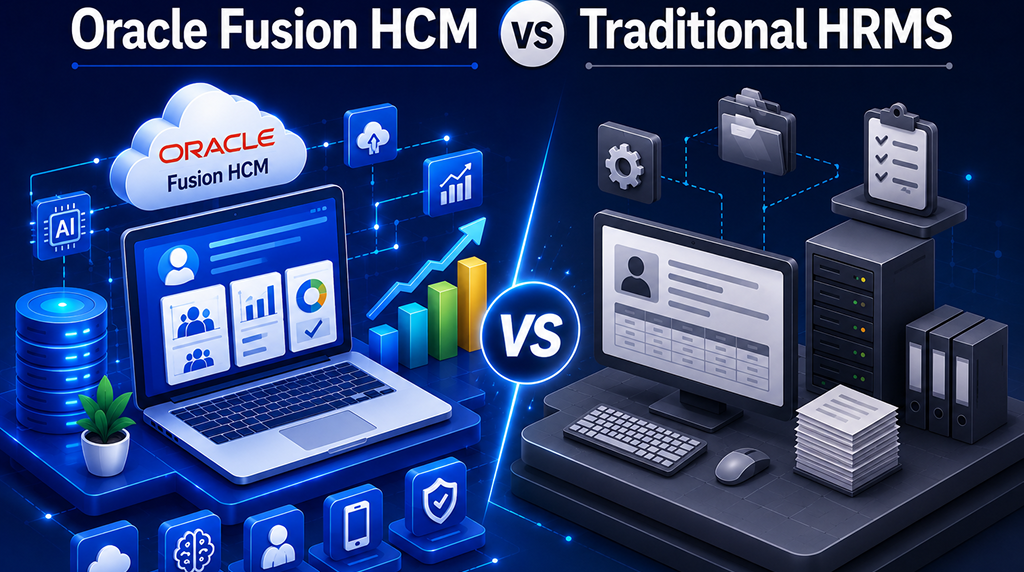
Here is a side-by-side look at how the two approaches compare across the factors that matter most to HR and IT teams.
| Factor | Traditional HRMS | Oracle Fusion HCM |
| Deployment | On-premise, customer-hosted servers | Cloud-native SaaS, hosted by Oracle |
| Updates | Periodic, disruptive upgrade projects | Continuous quarterly updates, no forced upgrades |
| Customization | Heavy code-level customization | Configuration-first, low-code workflows |
| AI capabilities | Minimal to none | Embedded generative and agentic AI |
| Analytics | Static, IT-dependent reports | Real-time, self-serve dashboards (OTBI, HCM Analytics) |
| Employee experience | Limited self-service | Mobile-first, Oracle ME self-service |
| Total cost of ownership | High (hardware, patching, in-house IT) | Lower (subscription-based, vendor-managed) |
| Security & compliance | Customer’s responsibility | Managed by Oracle, auto-updated for regulations |
As the table shows, the gap between the two systems is not just cosmetic. Traditional HRMS was engineered for a world of stability and predictability, where change happened slowly and IT owned every customization.
Oracle Fusion HCM was engineered for the opposite: constant change, embedded intelligence, and configuration that business users, not just developers, can manage.
Top Benefits of Oracle Fusion HCM
Beyond the feature list, the real-world Oracle HCM Cloud benefits show up in how HR teams operate day to day. Here is a closer look at five areas where the impact tends to be biggest.
- AI-Powered HR Operations: Oracle has embedded generative and agentic AI throughout the HCM suite, automating tasks like resume screening, interview scheduling, and compensation benchmarking. Forrester’s 2025 report on the HCM market specifically called out Oracle for delivering the largest set of agentic AI capabilities among major vendors.
- Better Employee Experience: With Oracle ME and a redesigned, mobile-first interface, employees can manage almost everything themselves, from requesting leave to exploring internal career opportunities, without waiting on HR.
- Real-Time Analytics: HCM Analytics and OTBI give HR leaders live dashboards instead of static, monthly reports, making it possible to spot attrition risk and compensation anomalies as they happen.
- Lower Maintenance Costs: Because Oracle manages the infrastructure, security patches, and quarterly updates, organizations no longer need large in-house teams dedicated purely to keeping the HR system running.
- Enhanced Security and Compliance: Oracle Cloud HCM is built with enterprise-grade security and automated updates for tax and regulatory changes across countries, reducing the compliance burden that typically falls on internal teams running on-premise systems.
Taken together, these Oracle HCM Cloud benefits explain why the platform dominates conversations about HR modernization. For a deeper look, see our related read on the benefits of Oracle Fusion Human Capital Management.
Experience Oracle Fusion HCM through practical, hands-on training at CloudShine.
Common Challenges During HRMS Migration
Migration is not effortless, and pretending otherwise does nobody any favors. Understanding where projects typically run into trouble is just as important as understanding the benefits, especially if you are the consultant expected to help solve these problems.
| Challenge | Why It Happens | How to Manage It |
| Data quality issues | Legacy systems carry duplicate or inconsistent records | Run structured data cleansing before using HCM Data Loader |
| Customization gap | Years of EBS or SAP customizations do not map directly | Re-evaluate each customization against standard Fusion functionality |
| Cutover timing | Migration must align with payroll and open enrollment cycles | Plan cutover windows around business-critical HR events |
| Legislative configuration | Each country needs its own payroll and compliance setup | Use experienced consultants for multi-country legislative data groups |
| Change management | Employees and HR teams resist new workflows | Invest in training, communication, and phased rollouts |
Most of these challenges are well understood, and experienced implementation partners exist specifically to help organizations avoid them. This is also where the opportunity lies for professionals building Oracle Fusion HCM skills today: companies need people who already understand data cleanup and change management, not just theoretical knowledge, which is why real-time project training and access to a genuine Oracle practice instance matter so much.
Who Should Migrate?
Not every organization needs to migrate immediately, and not every professional needs to specialize the same way. That said, certain groups have the most to gain from moving now.
- Mid-size and large enterprises still running Oracle EBS HRMS, older PeopleSoft, or fragmented, multi-system HR setups
- Global or multi-country companies that need standardized payroll, compliance, and reporting across regions
- Organizations under pressure to modernize employee experience to compete for talent
- HR professionals and functional consultants who want to move from operational HR into strategic, tech-enabled HR consulting
- SAP HCM consultants looking to diversify into the fastest-growing segment of the ERP consulting market
- IT professionals seeking to pivot into ERP or cloud consulting roles with strong long-term demand
- Freshers who want to enter the Oracle ecosystem through one of its highest-growth modules
If you fall into any of these categories, structured training that combines conceptual grounding with real project exposure, like CloudShine’s Oracle Fusion HCM course with practice instance access, is usually the fastest way to become job-ready. SAP HCM consultants already understand payroll logic and organizational structures deeply, which shortens the learning curve considerably. If Workday is more relevant to your target employers, CloudShine’s Workday HCM Training covers that path as well.
Start your Oracle Fusion HCM journey with CloudShine today.
Conclusion
The shift from traditional HRMS to Oracle Fusion HCM is not just a technology upgrade, it is a career opportunity hiding in plain sight. Every enterprise that migrates needs people who understand both the legacy systems they are leaving behind and the cloud platform they are moving toward, and that combination of skills is what makes Oracle Fusion HCM consultants so valuable right now.
If you are ready to build that expertise, CloudShine can help you get there with real-time project training, access to a genuine Oracle practice instance, trainers who are working consultants themselves, and placement assistance once you are ready for the market. Explore our Oracle Fusion HCM Training program, or reach out to our team to talk through the right learning path for your background. For professionals based in Maharashtra, we also offer Oracle Fusion training in Pune alongside our fully Oracle Fusion training online batches, so location is never a barrier to getting started.
Join CloudShine’s online or classroom Oracle Fusion HCM Training.