Introduction
Organisations everywhere are racing to modernise their ERP backbone, and SAP sits right at the centre of that shift. As businesses adopt SAP S/4HANA Cloud, SAP Business AI, and intelligent enterprise solutions, the market for professionals who hold a genuine SAP certification keeps expanding year after year.
Choosing the right SAP certification level matters more than most learners realise. Pick one that is too advanced too early, and you risk failing or wasting money. Pick one that is too basic, and you cap your salary ceiling for years. Getting this decision right shapes your job opportunities, your starting salary, and how quickly you move into senior roles.
This guide walks beginners and experienced professionals through the full SAP certification ecosystem so you can confidently pick the most suitable path for 2026, whether you are just starting out or looking to specialise further.
What Are SAP Certifications?
An SAP certification is an official credential issued by SAP that validates a professional’s technical or functional expertise on a specific SAP solution. It proves, through a proctored exam, that you understand configuration, business processes, or development within that solution area at a defined skill level.
These credentials give professionals a way to demonstrate industry-recognised skills to employers without requiring years of project history to prove competence. A certification signals baseline readiness, which is especially valuable for freshers and career switchers who do not yet have implementation experience to show.
SAP’s certification ecosystem is organised around both role-based tracks, such as functional consultant or technical developer, and solution-based tracks tied to specific products like S/4HANA, SuccessFactors, or Ariba. Understanding this structure is the first step toward picking the levels of SAP certification that actually fit your goals.
Why Are SAP Certifications Important for Career Growth in 2026?
SAP S/4HANA Cloud usage has nearly caught up with traditional on-premise deployments, and the broader SAP S/4HANA applications market is projected to reach $24.68 billion in 2026, growing toward $53.36 billion by 2034. That kind of expansion translates directly into demand for certified talent who can execute these migrations.
Employers increasingly prioritise certified candidates because certification reduces hiring risk. Recruiters can trust that a certified consultant already understands standard configuration steps, freeing up onboarding time for project-specific training instead of fundamentals.
The benefits compound over a career. Certified professionals typically see 15 to 25 per cent higher compensation compared to uncertified peers in similar roles, alongside better job mobility, global recognition that travels across employers, and a credible signal for promotion into lead or architect-level positions.
Understanding SAP Certification Levels
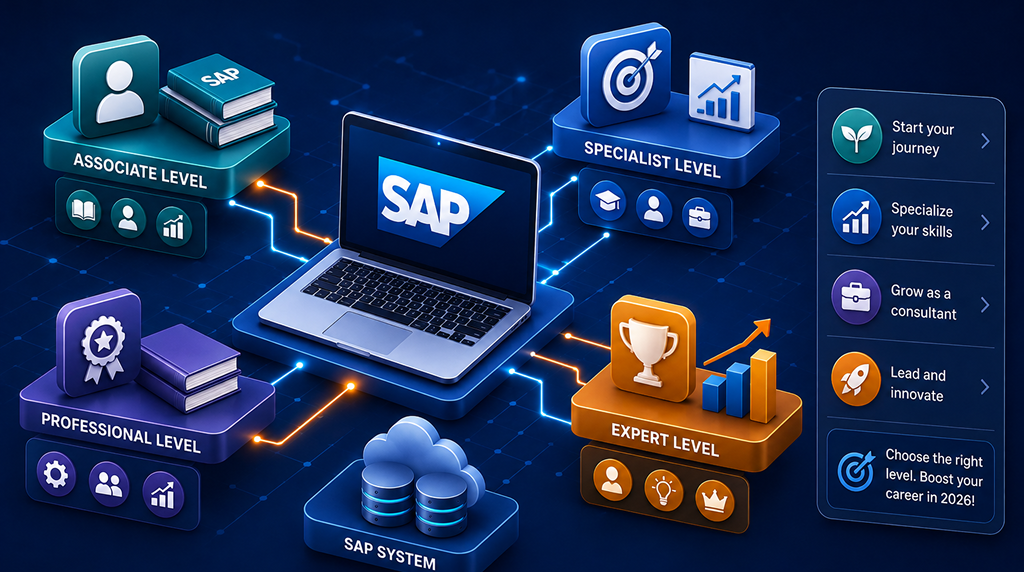
1. SAP Associate Certification
Associate is SAP’s entry-level certification, designed for beginners and professionals who are new to a particular SAP solution. It covers foundational knowledge such as navigation, core business processes, and basic configuration concepts.
This level suits fresh graduates, career switchers moving into SAP from another domain, and end-users who want to formalise their existing exposure to a module. No prior SAP project experience is required, though some familiarity with business processes helps.
2. SAP Specialist Certification
Specialist certifications focus on niche skills tied to a specific SAP solution rather than broad foundational knowledge. Professionals use this level to deepen expertise in areas such as SAP Analytics Cloud, SAP Integration Suite, SAP BTP, SAP SuccessFactors, or SAP Ariba.
This level makes sense once you already hold an Associate certification or have hands-on project exposure and want to differentiate yourself in a specific, in-demand product area rather than staying generalist.
3. SAP Professional Certification
Professional certifications sit at the top of SAP’s structure and are designed for experienced consultants who have led or contributed significantly to real implementations. They test advanced configuration, cross-module integration, and often project management or solution design skills.
Most candidates attempt Professional-level exams only after several years of hands-on implementation work, typically involving multiple full project lifecycles, since the exam content assumes practical exposure that theory alone cannot substitute for.
SAP Certification Levels Comparison
| Level | Experience Required | Difficulty | Best For | Career Opportunities |
| Associate | None to minimal | Beginner-friendly | Freshers, career switchers, end-users | SAP Associate Consultant, junior functional roles |
| Specialist | 1 to 3 years or Associate cert | Moderate | Professionals deepening a niche skill | SAP Analytics/Integration Specialist, module expert roles |
| Professional | 4+ years, multiple projects | Advanced | Experienced consultants and leads | Senior Consultant, Solution Architect, Project Lead |
Most professionals progress in sequence, starting with Associate to build a credible foundation, moving into Specialist certifications to sharpen a chosen module, and eventually pursuing Professional-level credentials once real project experience justifies the investment.
Not sure which SAP path fits your background? CloudShine’s team can walk you through module options over a free call. Call or WhatsApp +91-7587123123 or visit cloudshinepro.com to get started.
How to Choose the Right SAP Certification Based on Your Career
1. For Fresh Graduates
Start with an Associate-level certification in a widely used module such as S/4HANA Finance or MM. This builds a credible foundation without requiring project experience you do not yet have, and it keeps your options open while you explore which specialisation suits you.
2. For Working Professionals
If you are already employed, choose a certification that aligns with your current job responsibilities first. Upskilling within your existing module makes the certification immediately applicable, which strengthens your case for internal promotion or a lateral move into a certified role.
3. For Finance Professionals
Finance and accounting professionals are typically best suited to SAP S/4HANA Finance certifications, which open doors into finance transformation projects, general ledger redesigns, and reporting modernisation work across nearly every industry that runs SAP.
4. For Supply Chain Professionals
Those with operations or logistics backgrounds should look at SAP MM and broader SAP S/4HANA Supply Chain certifications. These credentials translate directly into procurement, inventory, and supply chain consultant roles that remain consistently in demand.
5. For Developers
Technically inclined professionals should pursue SAP ABAP certifications, which open opportunities in SAP development, custom extensions, and increasingly, cloud-native ABAP work built on SAP BTP.
Most Popular SAP Certification Paths in 2026
1. SAP S/4HANA Finance
This path leads to roles like Finance Functional Consultant and Financial Systems Analyst. Industries including manufacturing, banking, and retail are hiring aggressively as they modernise financial reporting, and senior-certified professionals in India can expect ₹18 to 25 lakh annually.
2. SAP MM
SAP Materials Management remains one of the most consistently requested modules across manufacturing, retail, and distribution. Career opportunities range from Procurement Analyst to Senior MM Consultant, and future scope stays strong as supply chain digitisation continues across industries.
3. SAP ABAP
ABAP developers now work increasingly with Cloud ABAP and SAP BTP integration rather than purely on-premise customisation. This shift is creating fresh demand for developers who can bridge traditional ABAP skills with modern, cloud-native extension patterns.
4. SAP SuccessFactors
As HR digital transformation accelerates, SAP SuccessFactors certification has become one of the fastest-growing HR technology credentials, driven by rising cloud adoption among mid-size and large enterprises modernising their people processes.
5. SAP Analytics Cloud
Professionals who combine business intelligence skills with AI-powered reporting capabilities are increasingly sought after, as organisations lean on SAP Analytics Cloud to turn operational data into real-time, decision-ready dashboards.
How AI Is Changing SAP Careers in 2026
SAP Business AI, including tools like SAP Joule, is being embedded directly into core workflows rather than bolted on as a separate feature. Recent industry surveys show a large share of SAP customers now treat generative AI as an integral part of business processes rather than an experimental add-on.
Automation is shifting consultant responsibilities away from repetitive configuration tasks and toward governing, validating, and optimising AI-assisted processes. This means professionals should develop comfort with prompt-based tools, AI-driven analytics, and automated testing alongside their core module expertise.
Importantly, AI complements rather than replaces SAP professionals. Enterprise SAP implementations still require deep business process judgment, stakeholder communication, and cross-module troubleshooting, none of which AI can fully own on its own.
Salary Expectations After SAP Certification
Salaries after certification depend on several factors working together: overall experience, certification level, the specific module chosen, geographic location, real project experience, and the hiring industry.
| Role | India (Annual) | United States (Annual) |
| SAP Associate | ₹3.5 to 6 LPA | $55,000 to 75,000 |
| SAP Consultant | ₹6 to 12 LPA | $80,000 to 115,000 |
| SAP Functional Consultant | ₹10 to 18 LPA | $95,000 to 130,000 |
| SAP Technical Consultant | ₹8 to 15 LPA | $90,000 to 125,000 |
| SAP Solution Architect | ₹20 to 35+ LPA | $130,000 to 160,000+ |
These are approximate industry ranges compiled from current salary aggregators and may vary based on employer tier, city, and negotiation.
How to Prepare for SAP Certification Successfully
1. Understand the Certification Exam
Most SAP exams are multiple-choice, delivered through a proctored online or test-centre format, with a defined passing score that SAP publishes per exam. Review the official exam guide before you begin studying so your preparation matches what is actually tested.
2. Get Hands-on Practice
Theory alone rarely survives contact with a real implementation. Practising inside a sandbox environment, working through realistic business scenarios, builds the muscle memory that exam questions and job interviews both expect.
3. Take Instructor-led Training
Self-paced learning offers flexibility but little troubleshooting support. Live online training pairs structured pacing with a mentor who can answer questions in real time. Classroom training adds in-person accountability but sacrifices scheduling flexibility. For most working professionals, live online training with lab access offers the strongest balance for certification success.
4. Practice Mock Tests
Timed mock exams reveal where your knowledge is shaky before the real exam does. They also build the time management skill needed to pace yourself through scenario-based questions without running out of time.
Looking for structured, hands-on SAP prep instead of self-study alone? Explore CloudShine’s course options on cloudshinepro.com or reach out through our Contact Us page for guidance on SAP ABAP on HANA, SAP Material Management course, and other module-specific training paths.
Common Mistakes to Avoid While Choosing SAP Certification
- Selecting a certification without a clear career plan behind it, rather than working backwards from the role you actually want.
- Ignoring prerequisite knowledge and jumping straight into Specialist or Professional exams before building a solid foundation.
- Choosing outdated SAP modules instead of cloud-first tracks like S/4HANA, which increasingly matter more to employers.
- Focusing only on passing the certification exam while skipping hands-on projects that interviewers actually probe for.
- Underestimating soft skills and business process knowledge, both of which matter as much as technical configuration ability.
Conclusion
SAP Associate, Specialist, and Professional certifications each serve a different purpose. Associate builds your foundation, Specialist sharpens a chosen niche, and Professional validates deep, real-world implementation experience at the senior level.
The right SAP certification ultimately depends on your career stage, current experience, and long-term goals rather than any single universally correct answer. Combining certification with practical project experience and continuous learning is what will keep you competitive in 2026 and beyond. Explore CloudShine’s training programs to build that combination step by step.